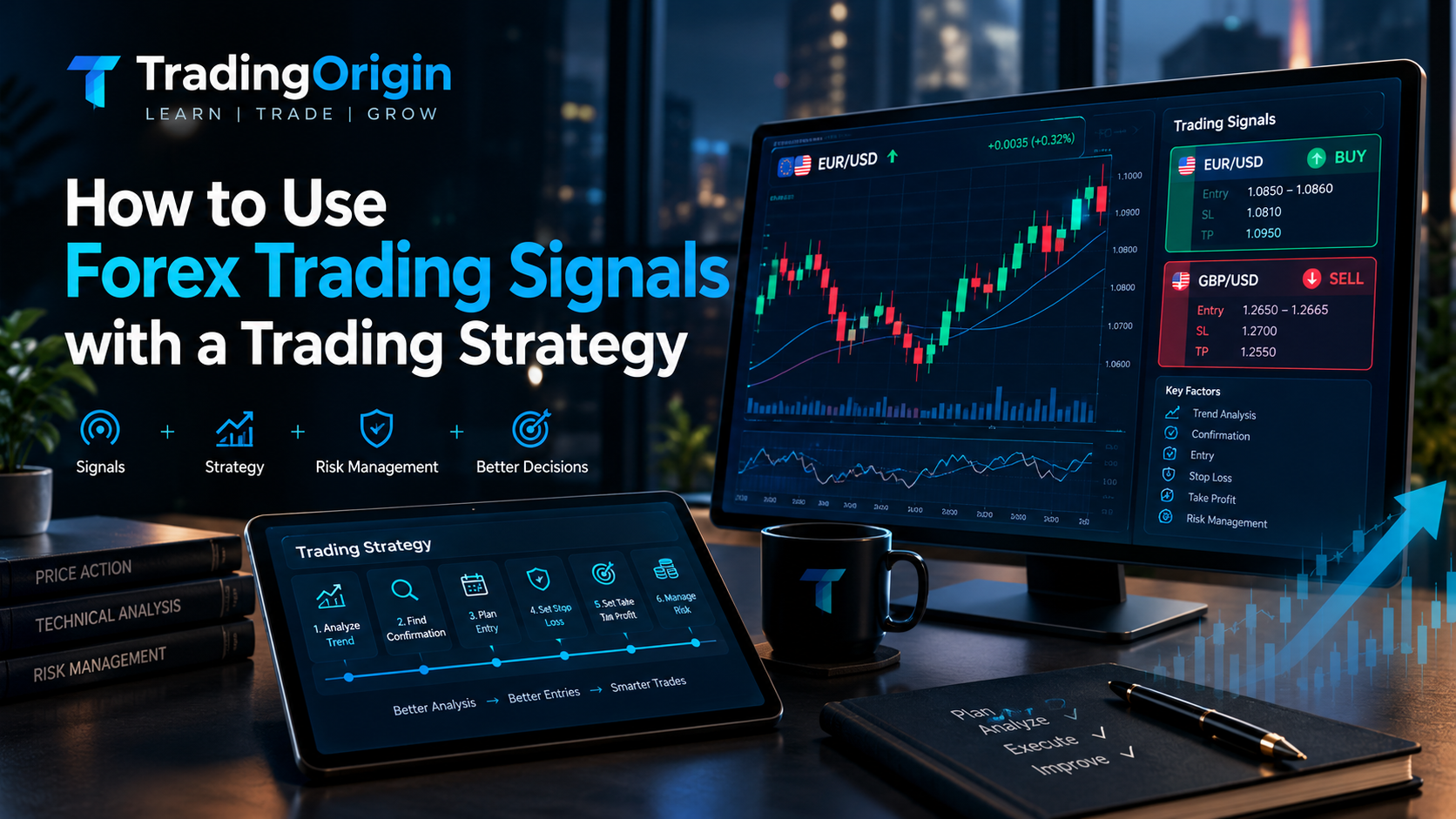
Forex trading signals can help traders identify potential opportunities in the foreign exchange market, but a signal should not be treated as a complete trading strategy. The most effective approach is to combine forex trading signals with a clear trading plan, market analysis, and disciplined risk management.
Learning how to use forex trading signals properly can help traders make more structured decisions instead of entering trades based only on a BUY or SELL recommendation.
What Are Forex Trading Signals?
Forex trading signals are trade ideas that identify a potential opportunity in the currency market. A typical signal may include a currency pair, trade direction, entry price or entry zone, stop loss, and take-profit targets.
For example, a signal may identify a potential EUR/USD buy opportunity around a specific price level with a predefined stop loss and profit target.
However, a trading signal does not guarantee a profitable trade. Market conditions can change quickly, which is why traders should understand the setup and compare it with their own trading strategy before entering a position.
Why You Should Not Follow Forex Signals Blindly
One of the most common mistakes traders make is entering every trade simply because a signal says BUY or SELL.
A signal is better viewed as a potential trading opportunity rather than an automatic instruction. Before entering a trade, consider the market trend, entry level, stop loss, potential reward, and overall risk.
- Does the signal match the current market trend?
- Is the entry level reasonable?
- Where should the stop loss be placed?
- Is the potential reward worth the risk?
- Does the setup fit your trading strategy?
- Is the market experiencing unusual volatility?
This process can help traders avoid impulsive decisions and focus on setups that fit their trading plan.
How to Use Forex Trading Signals With Your Strategy
The best way to use forex trading signals is to make them one part of an existing trading process. Your strategy should determine whether a signal is suitable for you, rather than allowing every signal to change your trading approach.
1. Define Your Trading Strategy
Before using a signal, understand what type of trading strategy you follow. Your approach may focus on trend following, breakouts, support and resistance, price action, technical indicators, or swing trading.
A signal should fit your strategy and trading timeframe. If it does not match your rules, skipping the trade can be a better decision than forcing the setup.
2. Check the Market Trend
After receiving a signal, examine the broader market direction.
For example, if a forex signal suggests buying GBP/USD, check whether the pair is showing bullish conditions or whether the trade is moving against a strong downward trend.
Understanding the market trend gives the signal additional context and can help you decide whether the setup deserves further analysis.
3. Confirm the Entry
Receiving a signal does not always mean you should enter the market immediately. Depending on your strategy, you may want additional confirmation before opening a position.
Confirmation can include:
- A support or resistance level
- A breakout or breakout retest
- A relevant candlestick pattern
- Trend continuation
- A technical indicator confirmation
- A reaction around an important price level
The goal is not to add as many indicators as possible. The goal is to make sure the signal fits your own trading rules.
4. Set a Stop Loss
Risk management is one of the most important parts of using forex trading signals.
A stop loss defines the price level where you will exit a trade if the market moves against your position. Before entering a trade, you should know where your stop loss belongs and how much money you are willing to risk.
A signal with an attractive profit target is not enough on its own. The potential loss should always be considered before entering the market.
5. Evaluate the Risk-to-Reward Ratio
The risk-to-reward ratio compares the potential loss of a trade with its potential profit.
For example, if a trade risks $50 and has a potential profit of $100, the risk-to-reward ratio is 1:2.
A favorable risk-to-reward ratio does not guarantee a winning trade, but it can help traders build a more disciplined approach over a series of trades.
6. Use Proper Position Sizing
Position size should be based on your account size, stop-loss distance, and predetermined risk level.
Avoid increasing your position simply because you believe a particular signal is highly likely to succeed. Even strong-looking setups can fail because financial markets are unpredictable.
Consistent position sizing can help prevent a single losing trade from having an excessive impact on your trading account.
How to Confirm a Forex Trading Signal
A forex signal can become more useful when it is supported by additional market information. Before entering a trade, use a simple confirmation process.
Market Trend → Key Price Level → Signal Direction → Entry → Stop Loss → Take Profit → Risk
If several parts of your analysis disagree with the signal, waiting for a better opportunity may be more appropriate than forcing a trade.
Common Mistakes When Using Forex Trading Signals
Following Every Signal
More trades do not necessarily mean better results. Consider only signals that fit your trading strategy and risk-management rules.
Ignoring Stop Losses
Trading without predefined risk limits can expose your account to unnecessary losses. A stop loss should be considered before entering the position, not after the trade starts moving against you.
Overtrading After a Loss
A losing trade does not mean you need to immediately enter another position to recover the loss. Revenge trading can lead to larger and less controlled risks.
Increasing Risk on High-Confidence Signals
Even a strong signal can fail. Avoid increasing your risk simply because you feel confident about a particular trade.
Changing Your Strategy for Every Signal
Consistency matters. If every new signal causes you to change your strategy, it becomes difficult to determine whether your trading approach is actually working.
A Simple Forex Trading Signal Workflow
A practical workflow for using forex trading signals can look like this:
- Receive the signal: Review the currency pair, direction, entry, stop loss, and target.
- Analyze the market: Check the current trend and important price levels.
- Compare it with your strategy: Make sure the setup follows your trading rules.
- Calculate your risk: Determine your position size before entering.
- Confirm the setup: Wait for the confirmation required by your strategy.
- Enter the trade: Enter only if the setup still meets your criteria.
- Manage the position: Follow your predetermined stop loss and take-profit plan.
- Review the result: Record the trade and evaluate whether you followed your strategy.
Forex Trading Signals and Risk Management
Trading signals should always be used together with responsible risk management. No signal provider can guarantee that every trade will be profitable.
Before entering a position, know your maximum acceptable risk, position size, stop loss, and potential reward. Avoid risking money that you cannot afford to lose.
The objective is not to win every trade. The objective is to follow a consistent process that manages risk across many trades.
Final Thoughts
Forex trading signals can be useful tools, but they should not replace a trading strategy.
The strongest approach is to combine signals with market analysis, clear entry rules, proper position sizing, stop-loss protection, and disciplined risk management.
Instead of asking whether a signal will definitely make money, focus on whether the setup fits your strategy and whether the potential risk is acceptable.
When used this way, forex trading signals can become one part of a structured trading process rather than the entire decision-making system.
To learn more about evaluating and using trading signals, explore our related guides on https://tradingorigin.com/articles/best-forex-trading-signals">how to choose the best forex trading signals and https://tradingorigin.com/articles/how-to-read-forex-trading-signals">how to read forex trading signals.
Keep Learning: More Crypto Articles
- How to Use Funding Rates and Open Interest to Confirm Crypto Signals
- Crypto Trading Signal Timeframes: 15-Minute, 1-Hour, and 4-Hour Charts
- How to Confirm Crypto Trading Signals with Volume
Want structured, step-by-step lessons? Explore the TradingOrigin Academy.
📢 Get our signals on Telegram
Follow our Telegram channel for crypto and forex signals, shared as they happen: 📲 Join TradingOrigin on Telegram
Want full access? View our crypto and forex signal plans.