Introduction
A forex trading signal can look convincing at first and still fail within minutes. Price may break above resistance, reverse sharply, or move against the expected direction after an economic announcement. For traders, the challenge is not simply finding signals. It is learning how to evaluate them before risking capital.
Understanding how to avoid false forex signals starts with recognizing that no indicator, chart pattern, or signal provider can predict every market movement correctly. The goal is to identify warning signs, confirm the market context, and follow a repeatable decision-making process.
In this guide, we explain seven practical forex signal confirmation rules, including candle-close confirmation, trend analysis, breakout and retest validation, indicator limitations, market volatility, price structure, and risk management.
Whether you trade manually or use a forex signal service, these principles can help you evaluate potential opportunities more systematically.
What Are False Forex Signals?
A false forex signal occurs when a trading indication suggests a potential market move that does not develop as expected.
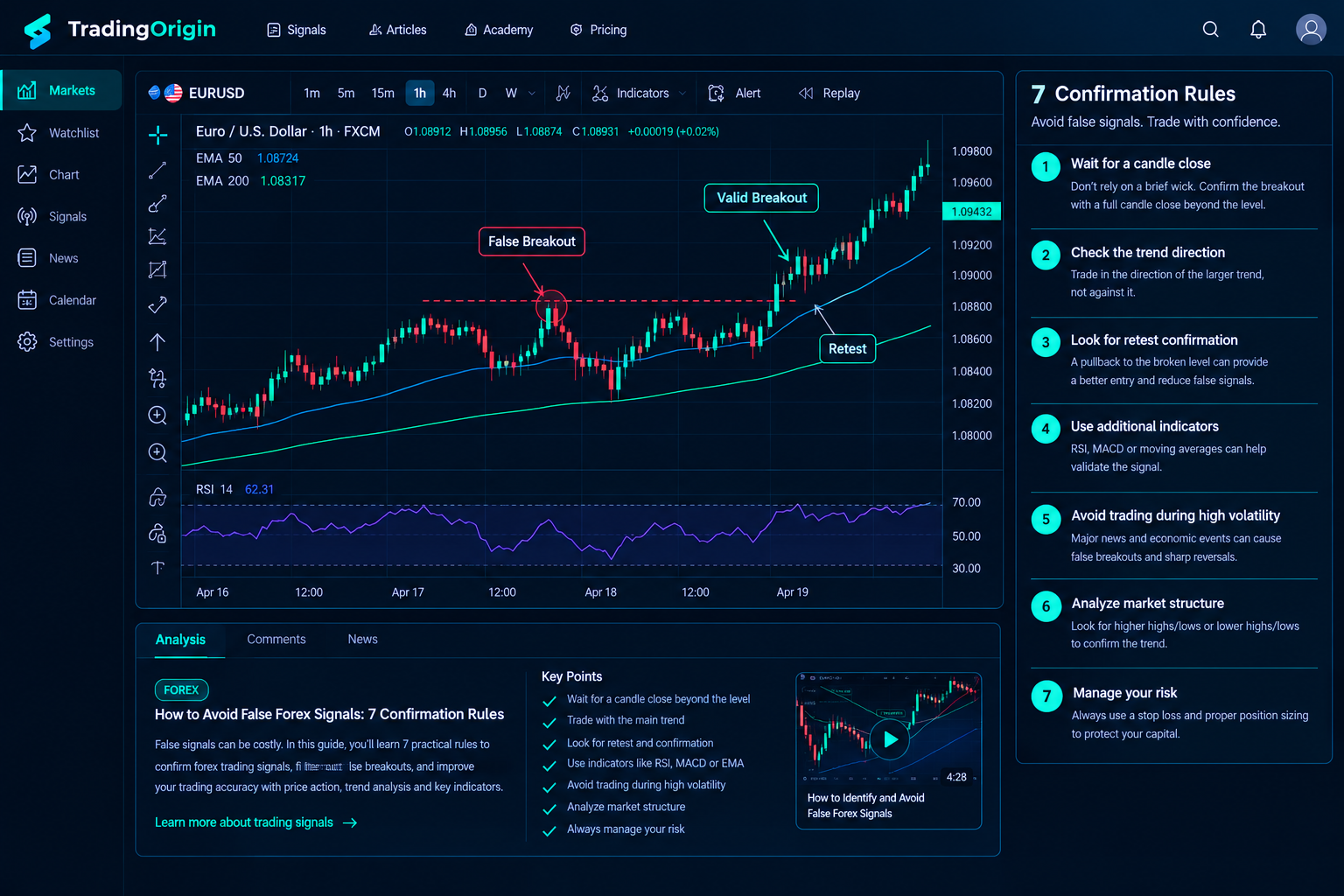
For example, a bullish signal may appear when EUR/USD breaks above resistance. However, price may quickly return below the level and continue moving sideways or decline. Traders who entered without considering confirmation and invalidation conditions may experience a loss.
False signals can arise from several sources:
Temporary price movements beyond support or resistance.
Weak or inconsistent market trends.
Lagging technical indicators.
Unexpected economic announcements.
Low-liquidity conditions or changing spreads.
Trading rules that do not account for market context.
A losing trade is not automatically evidence that a signal was false. Even a well-defined setup can fail. The important distinction is whether the trade followed a valid process and whether its risks were understood before entry.
Why Forex Signal Confirmation Matters
Forex signal confirmation means checking whether a potential trade is supported by the conditions specified in your trading strategy.
Confirmation may involve market structure, candle closes, momentum, a retest of a broken level, or other predefined criteria.
The purpose is not to find a method that eliminates losing trades. No such method exists. Instead, confirmation can help traders avoid acting on incomplete information and improve consistency in evaluating opportunities.
A useful process should answer four questions:
What is the broader market direction?
What specific condition triggered the potential signal?
What evidence supports the trade idea?
At what point would the setup no longer be valid?
If these questions cannot be answered clearly, the signal may not fit your trading plan.
Rule 1: Wait for a Candle Close Beyond the Key Level
One of the most common sources of false forex signals is entering immediately when price briefly crosses support or resistance.
A candle wick can extend beyond a level and then return before the candle closes. This movement may indicate temporary buying or selling pressure rather than a sustained breakout.
How to apply this rule
First, identify a meaningful support or resistance zone. Then decide whether your strategy requires a candle to close beyond that zone.
For a potential bullish breakout, look for a close above resistance. For a potential bearish breakdown, look for a close below support.
Consider the following example:
EUR/USD has repeatedly struggled to move above 1.0850. Price briefly rises to 1.0860 but closes back below the resistance area. This could be a warning that the breakout has not been confirmed under a candle-close strategy.
If price later closes convincingly above the zone, the setup can be reassessed.
A candle close does not guarantee continuation. It is one confirmation condition, not proof that the market will keep moving in the same direction.
Rule 2: Confirm the Broader Forex Trend
A signal that conflicts with the broader market structure may have a different risk profile from a signal that aligns with an established trend.
Trend analysis helps traders distinguish between an uptrend, a downtrend, and a sideways market.
Identifying an uptrend
An uptrend generally forms higher highs and higher lows. Traders following a trend-based strategy may look for potential buying opportunities after a pullback.
Identifying a downtrend
A downtrend generally forms lower highs and lower lows. Traders may evaluate potential selling opportunities when price resumes downward movement after a recovery.
Recognizing a sideways market
When price moves between support and resistance without establishing a sustained direction, trend-following signals may become less reliable.
Some traders use a higher timeframe to assess the broader trend and a lower timeframe to evaluate entries. For example, they might examine a four-hour chart for market structure and a one-hour chart for a possible setup.
These timeframes are illustrative. The appropriate combination depends on the instrument and the rules being tested.
Practical rule: Define your preferred market conditions before trading. If your strategy depends on a clear trend, do not force a trend-following entry when the chart shows no convincing direction.
Rule 3: Validate Breakouts with a Retest When Your Strategy Requires It
A breakout occurs when price moves beyond a significant support or resistance zone. However, some breakouts fail quickly and return to the previous trading range.
A breakout and retest strategy waits for price to return toward the broken level and evaluates whether the level holds.
Bullish breakout example
Imagine EUR/USD breaks above a resistance zone near 1.0850. Instead of entering immediately, a trader waits to see whether price returns toward the zone and whether buyers appear to defend it.
If price holds above the relevant area and resumes upward movement, the setup may satisfy the trader's confirmation rules.
Bearish breakdown example
Suppose GBP/USD breaks below a support zone. A trader may wait for price to revisit the area from below and look for evidence that former support is acting as resistance.
Important limitation
Not every successful breakout retests its level, and not every retest succeeds. Waiting for a retest may reduce some premature entries but can also cause traders to miss moves that continue without one.
The objective is to follow a tested method, not to treat a retest as a guarantee.
Rule 4: Use Technical Indicators as Supporting Evidence
Technical indicators can help analyze momentum and trend conditions, but they should not be treated as independent guarantees of a valid forex trading signal.
Moving averages
Moving averages smooth historical prices and help traders examine market direction.
For example, a trader may use a 50-period moving average to assess intermediate price movement and a 200-period moving average for broader context.
Price remaining above a rising moving average may support a bullish interpretation. However, moving averages can lag behind price and generate misleading signals in sideways markets.
Relative Strength Index (RSI)
The RSI measures the speed and magnitude of recent price changes.
Some traders use it to examine momentum or identify potential divergences between price and the indicator.
An RSI reading above 70 does not automatically mean that a market must fall, and a reading below 30 does not guarantee a rebound. Strong trends can remain overbought or oversold for extended periods.
Moving Average Convergence Divergence (MACD)
MACD compares moving averages to help assess momentum and potential changes in direction.
Traders may examine its line crossovers, histogram, or relationship to the zero line. These observations should be interpreted alongside market structure because MACD can produce repeated false crossovers in choppy conditions.
Avoid indicator overload
Using many indicators may create conflicting readings rather than stronger evidence.
A more structured approach is to use price action to define the setup, one or two complementary tools for confirmation, and predefined risk rules to decide whether the trade is acceptable.
The best combination is the one that can be explained, tested, and applied consistently—not the one with the most indicators.
Rule 5: Be Careful During High-Impact Economic Events
Economic announcements can cause rapid price movements, spread changes, and sudden reversals in forex markets.
Important events include central bank interest-rate decisions, inflation releases, employment reports, and major economic data.
A price breakout that appears technically convincing before an announcement may become unreliable when new information changes market expectations.
How to manage event-related risk
Check the economic calendar before entering a trade.
Understand whether your strategy permits trading around major announcements.
Consider changes in spreads and execution conditions.
Avoid assuming that a large candle represents a sustainable trend.
Follow predefined rules instead of reacting emotionally to sudden price movements.
There is no universally correct waiting period around every announcement. The appropriate approach depends on the instrument, event, strategy, and tested execution rules.
In spot forex, centralized market-wide volume is generally unavailable. Broker-provided tick volume can offer limited context, but it should not be treated as a complete picture of all market activity.
Rule 6: Analyze Support, Resistance, and Market Structure
A trading signal should be evaluated in relation to nearby price levels and the structure of the market.
A bullish setup may have limited room to develop if a major resistance zone lies immediately above the proposed entry. Similarly, a bearish setup may face strong support nearby.
Questions to ask before entering
Where is the nearest significant support or resistance zone?
Does the proposed entry align with the market structure?
Is the price movement extending an existing trend or attempting a reversal?
Has a recent swing high or low changed the original trade idea?
Is there enough potential room for the target relative to the planned risk?
Support and resistance should be treated as zones rather than perfectly precise lines. Price may move slightly beyond a zone before reversing, and different traders may identify different areas.
If the market structure no longer supports your original setup, reassess the trade rather than searching for reasons to justify an entry.
Rule 7: Define Risk Before Acting on a Signal
Risk management cannot guarantee that a signal will succeed. It helps determine how much a failed trade could cost and whether the opportunity fits your trading plan.
Before entering, define the entry condition, stop loss, potential target, and position size.
Example of a planned trade
Suppose a hypothetical forex setup has these parameters:
Planned entry: 1.0860
Planned stop loss: 1.0830
Potential take-profit target: 1.0920
The distance to the stop loss is 30 pips, while the potential distance to the target is 60 pips. The initial planned risk-to-reward ratio is 1:2 before trading costs.
This ratio does not mean the trade has a 50% probability of winning or that it is likely to be profitable. It describes only the relative distances between the proposed entry, stop loss, and target.
Position size should be calculated using the intended monetary risk, stop-loss distance, pip value, account currency, and instrument specifications.
Spreads, commissions, slippage, and gaps can affect the realized outcome. A stop loss may not execute at the exact requested price in fast-moving conditions.
Avoid increasing position size to recover previous losses or removing a stop loss because a trade moves against you.
A Complete Forex Signal Confirmation Checklist
Before acting on a potential signal, review these conditions:
Market direction: Is the broader trend or range clearly identified?
Key levels: Have meaningful support and resistance zones been marked?
Price confirmation: Has the required candle close or price-action trigger occurred?
Breakout validation: If the strategy requires a retest, has the retest condition been satisfied?
Indicator context: Do the selected indicators support the analysis without contradicting the predefined rules?
Market conditions: Have important economic events, spreads, and volatility been considered?
Risk management: Are the stop loss, target, position size, and maximum planned loss defined?
This checklist should be adapted to a specific strategy and tested. Requiring every possible indicator or confirmation on every trade may create unnecessary complexity.
The purpose is to apply consistent rules, not to make every trade look perfect after the fact.
How to Evaluate a Forex Signal Service
If you use a forex signal provider, examine more than the advertised direction or potential profit.
A useful signal should be understandable enough for you to evaluate its assumptions and risks.
Consider these questions:
Is the signal timely? Delayed information may no longer reflect current market conditions.
Are the entry and invalidation conditions clear? Vague instructions make it difficult to evaluate whether the trade still fits the original setup.
Is the methodology explained? Understand whether signals rely on technical analysis, automated rules, discretionary analysis, or a combination.
Are performance claims transparent? Look for meaningful sample sizes, losing periods, and realistic assumptions about trading costs. Be cautious of screenshots or claims that show only winning trades.
Does the service explain risk? No legitimate signal methodology can remove market risk or guarantee a profit.
Does it fit your trading plan? Even a well-presented signal may be unsuitable for your account, timeframe, or risk tolerance.
Treat signals as information to evaluate, not instructions to follow blindly.
Common Mistakes That Lead to False Signal Entries
Entering before confirmation
A trader sees price approaching resistance and buys before the breakout condition has been satisfied. If price reverses, the entry may have been premature.
Treating indicators as guarantees
An indicator can support a trading hypothesis, but no reading ensures that price will move in a particular direction.
Ignoring the broader trend
A lower-timeframe signal may conflict with the larger market structure. Traders should decide in advance how their strategy handles this conflict.
Chasing large candles
Entering after a sharp move may produce a poor entry price and leave insufficient room before the next opposing zone.
Changing the rules after a loss
One losing trade does not necessarily mean a strategy is broken. Review whether the trade followed the rules and evaluate results over a meaningful sample.
Ignoring transaction costs
Frequent trading can expose a strategy to substantial spreads, commissions, and slippage, especially on shorter timeframes.
How to Test Your Forex Signal Confirmation Rules
Before relying on a confirmation method with real capital, test it systematically.
First, define the entry and exit rules precisely. Record what counts as a valid trend, breakout, retest, confirmation candle, and invalidation level.
Next, examine historical examples across different market conditions. Include both successful and unsuccessful trades rather than selecting only the examples that support your expectations.
Account for spreads, commissions, swaps, and plausible slippage. Where possible, evaluate the rules on data that was not used to develop them.
Review the win rate together with average win, average loss, maximum drawdown, trade frequency, and overall performance after costs.
Finally, practice on a demo account to evaluate execution and discipline. Demo results do not guarantee equivalent results with real money.
A method that works in one market or period may perform differently when volatility, liquidity, and market structure change.
Explore Trading Resources at TradingOrigin
Learning to evaluate forex trading signals is an important part of developing a disciplined trading process.
At TradingOrigin, you can explore available trading resources and review the features offered through the site's plans.
Before choosing a plan, check its actual features, pricing, limitations, and terms. Select a service based on your needs and budget rather than assuming that a paid plan will guarantee better trading results.
Use educational material to understand the reasoning behind a setup, and evaluate any signal against your own rules, risk limits, and market conditions.
Explore TradingOrigin's available plans to see which features fit your trading workflow.
Trading tools can support analysis, but responsible decisions and risk management remain essential.
Frequently Asked Questions
How can I avoid false forex signals?
Use a consistent process that examines market structure, candle closes, relevant support and resistance, and any confirmation conditions defined by your strategy. Consider volatility and transaction costs, and establish the maximum planned loss before entry. No method can eliminate false signals.
What is the most reliable forex signal confirmation indicator?
There is no universally most reliable indicator. Moving averages, RSI, and MACD measure different aspects of price behavior and can all generate misleading readings. Their usefulness depends on the strategy, market conditions, and testing.
How do I confirm a forex breakout?
A trader may require a candle close beyond a meaningful support or resistance zone, then assess the broader trend and any required retest. These conditions can help structure the analysis but cannot guarantee that the breakout will continue.
Are forex signals accurate all the time?
No. Every trading method can produce losing trades. Signal accuracy should be assessed using a clearly defined methodology, an adequate sample of trades, and realistic trading costs rather than a few selected examples.
Can RSI and MACD prevent false signals?
They may provide additional context, but neither indicator prevents false signals. Both can lag behind price and produce misleading readings, especially in sideways or rapidly changing markets.
Should I trade forex signals during major news events?
That depends on your strategy and risk controls. Major announcements can change volatility, spreads, and execution conditions. Understand the event risk and follow tested rules rather than reacting impulsively.
What is a good risk-to-reward ratio for forex trading?
There is no universally ideal ratio. A higher potential reward relative to risk does not automatically create a better trade. Evaluate the ratio alongside the strategy's tested win rate, average outcomes, trading costs, and drawdown.
Can a forex signal service guarantee profits?
No signal service can guarantee trading profits or eliminate the possibility of loss. Review the methodology, performance evidence, risk disclosures, and service terms before making a purchasing decision.
Final Thoughts
Learning how to avoid false forex signals is not about finding a perfect indicator or eliminating every losing trade. It is about evaluating market conditions, applying confirmation rules consistently, and understanding risk before entering.
Use the seven rules in this guide as a starting framework. Test your approach, keep records, review both winning and losing trades, and adjust your process only when the evidence supports a change.
For more educational resources and information about available features, explore TradingOrigin and choose tools that support your own trading workflow.
Risk Disclaimer: This article is for educational and informational purposes only and does not constitute financial, investment, or trading advice. Forex and leveraged trading involve substantial risk, including the possible loss of your capital. Past performance does not guarantee future results.
Keep Learning: More Forex Articles
- Best Candlestick Patterns for Forex Signals: Engulfing, Pin Bar and Reversal Setups
- How Economic News Affects Forex Signals: Interest Rates, CPI and NFP
- How to Use ATR for Forex Signals, Stop Loss and Volatility Analysis
Want structured, step-by-step lessons? Explore the TradingOrigin Academy.
📢 Get our signals on Telegram
Follow our Telegram channel for crypto and forex signals, shared as they happen: 📲 Join TradingOrigin on Telegram
Want full access? View our crypto and forex signal plans.