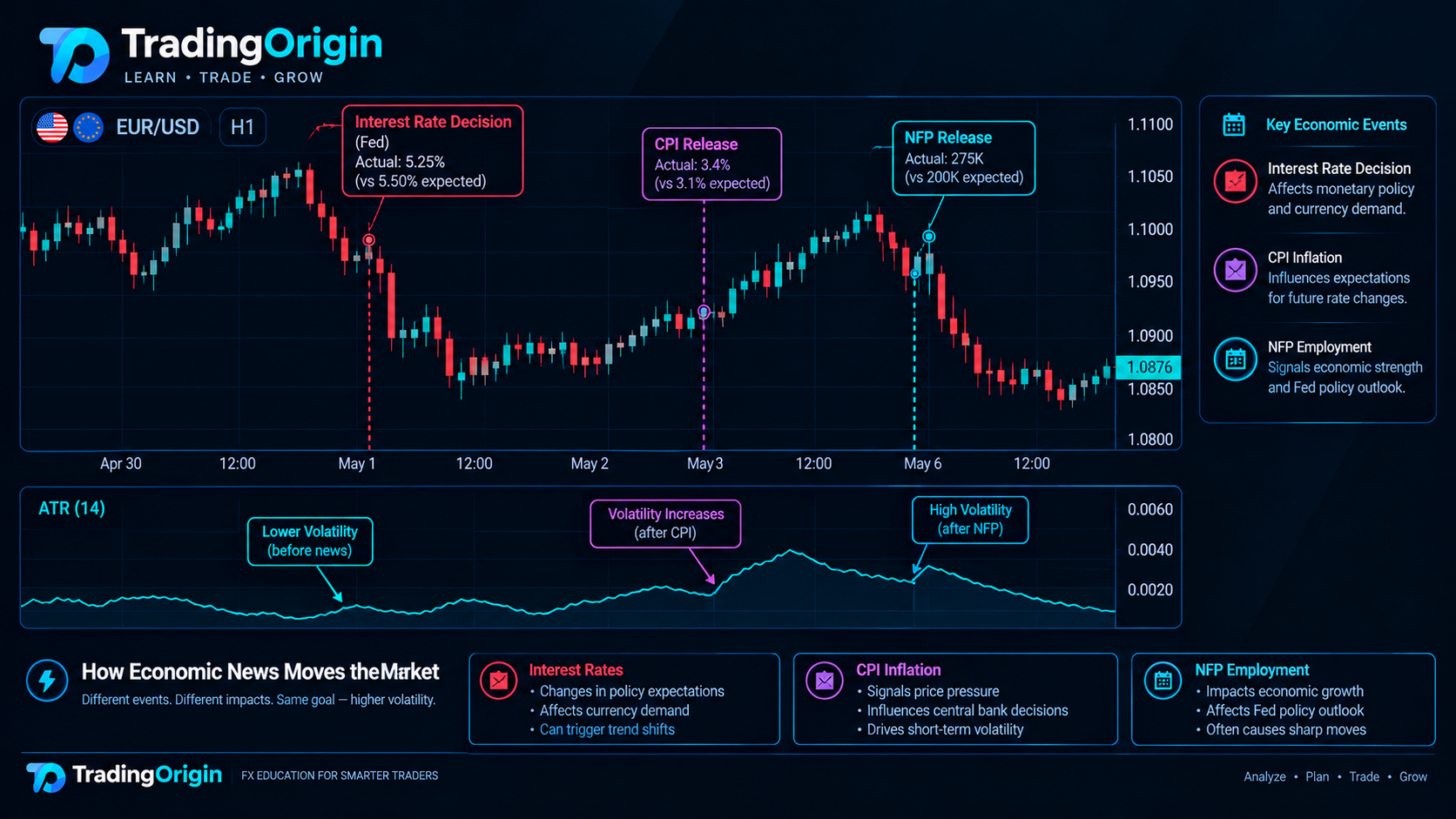
Economic news is one of the most important factors that forex traders consider when evaluating trading signals. Interest rate decisions, inflation reports, and employment data can change market expectations, trigger sudden price movements, and influence whether a technical setup remains valid.
A forex signal that looks convincing on a chart may behave differently when a major economic announcement is approaching. Spreads can widen, volatility can increase, and price can move sharply in either direction as traders react to new information.
Understanding how economic news affects forex signals helps traders combine technical analysis with fundamental analysis, recognise potentially dangerous trading conditions, and develop a more disciplined approach to risk management.
In this guide, you will learn how interest rates, the Consumer Price Index (CPI), and US Nonfarm Payrolls (NFP) influence currency markets. You will also discover how to use an economic calendar, evaluate market expectations, identify news-related volatility, and avoid common mistakes when trading around major announcements.
What Is Economic News in Forex Trading?
Economic news refers to published data, policy announcements, and official statements that provide information about an economy's condition or future direction.
Forex traders monitor these releases because currencies can respond to changes in economic expectations, monetary policy, inflation, employment, and economic growth.
For example, an announcement that changes expectations about future interest rates can influence demand for a currency. Similarly, an unexpected inflation or employment report may cause traders to reassess the likely path of a central bank's policy.
Important economic releases include:
Central bank interest rate decisions.
Consumer Price Index (CPI) inflation reports.
Nonfarm Payrolls (NFP) employment data.
Gross Domestic Product (GDP) reports.
Retail sales and unemployment figures.
Central bank speeches and monetary policy statements.
However, an economic release does not automatically create a reliable trading signal. Markets often react to the difference between the published result and what traders expected, as well as revisions, underlying details, and changes in the broader economic outlook.
A useful forex news trading strategy therefore considers both the economic information and the market's existing expectations.
How Economic News Affects Forex Signals
Economic news can affect a forex signal in several ways.
First, it can change the fundamental outlook for a currency. Second, it can increase volatility, making price movements larger and less predictable. Third, it can affect execution through wider spreads, slippage, and reduced liquidity.
Consider a technical buy signal on EUR/USD before an important US inflation report. If the report changes expectations about US monetary policy, the dollar may strengthen or weaken rapidly. The original technical setup may then become less attractive or invalid.
This does not mean that traders should avoid every news event. It means they should understand when a signal depends on market conditions that could change abruptly.
A complete evaluation asks three questions:
What economic event is approaching?
What outcomes does the market appear to expect?
How could the release affect the trade's entry, stop-loss, target, and execution risk?
Combining these questions with a predefined trading plan can help traders make more consistent decisions.
1. How Interest Rates Affect Forex Trading
Interest rates are a major driver of currency valuations because they influence the relative attractiveness of investments denominated in different currencies.
Central banks adjust policy rates in response to inflation, employment, economic growth, and other financial conditions. Their decisions can influence borrowing costs, bond yields, investor expectations, and currency demand.
Why Higher Interest Rates Can Support a Currency
Higher interest rates can make assets denominated in a currency more attractive, particularly when investors expect those rates to remain elevated relative to rates in other economies.
For example, if markets begin expecting the Federal Reserve to maintain higher rates than previously anticipated, the US dollar may strengthen against some other currencies.
However, this relationship is not automatic. A rate increase that was fully expected may produce little additional reaction. A currency may even weaken if the accompanying statement suggests that future rate cuts are more likely than markets had anticipated.
Why Lower Interest Rates Can Weaken a Currency
Lower interest rates may reduce the relative yield available on assets denominated in a currency. This can put downward pressure on the currency, particularly when the change is unexpected.
Yet the market reaction depends on context. If a rate cut is smaller than expected or the central bank signals a stronger economic outlook, the currency may rise instead.
The important distinction is between the announced decision and the change in expectations surrounding future policy.
How to Evaluate Interest Rate News Before a Trade
Before acting on a potential forex signal, consider:
The current policy rate and the expected decision.
Whether the announcement differs from market expectations.
The central bank's guidance about future decisions.
The relative policy outlook for the other currency in the pair.
The market's reaction to the full announcement, not just the headline.
For example, EUR/USD reflects the relative outlook for the euro and the US dollar. A change in expectations about either the European Central Bank or the Federal Reserve can influence the pair.
Do not assume that a rate increase always means a currency will rise. The surprise element and the outlook for future policy are often more important than the headline alone.
2. How CPI Inflation Data Affects Forex Signals
The Consumer Price Index (CPI) measures changes in the prices consumers pay for a basket of goods and services. It is a widely followed measure of inflation.
Inflation data matters to forex traders because it can influence expectations about central bank policy.
What Happens When CPI Is Higher Than Expected?
Suppose markets expect US CPI inflation to rise by 3.0% year over year, but the published figure is 3.4%.
This hypothetical upside surprise could lead traders to expect tighter monetary policy or fewer rate cuts, depending on the broader economic environment.
The US dollar might strengthen if the release meaningfully changes interest rate expectations.
However, the reaction is not guaranteed. Traders may focus on core inflation, previous-month revisions, other economic indicators, or whether the surprise was already reflected in prices.
What Happens When CPI Is Lower Than Expected?
Suppose the market expects annual inflation of 3.0%, but the actual figure is 2.7%.
If the lower reading leads traders to expect an easier monetary policy, the currency may weaken.
Nevertheless, a lower CPI reading does not guarantee a decline. The currency may rise if the report is less weak than feared, if other components are stronger, or if the market had already positioned for a larger downside surprise.
Headline CPI vs Core CPI
Headline CPI includes the full basket measured by the relevant statistical agency. Core CPI excludes selected volatile categories, commonly food and energy in US reporting.
Traders often examine both because the headline number can be influenced by large changes in energy or food prices, while core inflation may provide additional information about underlying price pressures.
The importance of each measure depends on the country, the central bank's policy framework, and the market's current concerns.
A Practical CPI Trading Checklist
Before evaluating a CPI-related forex signal:
Identify the actual release time and the relevant country.
Check the consensus forecast and the previous reading.
Compare the actual result with expectations.
Review headline and core figures where relevant.
Assess the currency pair's broader monetary policy outlook.
Check whether volatility and spreads remain suitable for your strategy.
CPI data should be interpreted as part of a broader economic picture, not as a standalone buy or sell instruction.
3. How NFP Affects Forex Signals
Nonfarm Payrolls (NFP) is a major US employment report released by the Bureau of Labor Statistics as part of the Employment Situation report.
The nonfarm payrolls figure estimates the change in employment across much of the US economy, excluding certain categories such as farm workers and private household employees.
NFP is closely watched because employment conditions can influence expectations for economic growth and Federal Reserve policy.
The report is generally published monthly, but its scheduled release date and time should always be verified using the official calendar.
What Happens When NFP Is Stronger Than Expected?
Suppose markets expect an increase of 180,000 jobs, but the report shows an increase of 250,000.
This hypothetical positive surprise may support the US dollar if traders interpret it as evidence of stronger economic activity or a reason for the Federal Reserve to maintain tighter policy.
However, traders also examine wage growth, the unemployment rate, and revisions to previous payroll figures.
A strong headline number combined with weaker wage growth or significant downward revisions may produce a different reaction from a report in which all major components are strong.
What Happens When NFP Is Weaker Than Expected?
Suppose the forecast is 180,000 jobs, but the report shows an increase of only 90,000.
The US dollar could weaken if the data reduces expectations for future interest rates.
But the market may respond differently if wages rise faster than expected, unemployment falls, or previous payroll figures are revised upward.
The full report matters more than any single number.
Why NFP Can Produce Sharp Price Movements
NFP can influence several expectations simultaneously, including employment strength, wage pressure, economic momentum, and the likely path of monetary policy.
When the release differs significantly from expectations, traders may rapidly adjust positions.
This can lead to:
Large candles on major currency pairs.
Rapid changes in bid and ask prices.
Wider spreads around the announcement.
Slippage on market orders and stop orders.
Breakouts that reverse shortly after the initial move.
A strong NFP report does not guarantee a bullish US dollar reaction, and a weak report does not guarantee a bearish reaction. The result must be interpreted in context.
4. How to Read an Economic Calendar for Forex Trading
An economic calendar helps traders identify scheduled announcements that may affect their currency pairs.
Most calendars display the release time, country or currency, event name, previous reading, forecast, actual result, and an indication of expected market impact.
Step 1: Identify the Currency You Are Trading
If you trade EUR/USD, US economic releases can affect the dollar side of the pair, while euro-area releases can affect the euro side.
For GBP/USD, UK and US announcements may both matter.
Focus on events relevant to either currency in your position rather than monitoring every release indiscriminately.
Step 2: Check the Event's Importance
Economic calendars commonly classify releases by expected impact. High-impact events may include major interest rate decisions, CPI reports, and US employment data.
Impact labels are useful guides, not guarantees. An event marked as high impact may generate a limited reaction if it matches expectations, while an unexpected development in another release may move the market substantially.
Step 3: Compare Forecast and Actual Results
The forecast represents market expectations gathered by the calendar provider. The actual figure is the published result.
The difference between the two can help explain the market's initial reaction, but it should not be treated as a complete trading signal.
Also review revisions, related indicators, and the market's response.
Step 4: Confirm the Release Time and Time Zone
Release times can vary because of daylight saving time, changes to official schedules, and the calendar's selected time zone.
Always verify the scheduled time using a reliable source, particularly before a major announcement.
Step 5: Plan the Trade Before the Release
Determine whether your strategy permits trading before, during, or after the event.
If you do not have a tested news-trading method, waiting until the initial volatility subsides may be more appropriate than entering immediately.
5. How Economic News Changes Forex Volatility
Volatility describes the extent of price movement over a period. Major announcements can cause volatility to rise rapidly as market participants respond to new information.
A previously quiet currency pair may experience large candles within seconds of a release. This can affect technical signals that depend on stable price behaviour.
Why Spreads Can Widen
The spread is the difference between the bid and ask prices.
Around major news announcements, liquidity conditions may change as market participants adjust their quotes or reduce exposure. Brokers may consequently display wider spreads.
A wider spread increases transaction costs and can affect whether a trade reaches its entry or stop-loss level.
Why Slippage Matters
Slippage occurs when an order is executed at a different price from the requested or expected price.
During fast markets, the next available price may differ significantly from the price visible when an order was placed.
Stop-loss orders can also be executed at a worse price than the specified level when the market moves rapidly or gaps.
How ATR Can Help Assess News Volatility
The Average True Range (ATR) measures recent price ranges and can help traders compare current candle movement with recent volatility.
For example, a news candle that is much larger than the current ATR represents an unusually large movement relative to the selected historical period.
However, ATR is based on past price data and cannot reliably predict the size or direction of a future news reaction.
For more information, read How to Use ATR for Forex Signals, Stop Loss and Volatility Analysis.
6. How to Combine Fundamental Analysis With Technical Forex Signals
Fundamental analysis examines economic conditions and policy expectations. Technical analysis examines price behaviour, chart structure, and indicators.
Combining the two can help traders evaluate a setup from different perspectives.
Consider a hypothetical EUR/USD resistance breakout ahead of a major US CPI release.
The technical setup may suggest an upward move. However, the upcoming report could change the US dollar outlook and create conditions in which the breakout becomes unreliable.
A structured evaluation might include:
Fundamental context: Identify the upcoming announcement and the market's expectations.
Technical structure: Mark support, resistance, trend direction, and the breakout level.
Volatility assessment: Review recent ATR and the possible effect of a sudden increase in price ranges.
Trade planning: Calculate the stop-loss, position size, target, and potential transaction costs.
Execution decision: Follow the predefined rules for trading around economic announcements rather than reacting to the first price spike.
Fundamental and technical analysis may sometimes conflict. That conflict is information to evaluate, not a reason to force a trade.
For additional confirmation methods, see How to Avoid False Forex Signals: 7 Confirmation Rules.
7. Should You Trade Before or After Major Economic News?
There is no universally best approach. The decision depends on the strategy, the event, the instrument, and the trader's ability to manage execution risk.
Trading Before the Announcement
Trading before a release means taking a position while the outcome is still unknown.
Potential advantages include entering before a large move if the market moves favourably.
Risks include unexpected results, sharp reversals, wider spreads, and adverse slippage.
A technical setup that appears attractive before the release may become invalid within seconds.
Trading During the Announcement
Trading immediately during a major release can be difficult because prices may change rapidly and order execution may be less predictable.
A large candle can reflect an initial reaction that reverses once traders interpret the complete report.
Market orders, stop entries, and tight stop-losses can be particularly vulnerable to fast price changes.
Trading After the Announcement
Waiting until after the initial reaction may provide more information about how the market interprets the data.
Traders can reassess the trend, support and resistance, and whether a breakout holds.
However, waiting does not remove risk. A later entry may offer less favourable reward relative to the stop-loss, and a second move or reversal can still occur.
The appropriate method should be tested against the strategy's rules, realistic execution costs, and different types of news events.
8. A Practical Forex News Trading Example
Consider a hypothetical EUR/USD trade before a US CPI announcement.
The pair is approaching a resistance zone, and a technical strategy has identified a possible bullish breakout.
Before entering, the trader checks the economic calendar and discovers that US CPI is scheduled for release shortly.
The trader then follows a structured decision process.
Step 1 — Identify the event: Confirm the release time and the relevant inflation measures.
Step 2 — Review expectations: Examine the forecast, previous reading, and broader market expectations.
Step 3 — Assess technical conditions: Mark the resistance zone and determine what would invalidate the breakout setup.
Step 4 — Review execution risk: Consider whether spreads, volatility, and potential slippage are compatible with the strategy.
Step 5 — Apply the trading rules: If the strategy prohibits entries immediately before major news, the trader waits. If the strategy is specifically designed and tested for news conditions, the trader follows its predefined rules.
Step 6 — Reassess after the release: Evaluate the actual result, the market's reaction, and whether the technical setup remains valid.
The CPI figure might come in above or below expectations, and the price reaction may not follow the simplest textbook interpretation.
The purpose of this process is not to predict the announcement. It is to avoid treating an ordinary technical signal as though economic news cannot change the market environment.
9. Common Forex News Trading Mistakes
Assuming Good Economic News Always Strengthens a Currency
Markets react to expectations, relative policy outlooks, and the full economic report. A positive headline may already be priced in.
Ignoring the Other Currency in the Pair
EUR/USD reflects the relative value of the euro and the US dollar. Analysing US data without considering the euro-area outlook can leave the assessment incomplete.
Entering After an Oversized Candle
A large initial move may leave little room before the next support or resistance level. Chasing price can produce an unfavourable trade even if the initial direction is correct.
Using an Unchanged Stop-Loss During Every News Event
A stop that is appropriate in a quiet market may be unsuitable during a period of unusually high volatility. Risk should be assessed before entering, not improvised after a loss begins.
Ignoring Spread and Slippage
A technically successful price prediction may still produce a poor trading result if execution costs are unexpectedly high.
Treating the Forecast as a Guarantee
Economic forecasts are estimates, not promises. The actual result, revisions, and accompanying details can differ substantially from expectations.
Overtrading Multiple Announcements
Several closely spaced releases can create conflicting information and unpredictable market reactions. Focus on the events that matter to the currency pair and strategy.
10. A Professional Economic News Checklist
Before trading a forex signal around an important release, ask:
Have I identified the next relevant economic announcement?
Have I verified the official release time and time zone?
Do I understand the forecast, previous reading, and actual result?
Have I considered both currencies in the pair?
Do I understand why the market might react differently from expectations?
Are spreads and execution conditions suitable for my strategy?
Have I assessed current volatility?
Is my stop-loss based on predefined rules?
Have I calculated position size and the maximum planned loss?
Is there enough potential reward relative to the risk?
Does my tested strategy permit trading during this event?
Am I following my plan rather than reacting emotionally?
If the setup fails your predefined conditions, skipping the trade is a valid decision.
Frequently Asked Questions About Economic News and Forex Signals
Which economic news affects forex the most?
Major central bank decisions, CPI inflation reports, and employment reports such as US NFP are widely followed. Their market impact depends on the size of the surprise, existing expectations, and the broader economic outlook.
How does CPI affect forex trading?
CPI can influence expectations about inflation and future monetary policy. A result above or below expectations may affect a currency, but the direction depends on the full report and what markets had already anticipated.
Why is NFP important for forex traders?
NFP provides information about US employment conditions and can influence expectations for economic growth and Federal Reserve policy. Traders also consider wages, unemployment, and revisions to earlier payroll figures.
Does an interest rate increase always strengthen a currency?
No. If the increase is already expected, the reaction may be limited. A currency can also weaken if the accompanying guidance is more dovish than expected or if other economic information changes the outlook.
What is the best time to trade forex news?
There is no universally best time. It depends on the event, currency pair, strategy, and execution conditions. Traders should verify official release schedules and test any news-specific approach before risking real money.
Should beginners trade NFP?
Beginners should first understand economic calendars, order execution, spreads, slippage, and position sizing. Observing NFP on a demo account can help them learn how markets behave without immediately exposing real capital to event risk.
Can technical analysis work during economic news?
Technical analysis can still help identify market structure, support, resistance, and potential invalidation levels. However, major announcements can disrupt existing patterns and increase execution risk.
How can I avoid false forex signals during news releases?
Check the economic calendar, understand market expectations, follow predefined confirmation rules, account for volatility and execution costs, and avoid treating a single candle or headline as a guaranteed signal.
Final Thoughts
Economic news can significantly influence forex signals by changing monetary policy expectations, currency demand, volatility, and trade execution conditions.
Interest rate decisions help shape expectations about relative returns. CPI provides information about inflation, while NFP offers insight into US employment conditions. Each can influence currency prices, but none guarantees a particular market direction.
The most effective approach is to combine fundamental context with technical analysis and disciplined risk management. Use an economic calendar to prepare for important announcements, evaluate the difference between actual results and expectations, and reassess your trading setup when conditions change.
A forex signal is not a promise of profit. It is a potential trading opportunity that must be evaluated against the available evidence, realistic execution costs, and the amount of risk involved.
Risk Disclaimer: Forex trading involves substantial risk and may not be suitable for every investor. Economic announcements can cause rapid price movements, wider spreads, and slippage. Technical and fundamental analysis cannot guarantee profits or predict market movements with certainty. Never risk money you cannot afford to lose.
Educational content by TradingOrigin.
Keep Learning: More Forex Articles
- How to Use ATR for Forex Signals, Stop Loss and Volatility Analysis
- Manual vs Automated Forex Trading Signals: Which Is Better?
- How to Read Forex Trading Signals: A Complete Beginner's Guide
Want structured, step-by-step lessons? Explore the TradingOrigin Academy.
📢 Get our signals on Telegram
Follow our Telegram channel for crypto and forex signals, shared as they happen: 📲 Join TradingOrigin on Telegram
Want full access? View our crypto and forex signal plans.