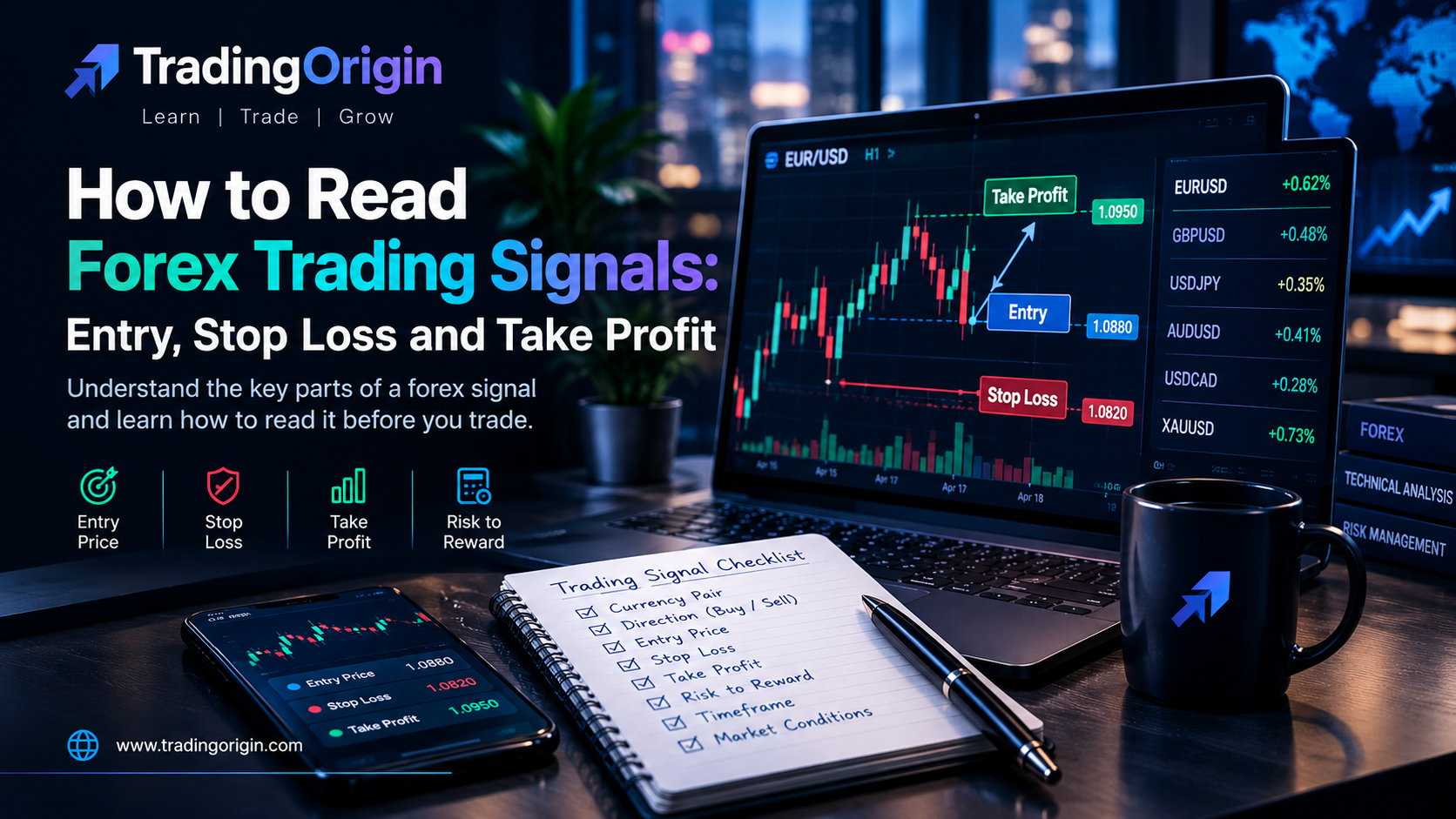
Forex trading signals can help traders identify potential opportunities in the currency market, but understanding a signal is just as important as receiving one.
A signal may contain a currency pair, an entry price, a stop-loss level, a take-profit target, and a trading direction. Each detail serves a purpose. If you misunderstand even one of these elements, you may enter a trade at the wrong price or take more risk than you intended.
In this guide, TradingOrigin explains how to read forex trading signals step by step, interpret common trading terms, calculate risk-to-reward, and evaluate a trade idea before deciding whether it fits your strategy.
What Is a Forex Trading Signal?
A forex trading signal is an idea that identifies a possible buying or selling opportunity in a currency pair. Signals can be generated by human analysts, technical indicators, automated systems, or a combination of methods.
For example, a signal provider might identify a potential EUR/USD buying opportunity after a price breakout. The signal may specify an entry level, a stop loss, and a take-profit target to help explain the proposed trade.
However, a signal is not a guarantee that the market will move in the expected direction. It is information that traders must evaluate alongside market conditions, transaction costs, and their own risk limits.
The Main Parts of a Forex Trading Signal
Before following a signal, learn what each component means.
1. Currency Pair
The currency pair identifies the two currencies involved in the trade.
Examples include:
EUR/USD — Euro against the US dollar.
GBP/USD — British pound against the US dollar.
USD/JPY — US dollar against the Japanese yen.
The first currency is the base currency, and the second is the quote currency. The pair's price expresses how much of the quote currency is needed to buy one unit of the base currency.
Always confirm the exact pair before evaluating a signal. Different pairs can have different spreads, volatility, and trading costs.
2. Trade Direction: Buy or Sell
A buy signal generally means the trader expects the pair's price to rise. A sell signal generally means the trader expects it to fall.
For example, a buy idea for EUR/USD expresses an expectation that the euro will strengthen against the US dollar over the relevant period.
The direction alone is not enough to evaluate a trade. You also need to understand the entry conditions, the invalidation level, and the potential loss if the market moves against the position.
3. Entry Price
The entry price is the level at which a trade is intended to open.
A signal might specify an exact entry price or a condition, such as entering only after a candle closes above resistance.
These instructions are not interchangeable. If a signal requires confirmation, entering before that confirmation appears may change the original setup.
Forex prices can move quickly, so check whether the signal is still valid. Avoid automatically chasing a market that has already moved far beyond the planned entry.
4. Stop Loss
A stop loss is an order designed to close a position when the market reaches a specified price, helping limit the planned loss.
For a buy trade, the stop loss is commonly placed below the entry price. For a sell trade, it is commonly placed above the entry price.
The appropriate level depends on the trading strategy, market structure, volatility, and position size.
A stop loss does not guarantee the exact exit price. During gaps or exceptionally volatile conditions, execution may occur at a worse price.
Learn more in our guide to what a stop loss is and how it works.
5. Take Profit
Take profit is the target price at which a trader intends to close a position to realize a gain.
For a buy trade, the target is generally above the entry. For a sell trade, it is generally below the entry.
A realistic target should make sense in the context of the chart, the trading timeframe, and nearby support or resistance levels.
A target is not a prediction that the market must reach that price. The trade can reverse before reaching it, and actual execution may differ from the planned outcome.
6. Timeframe and Signal Expiry
The timeframe describes the period used to analyze a setup or the expected duration of a trade.
A signal based on a five-minute chart may have a very different purpose from one based on a daily chart.
Check whether the provider gives a signal expiry time or conditions that cancel the trade. An old signal should not automatically be treated as a new opportunity.
A Practical Forex Signal Example
Consider this hypothetical EUR/USD signal:
| Component | Example |
|---|---|
| Trade direction | Buy |
| Entry price | 1.0850 |
| Stop loss | 1.0820 |
| Take profit | 1.0910 |
| Planned price risk | 30 pips |
| Potential price reward | 60 pips |
For most EUR/USD quotes, one pip is 0.0001. The distance from 1.0850 to 1.0820 is therefore 30 pips, while the distance from 1.0850 to 1.0910 is 60 pips.
The planned risk-to-reward ratio is 1:2 before transaction costs.
This means the target is twice as far from the entry as the stop loss. It does not mean the trade has a 2-in-3 chance of winning or that a profit is likely.
The example is for educational purposes only and is not a live trading recommendation.
How to Calculate Risk-to-Reward
Risk-to-reward compares the potential loss with the potential gain in a trade.
The formula is:
Risk-to-reward ratio = potential loss ÷ potential gain
Using the example above:
Potential loss: 30 pips.
Potential gain: 60 pips.
Ratio: 30 ÷ 60 = 0.5, equivalent to 1:2 risk-to-reward.
A 1:2 ratio means the planned reward is twice the planned risk.
However, a favourable ratio does not automatically make a strategy profitable. Results also depend on the strategy's win rate, execution, spreads, commissions, slippage, and how consistently the rules are followed.
For example, a strategy with a 1:2 risk-to-reward ratio can still lose money if too few trades reach their targets.
How to Calculate Position Size
Position size determines how much currency exposure a trade creates. It should be linked to the amount you are prepared to lose if the stop loss is reached.
Suppose a hypothetical account has a balance of $2,000, and a trader chooses a planned risk of 0.5% for an example calculation.
The planned monetary risk is:
$2,000 × 0.005 = $10.
The appropriate position size then depends on the stop-loss distance, pip value, account currency, and trading costs.
This calculation is illustrative, not a recommendation to risk 0.5% on every trade. Leverage can magnify losses, and stop orders may not always execute at the exact requested price.
Do not increase position size simply because a signal provider appears confident.
How to Evaluate a Forex Signal Before Acting
Reading the signal correctly is only the first step. You should also evaluate whether the trade makes sense.
Check the Current Market Price
Compare the current quote with the proposed entry. If the market has already moved substantially, the original risk-to-reward may no longer apply.
Understand the Reason Behind the Trade
Look for a clear explanation of the setup, such as a breakout, a trend continuation, or a reaction around a technical level.
You do not need to agree with every signal, but you should be able to understand the reasoning and identify what would invalidate it.
Review Support and Resistance
Nearby support and resistance can affect how much room the market has to move toward the target.
A potential buy trade directly below a strong resistance area may have less available upside than one with more space before the next major level.
For more background, explore our guide to what trading is and how it works.
Check Spreads and Economic News
Spreads, commissions, and slippage can reduce a trade's actual return. Major economic announcements can also cause rapid price changes and wider spreads.
Check the economic calendar and consider whether the setup remains appropriate for the market conditions.
Verify the Signal Provider
If the signal comes from a paid service or online group, look for a complete performance record, transparent risk rules, and clear subscription terms.
Be cautious of guaranteed-profit claims, selected winning screenshots, and requests for your broker password.
Our guide to evaluating forex trading signals and managing risk explains how to assess a provider more carefully.
Common Mistakes Beginners Should Avoid
Entering After the Price Has Already Moved
Chasing a price can produce a different risk-to-reward ratio from the original signal. If the planned entry is no longer available, reassess the setup instead of assuming it remains valid.
Ignoring the Stop Loss
Moving a stop loss farther away simply to avoid closing a losing trade can increase the potential loss. Any adjustment should follow a predefined strategy rather than an emotional reaction.
Treating Every Signal as an Instruction
Signals are ideas to evaluate, not orders that must be followed. You can reject a trade if it does not fit your plan or if the information is incomplete.
Using Too Much Leverage
Leverage increases market exposure relative to the funds committed. Even a small price movement can cause a substantial loss when the position is too large.
Understand your broker's margin requirements and the consequences of leveraged trading before opening a position.
Trusting Win Rates Without Context
A provider's advertised win rate does not reveal the full performance of a strategy. You also need to consider the size of winning and losing trades, costs, drawdowns, and the completeness of the record.
A Beginner's Checklist for Reading Forex Signals
Before considering a signal, ask yourself:
Is the currency pair clearly identified?
Is the trade direction understandable?
Is the entry price or entry condition specific?
Is the stop loss defined?
Is the take-profit target realistic?
Have I calculated the potential loss and reward?
Have I considered spreads, commissions, and slippage?
Is the signal still valid under current market conditions?
Do I understand why the trade might work and what would invalidate it?
Does the trade fit my own risk limits?
If important details are missing, there is no need to rush. Skipping an unclear trade can be a sensible decision.
Frequently Asked Questions
How do beginners read forex trading signals?
Start by identifying the currency pair, trade direction, entry price, stop loss, take profit, and timeframe. Then calculate the potential risk and reward and check whether the setup remains valid.
What does a 1:2 risk-to-reward ratio mean?
It means the planned potential reward is twice the planned risk. It does not guarantee a winning trade or establish the probability of success.
Can forex trading signals guarantee profits?
No. Forex signals are based on analysis or trading rules, and market conditions can change unexpectedly. Every strategy can experience losses.
Should beginners follow free forex signals?
Free signals can be useful for studying trade ideas, but free access does not guarantee quality or safety. Evaluate the provider, understand the risk, and consider practising on a demo account before risking real money.
Is a stop loss always guaranteed to limit losses to a fixed amount?
No. Gaps, slippage, and rapid market movements can cause an order to execute at a different price. Position sizing and an understanding of market risk remain important.
Final Thoughts
Learning how to read forex trading signals helps you understand what a trade idea proposes, how much you might lose, and what conditions could make the setup invalid.
Focus on the entry, stop loss, take profit, timeframe, and risk-to-reward ratio before making any decision. Evaluate the market context, trading costs, and provider transparency instead of relying on a signal's confidence or advertised win rate.
At TradingOrigin, our goal is to help traders build their knowledge, understand risk, and make more informed decisions through education.
Risk Disclaimer: This article is for educational and informational purposes only and does not constitute financial or investment advice. Forex and leveraged trading involve substantial risk, and you may lose some or all of your invested capital. Always conduct independent research and consider your financial circumstances before trading.
Keep Learning: More Forex Articles
- How Economic News Affects Forex Signals: Interest Rates, CPI and NFP
- How to Use ATR for Forex Signals, Stop Loss and Volatility Analysis
- Manual vs Automated Forex Trading Signals: Which Is Better?
Want structured, step-by-step lessons? Explore the TradingOrigin Academy.
📢 Get our signals on Telegram
Follow our Telegram channel for crypto and forex signals, shared as they happen: 📲 Join TradingOrigin on Telegram
Want full access? View our crypto and forex signal plans.