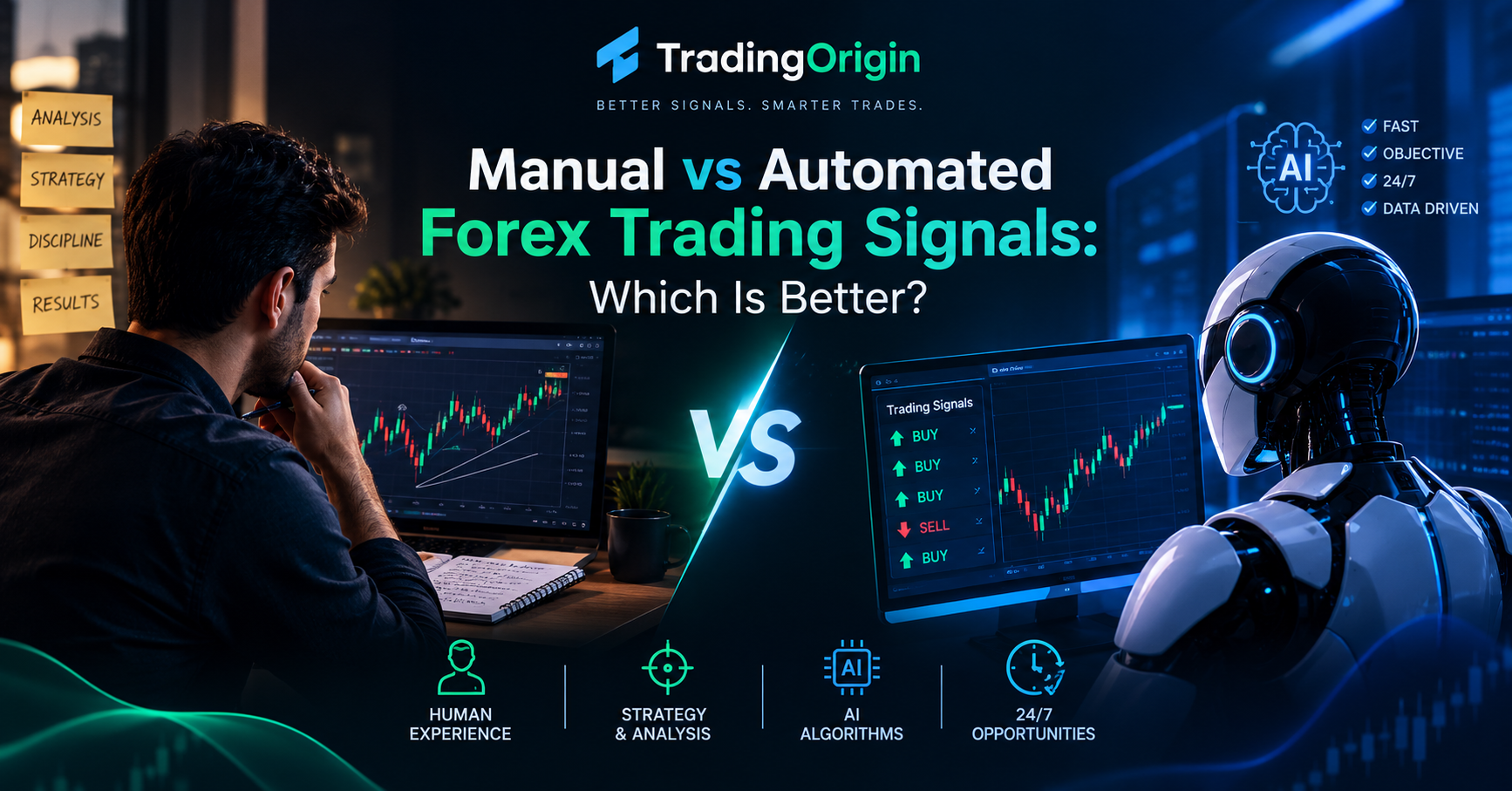
Forex trading signals can help traders identify potential opportunities in the currency market, but not all signals are generated in the same way. Some are created by experienced traders who analyze the market manually, while others are produced by software, algorithms, or automated trading systems.
Understanding the difference between manual vs automated forex trading signals can help traders decide which approach better fits their trading style, goals, experience, and risk-management plan.
What Are Manual Forex Trading Signals?
Manual forex trading signals are created by a person or team of traders who analyze market conditions before providing a trade idea.
A manual signal may be based on technical analysis, price action, support and resistance, market trends, economic events, or a combination of several factors.
A typical manual signal may include:
- Currency pair
- Buy or sell direction
- Entry price or entry zone
- Stop loss
- Take-profit target
- Risk-to-reward information
- Market analysis or reasoning
The main characteristic of manual forex trading signals is human decision-making. A trader evaluates the market and decides whether a particular setup meets the required criteria.
What Are Automated Forex Trading Signals?
Automated forex trading signals are generated by software, algorithms, or rule-based systems that analyze market data according to predefined conditions.
Depending on the system, automated signals may analyze price movements, technical indicators, trends, volatility, trading volume, or other market data.
When predefined conditions are met, the system can generate an automated trading signal without requiring a person to manually review every chart.
This process is sometimes referred to as forex signal automation.
How Automated Forex Signals Work
Understanding how automated forex signals work starts with the rules used by the system.
An automated system may be programmed to monitor the market continuously. For example, it could look for a specific combination of moving averages, price levels, momentum, or other technical conditions.
When those conditions are satisfied, the system can generate a signal containing information such as the currency pair, trade direction, entry level, stop loss, and take-profit target.
The process can be summarized as:
Market Data → Analysis Rules → Signal Generation → Trade Setup → Risk Management
The quality of the result depends heavily on the rules, data, testing, and risk controls behind the system.
Manual vs Automated Forex Trading Signals
The biggest difference between manual and automated signals is how the trading opportunity is identified and evaluated.
| Feature | Manual Signals | Automated Signals |
|---|---|---|
| Analysis | Human analysis | Algorithm or software |
| Speed | Depends on the trader | Can analyze markets quickly |
| Consistency | Can vary between decisions | Rules can be applied consistently |
| Flexibility | High | Depends on system rules |
| Emotions | Human emotions may influence decisions | Less direct emotional influence |
| Market Context | Can consider qualitative context | Depends on programmed inputs |
Neither approach is automatically better in every situation. The right choice depends on how the signals are created, tested, managed, and used.
Accuracy and Performance
Accuracy is one of the first things traders often consider when comparing automated trading signals with manual signals.
However, accuracy alone can be misleading.
A signal provider may have a high percentage of winning trades but still perform poorly if losing trades are significantly larger than winning trades.
When evaluating performance, consider the complete picture, including win rate, average profit, average loss, risk-to-reward ratio, drawdown, and consistency over time.
Past performance also does not guarantee future results. Market conditions can change, and a strategy that performed well in one environment may behave differently in another.
Speed and Market Monitoring
One potential advantage of automated systems is speed.
Software can monitor multiple currency pairs and predefined conditions continuously without requiring a trader to watch charts throughout the day.
Manual analysis, on the other hand, takes time and may require a trader to monitor charts, news, economic events, and price levels before making a decision.
For traders who want continuous market monitoring, automation can be useful. However, speed does not automatically mean better decisions.
Human Analysis vs Algorithms
Manual signals can incorporate human judgment and broader market context.
An experienced trader may consider factors that are difficult to convert into simple rules, such as unusual market behavior, changing sentiment, major economic developments, or unexpected volatility.
Algorithms have a different advantage: they can follow predefined rules consistently without becoming tired or distracted.
The trade-off is that an automated system is limited by the logic, data, and conditions it was designed to handle.
Consistency and Discipline
One potential benefit of automated forex trading signals is consistency.
If an algorithm is designed to follow specific rules, it can apply those rules repeatedly without changing its decision because of fear, greed, impatience, or excitement.
Manual traders can also be highly disciplined, but human psychology can influence trading decisions, especially during periods of losses or extreme market volatility.
This makes discipline and risk management important regardless of whether signals are manual or automated.
Risk Management
Risk management is more important than whether a signal is manual or automated.
A high-quality signal should provide enough information for a trader to understand the potential risk of the setup.
Important risk-management factors include:
- Stop-loss placement
- Position size
- Risk-to-reward ratio
- Maximum account risk
- Trade frequency
- Maximum drawdown
Automation does not eliminate trading risk, and manual analysis does not eliminate it either.
Traders should avoid assuming that automated systems are safer simply because they use technology.
Advantages of Manual Forex Trading Signals
Manual signals can offer several potential advantages:
- Human interpretation of market conditions
- Ability to consider unexpected market events
- Flexible decision-making
- Ability to adapt analysis to changing conditions
- Detailed explanations behind individual trade setups
For traders who value education and understanding the reasoning behind a trade, manual signals can provide useful context.
Advantages of Automated Forex Trading Signals
Automated forex trading signals can also offer several potential advantages:
- Fast market monitoring
- Consistent application of predefined rules
- Ability to monitor multiple currency pairs
- Reduced influence of emotional decisions
- Systematic signal generation
- Continuous monitoring when the system is operating
However, these advantages depend on the quality and design of the underlying system.
Disadvantages of Manual Signals
Manual signals also have limitations.
Human analysis can take more time, and decisions may sometimes be influenced by emotions or personal bias.
Two traders analyzing the same market may also reach different conclusions because they use different methods or interpret the available information differently.
Disadvantages of Automated Signals
Automated systems have their own limitations.
An algorithm can only make decisions based on the information, rules, and conditions available to it. If market conditions change significantly, a system designed for a particular environment may produce weaker results.
Technical failures, poor data, incorrect settings, over-optimization, and unrealistic backtesting can also create problems.
This is why traders should evaluate automated trading signals carefully rather than assuming that automation guarantees better performance.
Which Is Better for Beginners?
For beginners, understanding the reasoning behind a trading signal can be more valuable than simply receiving an automated BUY or SELL instruction.
Manual signals can provide an opportunity to learn about market structure, technical analysis, risk management, and trade planning.
However, beginners can also use automated tools as part of their research process if they understand their limitations and do not treat automated signals as guaranteed trade recommendations.
Which Is Better for Experienced Traders?
Experienced traders may benefit from either approach depending on their strategy.
A trader who already has a well-defined system may use automation to monitor markets, identify setups, or reduce repetitive analysis.
Another trader may prefer manual signals because they want to incorporate fundamental information, market sentiment, or discretionary analysis.
The best approach is the one that fits the trader's process and risk-management rules.
How to Choose Between Manual and Automated Signals
Before choosing between manual and automated forex trading signals, consider the following questions:
- Do you want human market analysis or rule-based signals?
- How much time can you spend monitoring the market?
- Do you understand the strategy behind the signals?
- Does the provider show transparent performance information?
- Are stop loss and risk-management rules clearly defined?
- Has the automated system been tested under different market conditions?
- Does the approach fit your trading timeframe?
- Can you manage the potential risks and drawdowns?
These questions can help you choose an approach based on your own needs rather than marketing claims.
What Makes a Good Forex Signal?
Whether a signal is manual or automated, traders should focus on the quality of the complete setup.
A useful forex trading signal should provide clear information about the trade and allow the trader to understand the potential risk.
Important characteristics can include:
- Clear entry information
- Defined stop loss
- Defined take-profit target
- Reasonable risk-to-reward structure
- Transparent performance information
- Consistent methodology
- Clear risk-management rules
Instead of focusing only on the number of winning trades, evaluate the complete trading process.
Final Thoughts
The debate between manual vs automated forex trading signals does not have one universal answer.
Manual signals can benefit from human judgment, flexibility, and market context, while automated forex trading signals can offer speed, consistency, and continuous market monitoring.
Neither approach guarantees profitable trading. The quality of the methodology, risk management, transparency, testing, and execution all matter.
For traders considering the best forex trading signals, the most important question is not simply whether the signals are manual or automated. Instead, ask whether the signals fit your strategy, risk tolerance, trading timeframe, and decision-making process.
Before using any signal service, it is also useful to learn how to choose the best forex trading signals and understand how to evaluate forex trading signals.
You can also learn how to use forex trading signals with a trading strategy as part of a structured trading plan.
Keep Learning: More Forex Articles
- How Economic News Affects Forex Signals: Interest Rates, CPI and NFP
- How to Use ATR for Forex Signals, Stop Loss and Volatility Analysis
- How to Read Forex Trading Signals: A Complete Beginner's Guide
Want structured, step-by-step lessons? Explore the TradingOrigin Academy.
📢 Get our signals on Telegram
Follow our Telegram channel for crypto and forex signals, shared as they happen: 📲 Join TradingOrigin on Telegram
Want full access? View our crypto and forex signal plans.