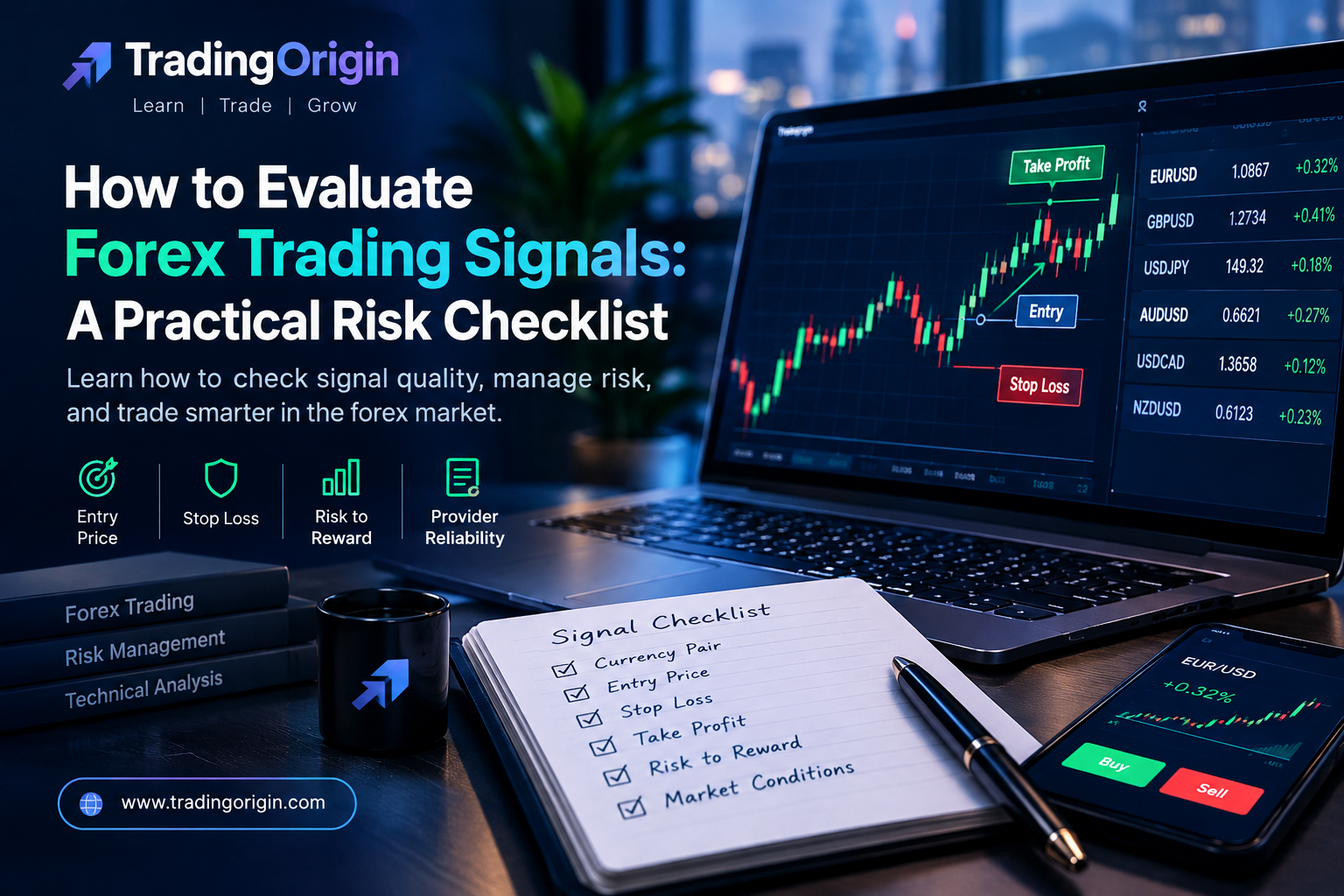
Forex trading signals can help traders identify potential opportunities in the currency market, but not every signal deserves to be followed. A clear entry price means little if the trade has no defined stop loss, the market has already moved, or the provider cannot explain its results.
The real skill is not finding the largest number of signals. It is learning how to evaluate a forex trading signal, understand the risk behind it, and decide whether it fits your own trading plan.
In this guide, you will learn how forex signals work, which details to check before entering a trade, how to assess risk-to-reward, and how to recognize unreliable signal providers.
What Are Forex Trading Signals?
Forex trading signals are trade ideas that suggest a possible buying or selling opportunity in a currency pair. They may be produced by a human analyst, a technical trading system, an algorithm, or a combination of methods.
A typical signal includes a currency pair, trade direction, entry price, stop-loss level, take-profit target, and timeframe. Better-quality signals also explain the market conditions behind the setup.
For example, a trader might receive a signal for EUR/USD based on a breakout above a resistance level. Before considering the trade, the trader should check whether the breakout is still valid, whether the entry price is realistic, and how much could be lost if the setup fails.
Forex signals are decision-support tools, not guarantees of profitable trades. Market conditions change, execution prices differ, and even carefully prepared trade ideas can lose money.
What Should a Reliable Forex Signal Include?
Before considering a signal, check whether it provides enough information to evaluate the trade independently.
| Signal component | What to check | Why it matters |
|---|---|---|
| Currency pair | Is the instrument clearly identified? | Prevents confusion about the market being traded |
| Direction | Is the idea a buy or sell? | Defines the intended trade |
| Entry price | Is there a clear entry level or condition? | Helps prevent chasing a move that has already happened |
| Stop loss | Is the invalidation level specified? | Defines the planned exit if the trade fails |
| Take profit | Is there a realistic target? | Helps assess potential reward relative to risk |
| Timeframe | Is the intended holding period clear? | Helps match the setup to the trader's strategy |
| Rationale | Is there an understandable reason for the setup? | Makes the signal easier to evaluate and review |
A signal that says only “BUY EUR/USD now” leaves too many unanswered questions. Without an entry plan, an exit condition, and a clear understanding of the risk, the trader is acting on an incomplete idea.
How to Evaluate Forex Trading Signals Before Entering
1. Check Whether the Signal Is Still Valid
Forex markets move quickly. A signal that was reasonable an hour ago may no longer offer the same opportunity.
Compare the current market price with the proposed entry. If price has already moved significantly, do not assume the original setup remains valid. The potential reward may have decreased while the distance to the stop loss has increased.
Check the publication time, the intended timeframe, and whether the provider has marked the signal as active, cancelled, or closed.
2. Confirm the Market Structure
A signal should make sense in the context of the price chart.
Look at the prevailing trend, nearby support and resistance levels, recent volatility, and the timeframe used to generate the idea. A buy signal immediately below a strong resistance area may have less room to move than one with a clear path toward its target.
Indicators such as moving averages or the Relative Strength Index (RSI) can provide additional context, but no single indicator confirms that a trade will succeed.
For a deeper understanding of chart behaviour, explore our guide on what trading is and how it works.
3. Calculate Risk-to-Reward
Risk-to-reward compares the amount a trader plans to risk with the potential profit at the target.
Consider this educational example:
Entry price: 1.0850
Stop loss: 1.0820
Take profit: 1.0910
The distance to the stop loss is 30 pips, while the distance to the target is 60 pips.
The planned risk-to-reward ratio is therefore 1:2 before trading costs. The potential reward is twice the planned price risk, but this does not mean the trade has a high probability of winning.
A favourable ratio alone cannot make a poor setup profitable. The strategy's actual outcomes, win rate, execution costs, and consistency also matter.
4. Decide How Much You Can Afford to Risk
Position size should be calculated from the amount you are prepared to lose if the stop loss is reached, rather than from how confident a signal appears.
For example, on a hypothetical $2,000 account, a 0.5% planned risk equals $10. The position size would then depend on the stop-loss distance, pip value, account currency, and trading costs.
This is an illustration, not a recommendation that 0.5% is appropriate for every trader. A stop loss does not guarantee an exact exit price during gaps or fast markets, and leverage can magnify losses.
Read our guide to what a stop loss is and how it works to understand why the exit level is an essential part of a trading plan.
5. Check Spreads, Slippage, and News Events
A signal may look attractive on a chart but deliver a different result when executed.
The spread is the difference between the bid and ask prices. Slippage occurs when an order is filled at a different price from the one expected. Both can affect the actual outcome, especially during volatile market conditions.
Major economic releases, including inflation reports and central bank decisions, can also cause sudden price movements and wider spreads.
Before acting on a signal, check the economic calendar and consider whether the expected trading costs and volatility fit your plan.
How to Identify Unreliable Forex Signal Providers
A provider's marketing claims are not a substitute for verifiable performance information.
Use the following checklist before paying for a subscription or relying on a signal service.
| Check | Positive sign | Warning sign |
|---|---|---|
| Trading history | Complete, timestamped records | Only selected winning screenshots |
| Losses | Losing trades are included | Losses disappear from the record |
| Methodology | The strategy is explained clearly | The system is described as a secret that cannot fail |
| Risk management | Stops and position risk are explained | Large positions are encouraged without risk calculations |
| Performance claims | Results include relevant costs and drawdowns | Guaranteed profits or extraordinary accuracy claims |
| Business transparency | Provider identity, terms, and conflicts are disclosed | Pressure to deposit with an unfamiliar broker |
| Fees | Pricing and cancellation terms are clear | Urgent payment demands or hidden charges |
A high advertised win rate is not enough to establish that a provider is reliable. A strategy can win frequently and still lose money if its losing trades are much larger than its winning trades.
Whenever possible, examine a complete history rather than a short promotional sample. Consider testing signals on a demo account and recording the results before risking real money.
Never share your broker password or account credentials with a signal provider simply because they promise to improve your results.
A Practical Forex Signal Evaluation Checklist
Before acting on any forex trading signal, ask yourself these questions:
Is the currency pair and trade direction clear?
Is the signal recent and still valid?
Do I understand the reason behind the setup?
Is the entry price realistic?
Is there a defined stop loss and take-profit target?
Have I calculated the potential loss and position size?
Have I considered spreads, slippage, and upcoming economic news?
Does the trade fit my strategy and risk limits?
Can I verify the provider's historical results?
Am I comfortable accepting the potential loss?
If important questions remain unanswered, skipping the trade can be a reasonable decision. There is no requirement to act on every signal that appears.
Common Mistakes When Following Forex Signals
Copying a Signal Without Checking the Chart
A signal is based on a particular market situation. If that situation changes before you enter, the original reasoning may no longer apply.
Increasing Position Size After a Losing Trade
Trying to recover a previous loss by increasing risk can create a cycle of increasingly damaging decisions. Position size should follow a consistent risk plan, not recent emotions.
Ignoring the Stop Loss
Removing or widening a stop loss simply to avoid closing a losing position can turn a defined risk into a much larger one. Any adjustment should follow a predetermined strategy rather than the desire to avoid a loss.
Trusting Screenshots Instead of Complete Records
Screenshots can show individual trades but cannot establish long-term performance on their own. Look for a consistent, timestamped record that includes losing trades and explains how results are measured.
Treating Signals as a Complete Trading Strategy
Signals do not remove the need to understand market structure, execution, position sizing, and risk management. Learning how the forex market works helps traders evaluate ideas rather than follow them blindly.
Are Forex Trading Signals Suitable for Beginners?
Forex signals can help beginners study how traders develop and communicate trade ideas. They can also provide examples of entries, exits, and risk calculations.
However, beginners should avoid treating signals as instructions that must be followed. Start by learning the basics of currency pairs, order execution, leverage, and stop-loss placement. A demo account can provide a way to practise evaluating signals without exposing real funds to trading losses.
The goal should be to understand why a setup may or may not be valid, rather than to depend on someone else's decisions indefinitely.
Frequently Asked Questions
Are forex trading signals reliable?
Reliability depends on the provider, the strategy, the market conditions, and the quality of the evidence supporting its results. No signal is guaranteed to succeed. Check the methodology, full trading history, risk controls, and execution costs before relying on a service.
Can forex signals guarantee profits?
No. Currency prices are uncertain, and even well-researched setups can fail. Be cautious of any provider that guarantees returns or claims that losses are impossible.
What is the most important part of a forex signal?
There is no single detail that makes a signal reliable. However, a clear entry, a defined stop loss, a realistic target, and an understandable rationale are essential for evaluating its risk.
Should I use free or paid forex signals?
Price alone does not establish quality. Evaluate free and paid services using the same standards: transparent methodology, complete results, clear risk controls, and honest disclosure of fees and conflicts of interest.
How can I test a forex signal provider?
Review historical records, check whether losses and costs are included, and consider recording signals in a demo account before making a decision. Remember that past results do not guarantee future performance.
Final Thoughts
The best approach to forex trading signals is to evaluate them rather than follow them automatically. Check whether the setup is still valid, understand the entry and exit levels, calculate the potential loss, and assess the provider's evidence before making a decision.
A disciplined evaluation process cannot eliminate trading risk, but it can help you avoid incomplete trade ideas, unrealistic promises, and decisions that do not fit your risk limits.
Risk Disclaimer: This article is for educational and informational purposes only. It does not constitute financial or investment advice. Forex and leveraged trading involve substantial risk, and you may lose some or all of your invested capital. Always conduct your own research and consider your financial circumstances before trading.
Keep Learning: More Forex Articles
- How Economic News Affects Forex Signals: Interest Rates, CPI and NFP
- How to Use ATR for Forex Signals, Stop Loss and Volatility Analysis
- Manual vs Automated Forex Trading Signals: Which Is Better?
Want structured, step-by-step lessons? Explore the TradingOrigin Academy.
📢 Get our signals on Telegram
Follow our Telegram channel for crypto and forex signals, shared as they happen: 📲 Join TradingOrigin on Telegram
Want full access? View our crypto and forex signal plans.