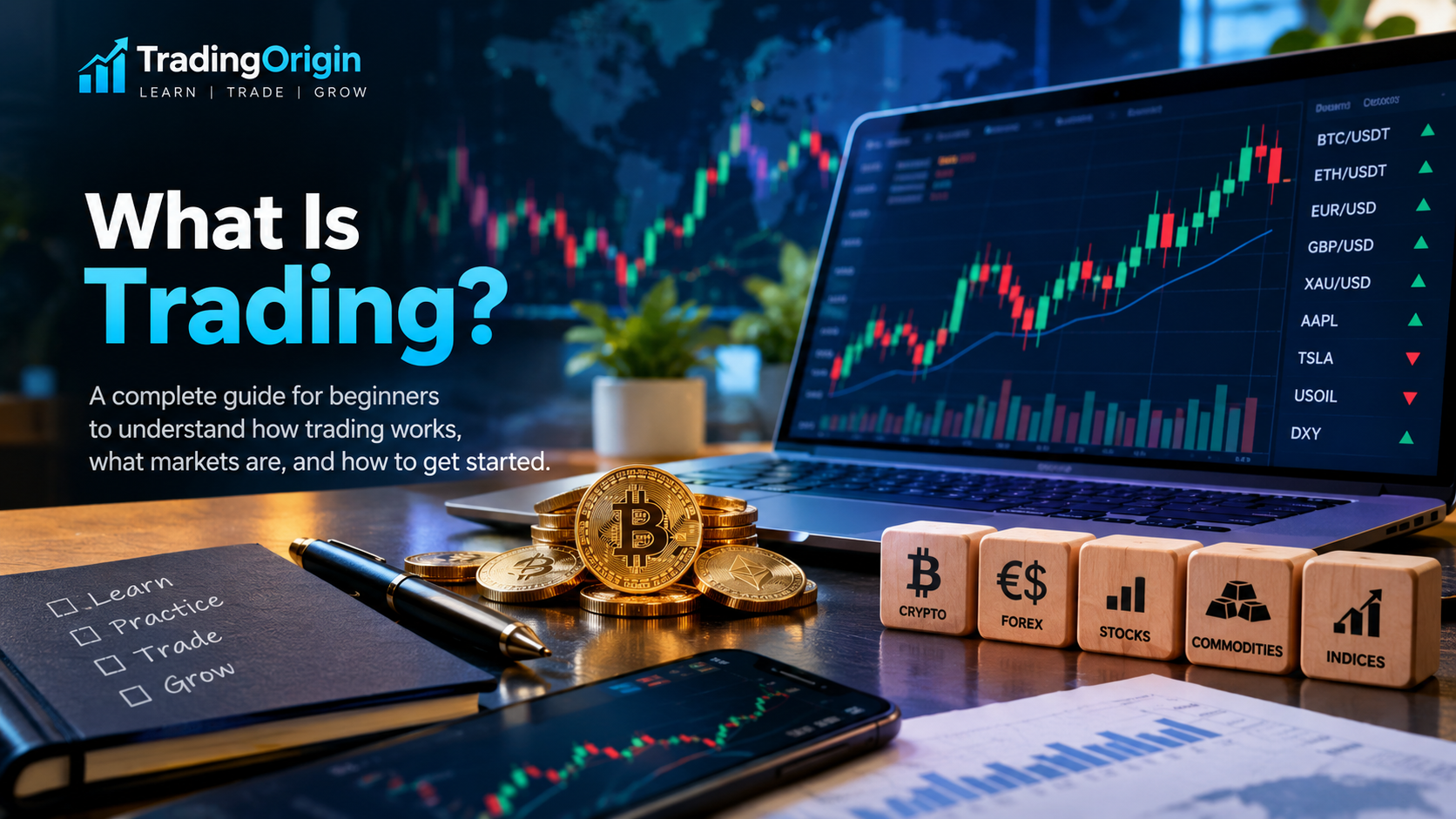
What Is Trading?
Trading is buying and selling an asset in a market, usually with the aim of benefiting from a change in its price. A trader might buy a share, a currency, or a cryptocurrency and later sell it; another trader might sell first and buy back later where the market and account allow it. The outcome is uncertain: prices can move against a trade, and fees or execution differences can affect the result.
How markets work
A market brings together people and organizations willing to buy and sell. Buyers place bids stating what they are willing to pay; sellers place asks stating what they are willing to accept. When a buyer and seller agree on a price, a transaction can occur. The latest transaction price is often shown as the market price, but it is not a promise that every trader can transact at that exact price.
Prices change as available buy and sell orders change. News, expectations, liquidity, and many other factors may influence those orders. No single explanation predicts every movement, and a chart records past prices rather than guaranteeing what happens next.
Buyers, sellers, and price
Every completed trade has both a buyer and a seller. If buyers are willing to pay higher prices to find a seller, the traded price may rise. If sellers accept lower bids to find a buyer, it may fall. This is a simple description of order matching, not a rule that makes future price direction certain.
Orders and the spread
A market order asks the broker or exchange to execute promptly at the best available prices. The final execution price can differ from the price displayed a moment earlier, particularly when the market is moving or has limited liquidity. A limit order sets a maximum buying price or minimum selling price, but it may not execute if the market does not reach that price.
The bid is the best displayed buying price and the ask is the best displayed selling price. The difference between them is the spread. It is one trading cost: a trader buying at the ask and immediately selling at the bid may receive less, even if the quoted prices have not otherwise moved. Commissions, funding charges, and other fees may also apply, depending on the product and provider.
What can you trade?
Traders can access many markets. Common categories include stocks (shares in companies), currencies (Forex), cryptocurrencies, commodities such as gold or oil, and indices that track a group of assets. The product matters: owning an asset, trading a contract based on its price, and trading with leverage can carry different rights, costs and risks, so check exactly what you are buying or selling.
Long and short positions
Going long means buying with the expectation that the price may rise. Going short means selling first, where the product allows it, with the expectation that the price may fall and the position can be closed by buying back later. Short selling is not available in every market or account, and a price that keeps rising can cause large losses on a short position. Understand your provider's rules before using it.
Forex and crypto examples
Forex
Forex trading involves exchanging one currency for another, shown as a pair such as EUR/USD. If the quoted pair rises, one euro costs more US dollars than before. A trader may buy or sell the pair based on a view about relative currency values, but exchange rates can move unexpectedly. Retail Forex products may involve leverage and may not provide ownership of the currencies themselves; check how your provider structures the product.
Cryptocurrency
Crypto trading involves buying and selling digital assets, often through an exchange. A BTC/USDT quote, for example, expresses a Bitcoin price in a dollar-linked token. Crypto markets can trade around the clock and prices may change quickly. Platform, custody, liquidity, and asset-specific risks matter in addition to price risk.
For a deeper look at this market, read our cryptocurrency trading guide.
Trading compared with investing
Trading generally focuses on buying and selling according to a shorter-term plan or a view about price movement. Investing generally means acquiring an asset with a longer-term ownership goal, though people use these words in different ways. The distinction is not simply "safe" versus "risky": both approaches can lose money, and the risks depend on the asset, method, costs, and time horizon.
Before deciding between them, consider what you are trying to achieve, when you may need the money, and how much loss you could withstand. Frequent transactions can add costs and require more attention; holding an asset longer does not guarantee recovery from a decline.
How traders analyze markets
Traders commonly use two broad approaches. Technical analysis studies price charts, patterns and indicators to look for possible setups. Fundamental analysis looks at information that may affect value, such as company results, economic data, interest rates or news about a crypto project. Many traders combine both. Neither approach predicts the future reliably, so treat them as tools for forming a plan, not as guarantees.
Common trading styles
Day trading
Day traders typically open and close positions within the same trading day. They may watch markets closely and use short-term plans. Rapid decisions, transaction costs, and the possibility of losses make this style demanding; the name alone does not imply that positions are always closed successfully or profitably.
Swing trading
Swing traders may hold a position for several days or longer, looking for a move over a broader period. They might review charts less frequently than a day trader, but prices can still move while they are away, including overnight or during market closures.
Scalping
Scalping seeks to take many small price movements, often over short periods. It can be sensitive to spread, fees, execution speed, and discipline. A small intended move does not mean a small possible loss, especially if execution differs from the plan.
Risk management basics
Decide your risk before entering
Some traders set a maximum amount they are willing to lose on an individual trade and keep it small relative to their account. The appropriate amount is personal; there is no universal percentage that makes trading safe. Consider the position size, the distance to the planned exit, fees, and the possibility that execution may be worse than expected. Avoid risking money needed for essentials.
Understand stop losses
A stop-loss order is intended to close a position if the market reaches a specified level. It can help make an exit plan explicit, but it cannot guarantee the exact exit price. In a fast-moving or illiquid market, a gap, slippage, or product rules may result in a different execution or loss than expected. Check how the order works on the venue you use.
Know what leverage changes
Leverage lets a trader control a larger position than the cash set aside for it. That magnifies exposure: a relatively small adverse price move can cause a large loss relative to the money deposited, and a provider may close a position when margin requirements are not met. Leverage does not improve the odds of a trade. Beginners should understand margin, liquidation, fees, and worst-case loss before considering it.
HYPOTHETICAL example: planning a small trade
This illustration is not a recommendation or a prediction. Suppose a trader has a $2,000 account and chooses, for practice, to risk at most $10 on one hypothetical position. They consider buying five units at $100 each and plan an exit at $98 if the idea is wrong. If filled exactly at those prices, the price difference would be $2 per unit, or $10 total before fees. Actual execution could differ, the exit might not fill at $98, and the trader could lose more than planned. A possible target price does not make a gain likely or guaranteed.
Common beginner mistakes
- Trading before understanding the product, order types, spread, and fees.
- Using borrowed money or leverage without understanding how losses and liquidation work.
- Risking money needed for bills, or increasing position size to try to recover a loss.
- Changing an exit plan impulsively or assuming a stop order guarantees a fixed loss.
- Following a tip or Trading Signals service without checking its reasoning, risks, and suitability for your own situation.
- Judging a method from a few outcomes instead of recording decisions, costs, and results over time.
A written plan can help make a decision reviewable: what would justify an entry, what would invalidate the idea, how much is at risk, and what costs apply. Practicing with a simulator can help learn platform mechanics, but simulated fills and emotions may differ from live trading.
How a beginner can start learning
- Learn the basics: markets, order types, spread, fees and the risks described above.
- Study one market first, such as Forex or crypto, instead of many at once.
- Check that a broker or exchange is regulated where applicable and has clear terms. Be cautious of anyone promising guaranteed returns.
- Practice on a demo account to learn the platform.
- If you move to live trading, start with an amount you can afford to lose and a written plan.
- Keep a trading journal to review your decisions, costs and results.
Frequently asked questions
Can beginners trade?
A beginner can learn how trading works, but access to a platform does not make a trade suitable or safe. Learn the product and order process first, use only money you can afford to lose, and consider seeking independent financial guidance for personal decisions.
Do I need a lot of money to start?
Requirements vary by provider, product, jurisdiction, and account type. A small minimum deposit does not remove market or platform risk. Check fees, minimum order sizes, and withdrawal conditions before funding any account.
Are Trading Signals a substitute for learning?
No. A signal is information or an idea, not a guarantee or a personalized assessment of your finances. Understand why a trade is proposed, how it could fail, and whether the risk fits your circumstances before making any decision.
Where can I learn more?
For another beginner-friendly topic, read our cryptocurrency trading guide. Compare educational material with reliable, independent sources and verify product details with the provider.
Risk disclaimer
Trading Forex, cryptocurrencies, and other financial products involves risk and may result in the loss of some or all of your money. This article is general education, not financial advice or a recommendation to buy or sell any asset. Make decisions based on your own circumstances and seek qualified independent advice if needed.
Keep Learning: More Crypto Articles
- How to Use Trading Signals: A Practical Guide to Entries, Exits, and Risk Management
- What Is a Take Profit? A Beginner’s Guide to Setting Profit Targets
- What Is a Trading Strategy? A Beginner’s Guide
Want structured, step-by-step lessons? Explore the TradingOrigin Academy.
📢 Get our signals on Telegram
Follow our Telegram channel for crypto and forex signals, shared as they happen: 📲 Join TradingOrigin on Telegram
Want full access? View our crypto and forex signal plans.