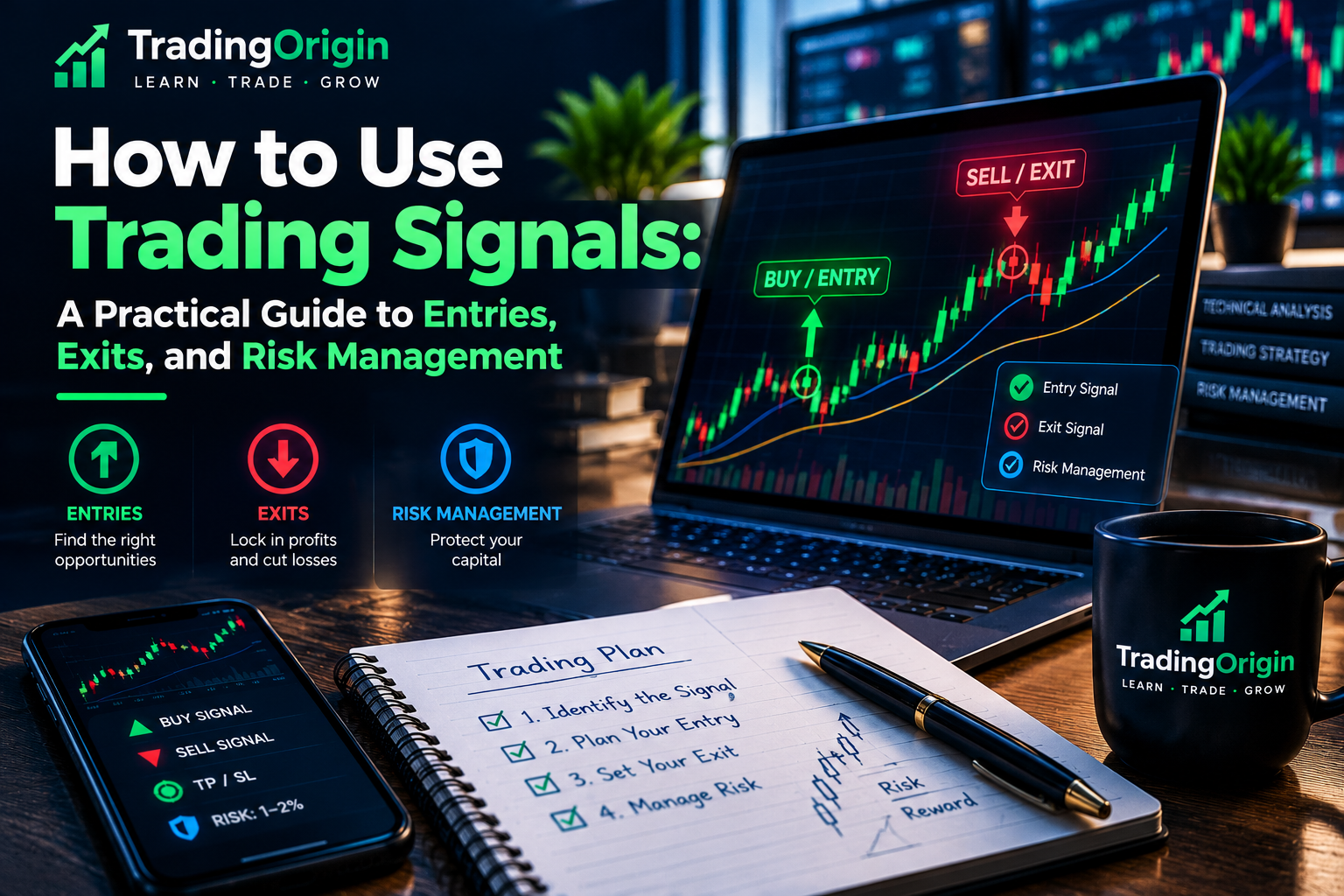
Trading signals can help traders identify potential market opportunities, but receiving a signal is only the beginning. The real skill is knowing how to read the information, evaluate the setup, manage risk, and decide whether the trade fits your strategy.
If you are learning how to use trading signals, this guide will walk you through the process from the first look at a signal to trade execution and risk management. You will learn what entry, stop loss, take profit, risk-to-reward ratio, and market conditions mean—and how to avoid common mistakes that can turn a good setup into a poor trade.
What Is a Trading Signal?
A trading signal is an indication that a particular market may be worth watching for a potential trade. Depending on the provider and strategy, a signal may include information such as the trading pair, market direction, entry area, stop loss, take profit targets, timeframe, and sometimes an explanation of the setup.
For example, a signal might indicate that a trader should watch for a potential long position after price reaches a specific area and confirms the expected setup.
A signal is not a guarantee that the market will move in a particular direction. Markets can change quickly, and even a well-structured setup can fail. That is why understanding the information behind a signal is more important than simply copying it.
How to Use Trading Signals Step by Step
Using a trading signal effectively is a process. Instead of immediately opening a position after receiving a signal, work through the information in a logical order.
1. Check the Trading Pair and Market
Start by identifying exactly what market the signal refers to.
For example, a signal may apply to BTC/USDT, ETH/USDT, EUR/USD, GBP/USD, or another financial instrument. Make sure you are looking at the correct market before considering an entry.
You should also check whether the signal is for the spot market, futures, or another type of trading environment. The same price movement can have very different consequences depending on the position type and leverage involved.
2. Understand the Market Direction
Next, determine whether the signal is looking for a long or short opportunity.
A long setup generally expects price to move higher, while a short setup generally expects price to move lower.
Understanding the direction matters because it gives you context for the rest of the setup. Do not focus only on the entry price without understanding what the trade is attempting to capture.
3. Identify the Entry Price or Entry Zone
The entry tells you where the trade may become active.
Some signals provide a single entry price, while others provide an entry range. An entry zone can be useful when the market does not move in a perfectly precise way and price may react within an area rather than at one exact number.
However, an entry is not automatically a command to enter the market immediately. If the signal includes a confirmation condition, wait for that condition before taking the trade.
4. Find the Stop Loss
The stop loss is one of the most important parts of a trading setup.
It defines the price level where the trade should be closed if the market moves against the original idea. A stop loss does not prevent every loss, but it can help limit the amount of capital exposed to a single trade.
Never treat the stop loss as an optional part of a signal. A trade without a defined invalidation point can expose your account to unnecessary risk.
5. Check the Take Profit Levels
Take profit levels show where the trade may begin locking in gains if price moves in the expected direction.
A signal may include one target or several targets. When multiple targets are provided, the trader may choose to reduce part of the position at earlier targets while allowing the remaining position to aim for later levels.
The exact approach depends on the trading strategy and risk management plan.
6. Calculate the Risk Before Entering
One of the biggest mistakes beginners make is deciding how much to trade before deciding how much they are willing to lose.
Instead, think about the amount of capital you are prepared to risk if the stop loss is reached. Position size can then be adjusted according to the distance between the entry and stop loss.
A wider stop generally requires a smaller position if the dollar amount of risk is kept constant. A tighter stop may allow a larger position under the same risk limit, although a stop that is too tight can be triggered by normal market fluctuations.
Understanding Risk-to-Reward Ratio
The risk-to-reward ratio compares the potential loss of a trade with its potential profit.
For example, suppose a setup risks $50 if the stop loss is reached and targets a potential $100 gain. The trade has a potential risk-to-reward ratio of 1:2.
This does not mean the trade is guaranteed to succeed. It simply describes the relationship between the planned risk and potential reward.
Looking at this relationship before entering a trade can help prevent situations where a trader risks a large amount for a relatively small potential gain.
Do Not Follow a Trading Signal Blindly
A trading signal should be treated as information, not as a promise.
Markets can be affected by volatility, economic announcements, liquidity changes, unexpected news, and rapid shifts in sentiment. A setup that looked attractive several minutes ago may no longer offer the same conditions.
Before entering, consider whether the market still matches the original setup. If the price has already moved significantly beyond the planned entry, chasing the trade may create a completely different risk profile.
When You Should Avoid a Signal
Knowing when not to trade is an important part of using signals effectively.
You may want to avoid or reassess a setup when:
- The entry area has already been missed by a large margin.
- The stop loss creates unacceptable risk for your account.
- The market has become unusually volatile.
- A major economic announcement is approaching.
- The original setup has been invalidated.
- The potential reward does not justify the planned risk.
- You do not understand how the trade works.
- You would need excessive leverage to take the position.
Skipping a trade is not the same as missing an opportunity. Sometimes protecting your capital is the better decision.
Common Mistakes When Using Trading Signals
Entering Too Late
One common mistake is entering after price has already made a large move. Traders may feel pressure because they believe they are missing the opportunity.
This can result in an entry that is very different from the original setup.
Ignoring the Stop Loss
Moving a stop loss farther away simply because the market is moving against the position can turn a controlled trade into an uncontrolled loss.
If the original reason for the trade is no longer valid, accepting the planned loss may be better than continuously increasing the risk.
Using Too Much Leverage
Leverage can increase exposure, but it also increases the speed at which losses can accumulate.
A signal that looks reasonable without leverage can become extremely risky when a large leveraged position is used.
Risking Too Much on One Trade
No individual signal should be treated as certain.
Even a strong setup can fail. Spreading risk across a consistent trading plan is generally more sustainable than putting a large portion of an account behind one idea.
Taking Every Signal
More trades do not automatically mean better results.
A trader may receive several signals and still decide to take only the setups that fit their risk limits, timeframe, and personal trading plan.
How to Evaluate the Quality of a Trading Signal
Not all signals provide the same level of useful information.
A well-structured signal should make the important parts of the setup understandable. Depending on the strategy, useful information can include:
- Trading instrument
- Market direction
- Entry price or entry zone
- Stop loss
- Take profit target or targets
- Timeframe
- Setup explanation or market context
- Risk considerations
A signal that gives only a direction and a price without explaining the risk may provide much less value to someone who is still learning.
Trading Signals and Your Own Analysis
Experienced traders often use signals as one input within a broader decision-making process.
For example, a trader may compare a signal with support and resistance, market structure, trend direction, volatility, or other technical factors before deciding whether the setup makes sense.
This approach can help transform a signal from something that is simply copied into something that is understood and evaluated.
If you are learning technical analysis, understanding concepts such as support and resistance can also help you interpret why a potential entry or target may matter.
A Simple Example of Using a Trading Signal
Imagine a hypothetical signal for a cryptocurrency:
- Direction: Long
- Entry: $100
- Stop Loss: $95
- Take Profit: $110
The planned downside from the entry to the stop is $5 per unit, while the potential upside to the target is $10 per unit.
That creates a planned 1:2 risk-to-reward relationship.
Before entering, the trader should still ask whether the market conditions remain consistent with the setup, whether the position size is appropriate, and whether losing the planned amount would be acceptable.
The example is simplified for educational purposes. Real markets can move quickly, and actual execution may differ from the planned prices.
How to Build a Better Routine Around Trading Signals
A consistent process can be more useful than trying to predict every market move.
Before a trade, consider following this checklist:
- Identify the market and timeframe.
- Read the complete signal.
- Confirm the entry area.
- Identify the stop loss.
- Review the take profit target.
- Calculate the potential risk.
- Check the risk-to-reward relationship.
- Consider current market conditions.
- Decide whether the setup fits your trading plan.
- Only then consider entering the position.
After the trade, record what happened. Keeping a trading journal can help you identify whether your decisions are consistent or whether the same mistakes are happening repeatedly.
Trading Signals Are Tools, Not Guarantees
The most important lesson is simple: a trading signal does not remove risk from trading.
A signal can help organize a potential opportunity, but the trader still needs to understand the setup, control position size, respect the stop loss, and accept that the market can move differently from expectations.
The goal should not be to find a signal that can never lose. Such certainty does not exist in financial markets. A better goal is to develop a repeatable process for evaluating opportunities and managing risk.
Frequently Asked Questions About Trading Signals
What is the best way to use trading signals?
The best approach is to treat a signal as a starting point for analysis. Review the entry, stop loss, target, risk-to-reward ratio, and market conditions before deciding whether the setup fits your trading plan.
Can beginners use trading signals?
Beginners can use trading signals as an educational tool, but they should first understand basic concepts such as entries, stop losses, position sizing, and risk management. Following a signal without understanding the risk can lead to poor decisions.
Are trading signals guaranteed to make money?
No. Trading signals cannot guarantee profits. Every setup carries uncertainty, and even well-planned trades can fail.
Should I enter a trade immediately after receiving a signal?
Not necessarily. First check whether the price is still within the planned entry area and whether the market conditions remain consistent with the setup. Entering significantly late can change the trade's risk and reward.
How much should I risk on a trading signal?
There is no universal amount that is appropriate for every trader. Risk should be determined as part of your overall trading plan, account size, experience, and tolerance for loss. The important principle is to avoid exposing too much capital to a single trade.
Can I use trading signals with my own analysis?
Yes. Combining a signal with your own market analysis can help you understand the reasoning behind a setup instead of simply copying it. This may include reviewing trend, support and resistance, volatility, and market structure.
Final Thoughts
Learning how to use trading signals is not about finding a perfect entry or following every alert that appears on your screen. It is about understanding the setup and making disciplined decisions around it.
A strong process starts with the market and entry, continues through stop loss and position sizing, and ends with a clear understanding of the potential risk and reward.
When signals are combined with sound risk management and independent thinking, they can become a useful part of a structured trading approach rather than a shortcut to guaranteed profits.
TradingOrigin provides educational trading content designed to help traders better understand markets, trading concepts, and risk management. Always do your own research and never risk more than you can afford to lose.
https://tradingorigin.com/articles/how-to-use-trading-signals-entry-exit
Keep Learning: More Crypto Articles
- What Is a Take Profit? A Beginner’s Guide to Setting Profit Targets
- What Is a Trading Strategy? A Beginner’s Guide
- Support and Resistance Explained: A Beginner's Guide to Key Price Levels
Want structured, step-by-step lessons? Explore the TradingOrigin Academy.
📢 Get our signals on Telegram
Follow our Telegram channel for crypto and forex signals, shared as they happen: 📲 Join TradingOrigin on Telegram
Want full access? View our crypto and forex signal plans.