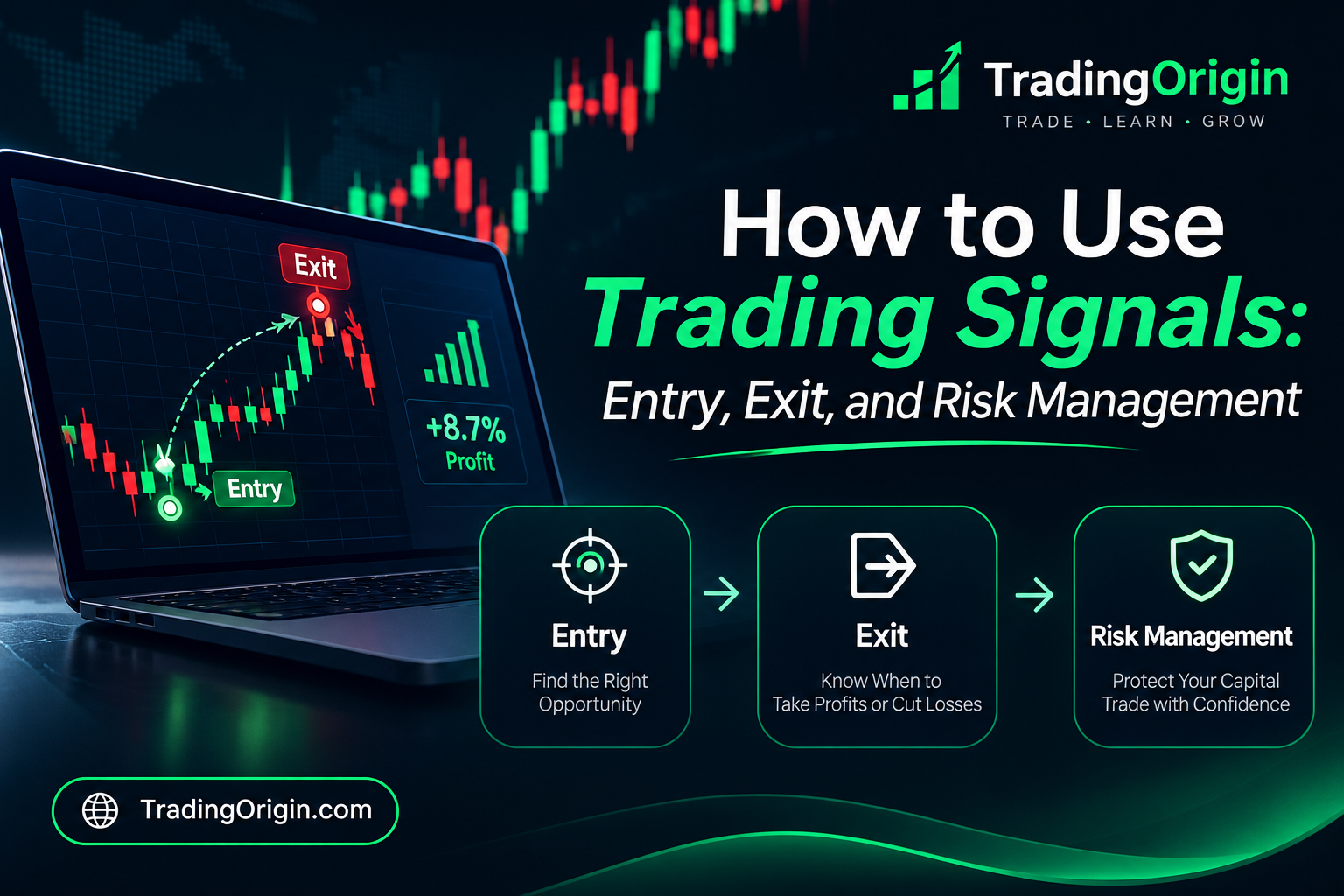
By TradingOrigin | Trading Education
Introduction: A Trading Signal Is Only the Beginning
Trading signals can help traders identify potential opportunities in the cryptocurrency, forex, and other financial markets. However, receiving a buy or sell alert does not automatically mean a trade is worth taking.
The real skill lies in understanding the signal, evaluating the market conditions behind it, identifying a suitable entry and exit, and controlling the amount of money at risk.
At TradingOrigin, we believe that successful trading education starts with a simple principle: understand the risk before you consider the reward.
This guide explains how to use trading signals step by step, how to plan entries and exits, how to calculate position size, and how to avoid common mistakes that can turn a reasonable trading idea into an unnecessary loss.
Whether you are learning about crypto trading signals or forex trading signals, these principles can help you build a more structured decision-making process.
What Are Trading Signals?
Trading signals are alerts or analytical observations that suggest a possible trading opportunity. They may be generated by technical indicators, price action, fundamental analysis, market data, or automated trading systems.
A trading signal might suggest that an asset could move higher or lower under certain conditions. It does not predict the future with certainty.
A useful signal should provide enough information for a trader to evaluate the opportunity rather than simply encouraging an immediate buy or sell.
A well-structured trading signal may include:
Trading pair or asset: The instrument being analyzed, such as BTC/USDT or EUR/USD.
Trade direction: A potential long or short position.
Entry level: The price or price range where the setup may become actionable.
Stop-loss level: The point where the planned trade is exited if the market moves against the idea.
Take-profit target: A predefined level for taking profit.
Timeframe: The chart timeframe and, where specified, the period for which the signal remains valid.
Trade rationale: The conditions or evidence supporting the idea.
Not every signal provider includes all these details. If important information is missing, you may not have enough information to evaluate the trade responsibly.
1. Understand the Signal Before Entering a Trade
The first step in using trading signals effectively is to understand why the signal appeared.
Do not treat a message that says BUY, SELL, LONG, or SHORT as a complete trading strategy. Instead, identify the conditions behind the recommendation.
Start by asking these questions:
What asset or trading pair does the signal refer to?
Is the signal suggesting a long or short position?
Which timeframe is being used?
What market conditions support the trade idea?
Where does the idea become invalid?
Is there enough information to calculate the potential loss?
Is the signal still relevant at the current market price?
The final question is especially important. Prices can change between the moment a signal is published and the moment you see it.
For example, a signal might identify an attractive entry at a particular price. If the market has already moved significantly, entering late could produce a different risk-to-reward ratio from the one originally intended.
TradingOrigin principle: Evaluate the signal that exists now, not the opportunity you wish you had received earlier.
2. How to Identify a Trading Entry Point
A trading entry point is the price or condition at which a trader decides to open a position.
An entry should be based on a defined trading method rather than fear of missing out.
There are several common approaches to identifying potential entries.
Support and Resistance
Support is an area where buying interest has previously helped slow or reverse a decline. Resistance is an area where selling interest has previously limited an advance.
Traders may watch how price behaves when it approaches these areas.
For example, a possible long setup could develop when price approaches support and shows signs of buyers returning. A possible short setup could develop when price approaches resistance and shows signs of selling pressure.
Neither support nor resistance guarantees a reversal. Price can break through these areas, so an entry plan should also define what would invalidate the setup.
Trend Confirmation
Some trading strategies look for opportunities in the direction of an established trend.
A trader might use swing highs and lows, moving averages, or other technical tools to assess whether the market is trending upward or downward.
For example, a strategy might require an upward trend and a confirmed pullback before considering a long entry.
The important point is consistency. Define the conditions in advance and avoid changing them simply because you want a particular trade to work.
Breakout Confirmation
A breakout occurs when price moves beyond an area that previously contained its movement.
However, not every breakout develops into a sustained move. Price can briefly cross a level and then return to its previous range.
A trader may therefore wait for a candle close beyond the level, a retest, or another predefined confirmation condition.
Waiting for confirmation can mean entering at a less favorable price, and it does not eliminate false breakouts. The method should be tested against historical data and monitored under realistic trading conditions.
3. How to Set a Stop-Loss Level
A stop-loss is an order or planned exit designed to limit losses when a trade moves against you. Its execution price is not guaranteed, especially during fast markets, gaps, or periods of low liquidity.
A stop-loss should be selected as part of the trading strategy before the position is opened.
Common approaches include placing a stop beyond a relevant swing high or low, outside a support or resistance area, or at a level that invalidates the original trade idea.
Consider a hypothetical example:
Entry price: $100
Stop-loss price: $97
Risk per unit: $3
If the trade is a long position, the planned price risk is $3 per unit before fees and potential slippage.
This does not mean every trade should use the same stop distance. Different assets, volatility conditions, and trading strategies require different approaches.
Avoid moving a stop-loss farther away simply because you do not want to accept a loss. Doing so can increase the amount at risk beyond the original plan.
A stop-loss is not a guarantee against loss, but a properly designed risk plan helps establish the limits of a trade.
4. How to Choose a Take-Profit Target
A take-profit target defines where a trader plans to close a position to realize a gain.
Targets can be based on technical levels, the structure of the market, a tested strategy, or a predefined risk-to-reward objective.
For example, a long trade might target a previous swing high, while a short trade might target a previous swing low.
The target should be evaluated against the entry price and stop-loss distance.
Avoid selecting a target solely because it would produce an attractive profit. A target must also make sense within the market conditions and the rules of your trading method.
Some strategies use one target, while others use multiple targets or partial exits. Each approach has trade-offs involving execution, fees, and the possibility of missing a larger move.
The best approach is the one you can define clearly, test consistently, and follow without improvising every time the market changes.
5. Understand Risk-to-Reward Ratio
The risk-to-reward ratio compares the amount you plan to risk with the potential profit you are targeting.
Suppose a hypothetical trade has these levels:
Entry price: $100
Stop-loss price: $97
Take-profit price: $106
The planned risk is $3 per unit, and the planned reward is $6 per unit.
The risk-to-reward ratio is therefore 1:2.
This means the potential reward is twice the planned risk, before transaction costs and execution differences.
A higher potential reward relative to risk does not automatically make a trade profitable. The strategy's win rate, trading costs, execution quality, and market conditions also matter.
For example, a strategy with a 1:2 planned risk-to-reward ratio can still lose money if its successful trades are too infrequent or its actual losses consistently exceed the planned amount.
Use the ratio as one part of your evaluation, not as a guarantee of success.
6. Position Sizing: How Much Should You Risk?
Position sizing determines how much of an asset you trade.
It is one of the most important parts of risk management because the same price movement can produce a small loss on one position and a much larger loss on another.
Consider a hypothetical trading account with $1,000.
If a trader chooses a maximum planned risk of 1% of account equity, the amount at risk would be:
$1,000 × 0.01 = $10
If the distance between the entry and stop-loss represents $2 per unit, a simplified calculation would be:
Position size = Planned monetary risk ÷ Risk per unit
$10 ÷ $2 = 5 units
This calculation assumes a straightforward position where the stop distance can be expressed as a monetary loss per unit. Forex contracts, leveraged products, derivatives, and different account currencies may require additional conversion and contract-size calculations.
Fees, funding costs, slippage, and gaps can also cause the actual loss to differ from the planned amount.
The 1% figure is an illustrative risk policy, not a universal rule or a guarantee of safety. Your appropriate risk limit depends on your circumstances, trading method, and tolerance for loss.
Remember: Choose the acceptable risk first, then calculate the position size. Never increase the risk simply because a signal appears convincing.
7. A Practical Trading Signals Example
The following example demonstrates how a trader might evaluate a hypothetical crypto trading signal. It is an educational illustration, not a live market recommendation.
Imagine a signal identifies a possible long trade on a fictional cryptocurrency.
Signal details
Asset: ABC/USDT
Direction: Long
Entry price: $50
Stop-loss: $48
Take-profit target: $54
Planned risk per unit: $2
Potential reward per unit: $4
Planned risk-to-reward ratio: 1:2
Before considering the trade, the trader checks whether the signal is still valid, whether the market conditions match the strategy, and whether the entry, stop-loss, and target remain reasonable.
Next, the trader calculates a position size based on a predefined risk limit and accounts for relevant trading costs.
If the price has already moved substantially above $50, the original entry may no longer be suitable. The trader should not assume that the same risk-to-reward ratio still applies.
If the setup does not meet the trader's rules, the correct decision may be to skip it.
If the trade is taken, the trader follows the predefined exit plan rather than widening the stop-loss or increasing the position impulsively.
The result can be a profit or a loss. What matters for evaluating the process is whether the decision followed the rules and whether the rules demonstrate an edge over a sufficiently large sample of trades.
8. Common Mistakes When Using Trading Signals
Even a well-presented signal can be used poorly. The following mistakes are worth avoiding.
Entering Too Late
A signal may no longer offer the same opportunity after the market has moved. Check the current price and recalculate the potential risk and reward rather than blindly following the original levels.
Trading Without a Stop-Loss Plan
Without a predefined exit for an invalidated trade, a manageable loss can become much larger than intended.
Ignoring Market Conditions
Economic announcements, volatility changes, low liquidity, and broader market movements can affect how a setup behaves.
Increasing Position Size After a Loss
Trying to recover a loss by taking a larger position can increase financial risk and encourage emotional decisions. Evaluate each new trade independently.
Trusting Claims of Guaranteed Profits
No trading signal can guarantee a profit. Be cautious of providers that promise fixed returns, hide losses, or use selected winning trades as proof of consistent performance.
Confusing Leverage With Profitability
Leverage increases exposure relative to the capital committed. It can magnify losses as well as gains, and liquidation or margin requirements may create additional risks.
Changing the Rules Mid-Trade
Moving targets, widening stops, or adding to losing positions without a tested rule can undermine the original strategy.
A trading journal can help identify these habits and show whether the problem lies in the strategy, execution, or risk management.
9. How to Evaluate a Trading Signal Provider
Before relying on a trading signals service, examine the evidence behind its claims.
Look for transparent performance records that include losing trades, a clearly explained methodology, and information about the assets and timeframes covered.
Consider the following questions:
Does the provider explain how its signals are generated?
Are entry, stop-loss, and exit conditions clearly defined?
Are performance claims supported by a complete and verifiable record?
Are fees and other trading costs considered?
Does the provider disclose the risks and limitations of its approach?
Does the service avoid promising guaranteed returns?
Can you test the approach without risking real money?
A large number of successful screenshots is not sufficient evidence of long-term performance. Selected examples may omit losing trades, unfavorable market conditions, or differences between suggested and actual execution prices.
Where possible, test a strategy using historical data and a demo account. Avoid relying on a short winning streak to judge whether a method is dependable.
10. Build a Repeatable Trading Signal Routine
A repeatable routine can help traders make decisions more consistently and review their results more objectively.
At TradingOrigin, we recommend thinking about the process in five stages.
Stage 1: Review
Identify the asset, direction, timeframe, source, and reasoning behind the signal.
Stage 2: Validate
Check the current market price, relevant technical levels, volatility, and any important upcoming events.
Stage 3: Plan
Define the entry condition, invalidation point, stop-loss, take-profit target, and maximum acceptable risk.
Stage 4: Execute or Skip
Take action only if the setup meets your rules. If key information is missing or the risk is unacceptable, stand aside.
Stage 5: Record and Review
Document the signal, the decision, the outcome, trading costs, and any deviation from the plan.
Reviewing a series of trades can reveal whether your approach is working as intended. One winning trade does not prove a strategy is effective, and one losing trade does not automatically prove it is ineffective.
The goal is to improve the quality of your process rather than chase individual outcomes.
Trading Signals Checklist Before You Enter
Use this checklist to review a potential trade before committing capital.
I understand what the signal means and why it appeared.
I have checked the asset, direction, timeframe, and current price.
The entry condition matches my trading strategy.
I know what would invalidate the trade idea.
I have defined a stop-loss and a realistic exit target.
I have calculated the position size and planned monetary risk.
I have considered trading fees, slippage, and leverage where relevant.
I have checked for market conditions that could affect execution.
I am prepared to accept the planned loss if the trade fails.
I have a plan for recording and reviewing the outcome.
If important items remain unresolved, take the time to address them before deciding whether to trade.
Frequently Asked Questions
Are trading signals suitable for beginners?
Trading signals can help beginners study potential market setups, but they do not replace learning the basics of markets, order execution, and risk management. Beginners can start by analyzing historical examples and using a demo account before considering real-money trading.
How do I know when to enter a trading signal?
An entry should follow the signal's stated conditions and your own trading rules. Check whether the price, timeframe, and confirmation criteria still match the original setup. Avoid entering simply because an alert has arrived.
Should I always follow a trading signal?
No. A signal is information to evaluate, not an obligation to trade. You can reject a signal if it is outdated, incomplete, inconsistent with your strategy, or outside your risk limits.
What is the difference between a trading signal and a trading strategy?
A trading signal identifies a potential opportunity. A trading strategy defines the rules for evaluating opportunities, entering and exiting positions, sizing trades, and managing risk over time.
Can trading signals guarantee profits?
No. Markets are uncertain, and even well-researched signals can fail. Past performance does not guarantee future results, and no signal provider can reliably eliminate trading risk.
Are crypto trading signals different from forex trading signals?
They share many principles, including entry planning, stop-loss placement, position sizing, and risk management. However, crypto and forex markets can differ in trading hours, liquidity, volatility, contract specifications, and market drivers. Your approach should reflect the instrument you trade.
Final Thoughts: Trade With a Plan, Not Just an Alert
Learning how to use trading signals effectively means developing a disciplined process for evaluating opportunities rather than reacting automatically to every alert.
Understand the signal, confirm the setup, define the entry and exit, calculate the position size, and accept that losses are part of trading. Just as importantly, learn when to avoid a trade.
At TradingOrigin, our educational approach focuses on helping traders understand the reasoning behind their decisions. The objective is not to promise perfect entries or guaranteed profits, but to encourage informed decisions, realistic expectations, and responsible risk management.
Before you take your next trade, ask yourself one question: Do I understand the risk as clearly as I understand the potential reward?
If you cannot answer that question, you may need more information before proceeding.
Educational Disclaimer
This article is provided by TradingOrigin for educational and informational purposes only. It does not constitute financial, investment, or trading advice, and it is not a recommendation to buy or sell any financial instrument. Trading cryptocurrencies, forex, and leveraged products involves substantial risk, including the possible loss of all capital committed. Always conduct your own research, consider your financial circumstances, and seek independent professional advice where appropriate.
Before choosing which signals to use, read our guide on [How to Choose Reliable Trading Signals: Risk Management, Strategy, and Smart Trading].
Keep Learning: More Crypto Articles
- Cryptocurrency Trading Guide: How to Buy Crypto, Trade & Use Signals
- How to Manage Risk in Crypto Trading
- What Is a Crypto Trading Strategy? A Beginner’s Guide
Want structured, step-by-step lessons? Explore the TradingOrigin Academy.
📢 Get our signals on Telegram
Follow our Telegram channel for crypto and forex signals, shared as they happen: 📲 Join TradingOrigin on Telegram
Want full access? View our crypto and forex signal plans.