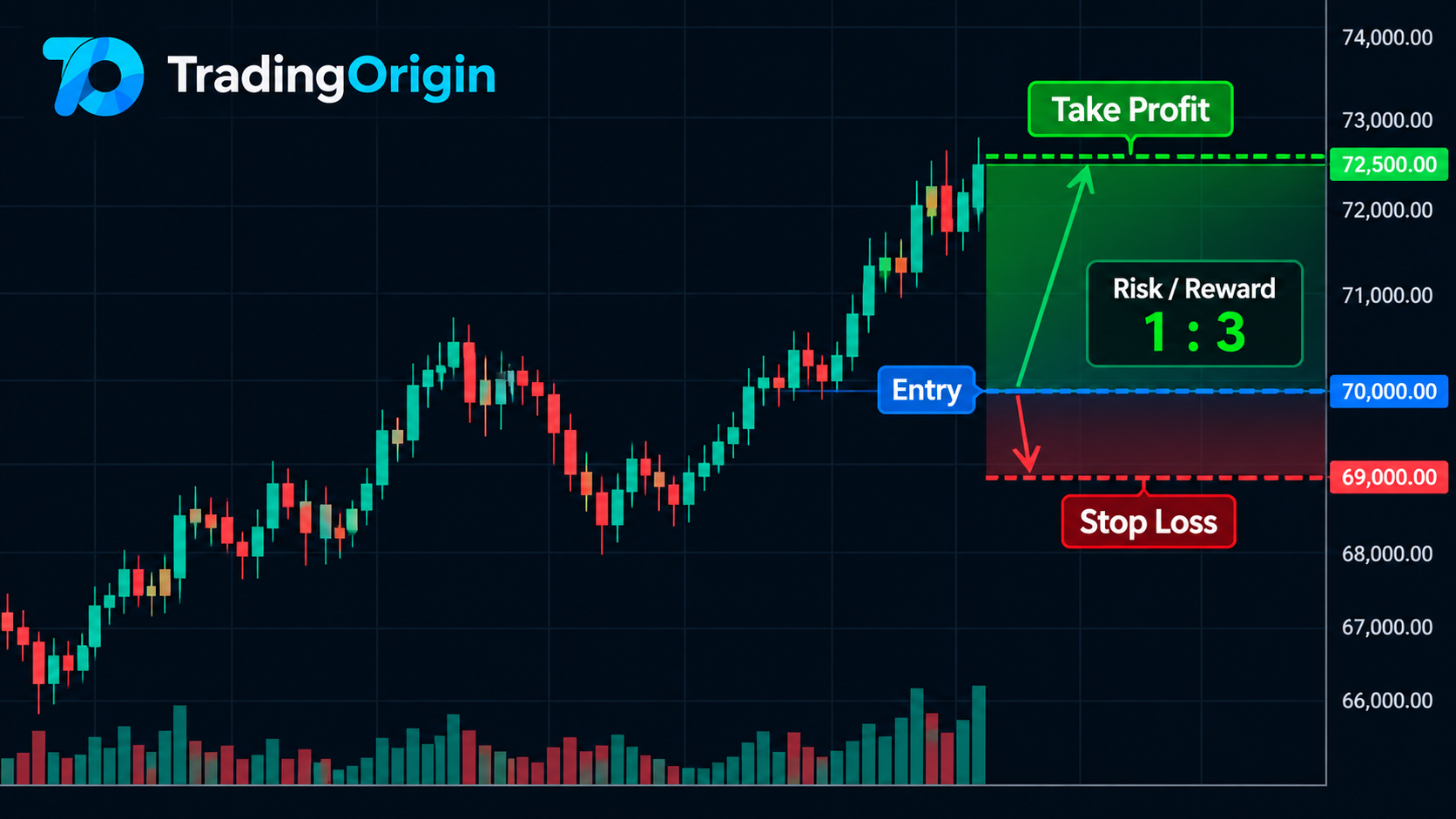
Crypto risk management is one of the most important skills a trader can develop. Cryptocurrency markets can move quickly, and even a well-researched trade can move against you. A good risk management plan does not try to eliminate losses. Instead, it helps control how much can be lost when a trade or market move does not go as expected.
Successful trading is not only about finding good entries. It is also about controlling position size, defining invalidation levels, managing leverage, planning exits, and protecting trading capital over a series of trades.
This guide explains the main principles of crypto risk management and shows how traders can build a practical risk management process before entering a trade.
Why Is Crypto Risk Management Important?
Cryptocurrency markets can experience large price movements in relatively short periods. This can create opportunities, but it can also increase the size of potential losses.
Without a clear risk plan, traders may increase their position after a loss, move a stop-loss further away, use excessive leverage, or enter trades based on emotion.
A structured crypto risk management plan creates rules before these situations happen.
The main goal is simple: protect enough capital so that a series of losing trades does not prevent you from continuing to trade according to your strategy.
The Core Principles of Crypto Risk Management
A complete risk management plan can include several different controls:
- Position sizing
- Stop-loss planning
- Risk-reward analysis
- Leverage control
- Portfolio exposure limits
- Drawdown limits
- Correlation management
- Trading discipline
These controls work together. A stop-loss alone is not enough if the position is too large or if several highly correlated trades are open at the same time.
1. Decide How Much You Are Willing to Risk
Before opening a trade, determine the maximum amount of capital you are willing to lose if the setup fails.
This should be decided before entering the position, not after the market starts moving against you.
For example, suppose a trader has a $5,000 trading account and decides that the maximum planned loss on one trade is $50.
The trader's planned risk is:
$50 ÷ $5,000 = 1%
The 1% figure here is only an example, not a universal rule. The appropriate risk level depends on the trader's strategy, account size, experience, financial situation, and overall risk tolerance.
The important principle is that the maximum acceptable loss should be defined before the trade.
2. Understand Position Sizing
Position sizing determines how large a trade should be based on the amount of money the trader is willing to risk and the distance to the stop-loss.
A simple position sizing concept is:
Position Size = Amount at Risk ÷ Stop-Loss Distance
For example, imagine a trader is willing to risk $50 and the planned loss from the entry price to the stop-loss is $5 per coin.
The calculated position would be:
$50 ÷ $5 = 10 coins
If the stop-loss is farther away, the position generally needs to become smaller if the trader wants to keep the same dollar risk.
This is an important concept because position size should be determined by risk rather than by how confident a trader feels about a setup.
3. Use a Logical Stop-Loss
A stop-loss is an important part of a trading plan because it defines where a trade idea is considered invalid.
The stop should generally be connected to the structure of the setup rather than placed at an arbitrary percentage simply because that number feels comfortable.
For example, a trader might place a stop below a meaningful support area in a long trade if a break below that area would invalidate the original setup.
However, a stop-loss does not guarantee an exact execution price during a fast-moving or illiquid market. Slippage can cause the actual exit price to differ from the planned stop level.
For that reason, traders should consider market volatility and liquidity when determining position size.
For a deeper explanation of stop-loss concepts, read https://tradingorigin.com/articles?slug=what-is-a-stop-loss">What Is a Stop Loss? A Beginner's Guide to Managing Risk.
4. Understand Risk-to-Reward Ratio
The risk-to-reward ratio compares the potential loss of a trade with its potential profit target.
For example, if a trader plans to risk $50 while targeting a potential $100 profit, the potential reward is twice the planned risk.
That can be described as a 2:1 risk-to-reward ratio.
The calculation is:
Risk-to-Reward Ratio = Potential Reward ÷ Potential Risk
Risk-to-reward analysis can help traders determine whether a setup is attractive before entering it.
However, a high potential reward relative to risk does not automatically make a trade profitable. The probability of the setup working, market conditions, execution costs, and the quality of the trading strategy still matter.
5. Do Not Risk Too Much on One Trade
One of the most important goals of crypto risk management is preventing a single trade from causing serious damage to the trading account.
A trader may have strong confidence in a particular Bitcoin or altcoin setup, but confidence does not remove market risk.
Oversized positions can create several problems:
- A normal market move can produce a large account loss.
- Emotions become harder to control.
- Traders may move their stop-loss to avoid taking a loss.
- A single losing trade can affect future trading decisions.
- Recovery may require taking unnecessary additional risk.
Keeping individual trade risk controlled allows traders to focus on executing their strategy rather than trying to recover from one oversized position.
6. Control Leverage When Trading Crypto
Leverage allows traders to control a larger position with less initial margin, but it also increases the consequences of price movements relative to the trader's deposited capital.
High leverage can make a relatively small market movement have a large impact on account equity and can increase liquidation risk.
Leverage should therefore be treated as a risk factor rather than a shortcut to larger profits.
Before using leverage, traders should understand:
- Position value
- Margin requirements
- Liquidation price
- Funding costs
- Trading fees
- Potential slippage
- Distance between the stop-loss and liquidation price
A planned stop-loss should not be so close to liquidation that the exchange can liquidate the position before the trading plan has a chance to work.
7. Manage Total Portfolio Exposure
Looking at each trade separately is not always enough.
Imagine a trader has five different altcoin positions. Each position may appear to have a small individual risk, but if all five assets tend to move in the same direction, the combined portfolio can still have substantial exposure to one market move.
This is why experienced traders consider total exposure as well as individual trade risk.
Before opening a new position, ask:
- How much capital is already exposed?
- How many open positions are currently active?
- Are several positions strongly correlated?
- Are most positions dependent on Bitcoin's direction?
- Would several stop-losses likely be triggered during the same market move?
Managing combined exposure can help prevent a portfolio from becoming unintentionally concentrated.
8. Understand Correlation in Crypto Markets
Crypto assets do not always move independently.
During strong market moves, several cryptocurrencies may move in the same direction at the same time. This means holding multiple coins does not automatically mean that a portfolio is well diversified.
For example, a trader could hold Bitcoin, Ethereum, and several large altcoins. If all positions are long and the broader crypto market suddenly falls, multiple trades may lose value simultaneously.
Correlation should therefore be considered when calculating overall portfolio risk.
9. Set a Maximum Drawdown
Drawdown measures the decline from an account's previous peak to a later low.
For example, if a trading account grows from $10,000 to $12,000 and later falls to $10,800, the drawdown from the peak is $1,200.
That represents a:
$1,200 ÷ $12,000 = 10% drawdown
A maximum drawdown rule can act as a circuit breaker. If losses reach a predefined level, the trader can pause trading and review the strategy instead of continuing to trade emotionally.
10. Avoid Revenge Trading
Revenge trading happens when a trader tries to quickly recover a loss by taking additional trades without following the original strategy.
It can lead to:
- Larger position sizes
- More frequent trades
- Excessive leverage
- Lower-quality setups
- Moving stop-losses
- Ignoring trading rules
A losing trade is part of trading. The objective of risk management is to make sure one loss does not turn into a chain of emotional decisions.
11. Never Increase Risk Just Because a Trade Looks Certain
There is no guaranteed setup in cryptocurrency trading.
A chart may look extremely bullish, a signal may appear strong, or several indicators may point in the same direction. The market can still move unexpectedly.
A consistent risk model helps traders avoid changing their position size simply because they feel unusually confident.
Confidence can improve execution, but it should not replace risk management.
12. Include Fees, Slippage, and Funding Costs
The planned loss shown on a chart may not be the complete cost of a trade.
Traders should consider:
- Entry fees
- Exit fees
- Bid-ask spread
- Slippage
- Funding payments on perpetual futures
- Other platform costs
These costs can reduce the actual return of a trade and may become more important when trading frequently or using large positions.
A risk plan should therefore leave enough room for real-world execution costs rather than assuming that every trade will enter and exit at exactly the expected price.
13. Build a Risk Management Checklist
One of the easiest ways to improve consistency is to use the same checklist before every trade.
Before entering a crypto trade, ask:
- What is the trading setup?
- Why am I entering?
- Where is the invalidation level?
- Where is my stop-loss?
- How much money am I risking?
- What is my position size?
- Where is my potential take-profit level?
- What is the risk-to-reward ratio?
- How much exposure do I already have?
- Are my other positions correlated?
- Am I using leverage?
- Have I considered fees, spread, slippage, and funding?
- Does this trade follow my strategy?
If the answers are unclear, the setup may not be ready for execution.
Crypto Risk Management Example
Consider a hypothetical trader with a $5,000 account.
The trader decides that the maximum planned loss for the trade is $50.
The trader identifies an entry at $100 and determines that the trade idea becomes invalid at $95.
The distance between entry and stop is:
$100 − $95 = $5
The position size is:
$50 ÷ $5 = 10 units
If the trader's target is $110, the potential reward per unit is $10 while the planned risk per unit is $5.
That creates a theoretical 2:1 risk-to-reward ratio.
This example is purely educational. Actual trading results can differ because of execution price, fees, slippage, volatility, liquidity, and other market conditions.
Crypto Risk Management for Beginners
Beginners do not need a complicated system to start learning risk management.
A simple framework can include:
- Define the maximum acceptable loss before entering.
- Identify where the trading idea becomes invalid.
- Set the stop-loss around that invalidation level.
- Calculate position size from the planned risk.
- Define a realistic profit target.
- Check the risk-to-reward ratio.
- Review total exposure before opening another position.
- Record the trade and review the result later.
The purpose is not to predict every market movement. It is to create a repeatable process for dealing with uncertainty.
Crypto Risk Management and Trading Signals
Trading signals can help traders identify potential market setups, but a signal should not replace a personal risk management plan.
Before acting on a signal, traders should consider the entry, invalidation level, stop-loss, potential target, position size, and overall exposure.
A signal can identify an opportunity, while risk management determines how much capital should be exposed to that opportunity.
For more information about evaluating crypto setups, read https://tradingorigin.com/articles?slug=bitcoin-trading-signals-how-to-confirm-btc-trade-setups">Bitcoin Trading Signals: How to Confirm BTC Trade Setups.
Common Crypto Risk Management Mistakes
Some of the most common mistakes include:
- Entering a trade without knowing the maximum possible loss.
- Using a position size based on confidence instead of risk.
- Moving a stop-loss farther away after entering.
- Using excessive leverage.
- Ignoring correlated positions.
- Risking too much capital on one trade.
- Trying to recover losses immediately.
- Ignoring trading fees and slippage.
- Taking trades outside the normal strategy.
- Failing to keep a trading journal.
How to Improve Your Crypto Risk Management Over Time
Risk management should evolve as you gain more trading experience.
Keep a record of your trades and review important information such as entry quality, position size, stop placement, risk-to-reward ratio, maximum drawdown, and whether you followed your rules.
Over time, this information can reveal patterns in your trading behavior.
For example, you may discover that losses become larger when you increase leverage, trade during highly volatile conditions, or enter setups that do not meet your normal criteria.
The purpose of reviewing your trading history is not to eliminate every losing trade. It is to identify avoidable mistakes and improve the consistency of your process.
Final Thoughts
Crypto risk management is about controlling exposure before the market forces you to make a decision.
Position sizing, stop-losses, risk-to-reward analysis, leverage control, portfolio exposure, drawdown limits, and trading discipline all work together to protect trading capital.
No risk management system can guarantee profits or eliminate market losses. However, a disciplined approach can help traders keep individual losses controlled and remain capable of following their strategy over a longer series of trades.
The goal is not to win every trade. The goal is to make sure that losing trades are manageable and that one mistake does not determine the outcome of your entire trading account.
For more educational content about crypto trading strategies, technical analysis, risk management, and trading signals, explore the TradingOrigin Articles section.
Keep Learning: More Crypto Articles
- What Is a Crypto Trading Strategy? A Beginner’s Guide
- How to Use Entry Price, Stop Loss, and Take Profit in Crypto Trading Signals
- How to Identify Fake Crypto Trading Signals
Want structured, step-by-step lessons? Explore the TradingOrigin Academy.
📢 Get our signals on Telegram
Follow our Telegram channel for crypto and forex signals, shared as they happen: 📲 Join TradingOrigin on Telegram
Want full access? View our crypto and forex signal plans.