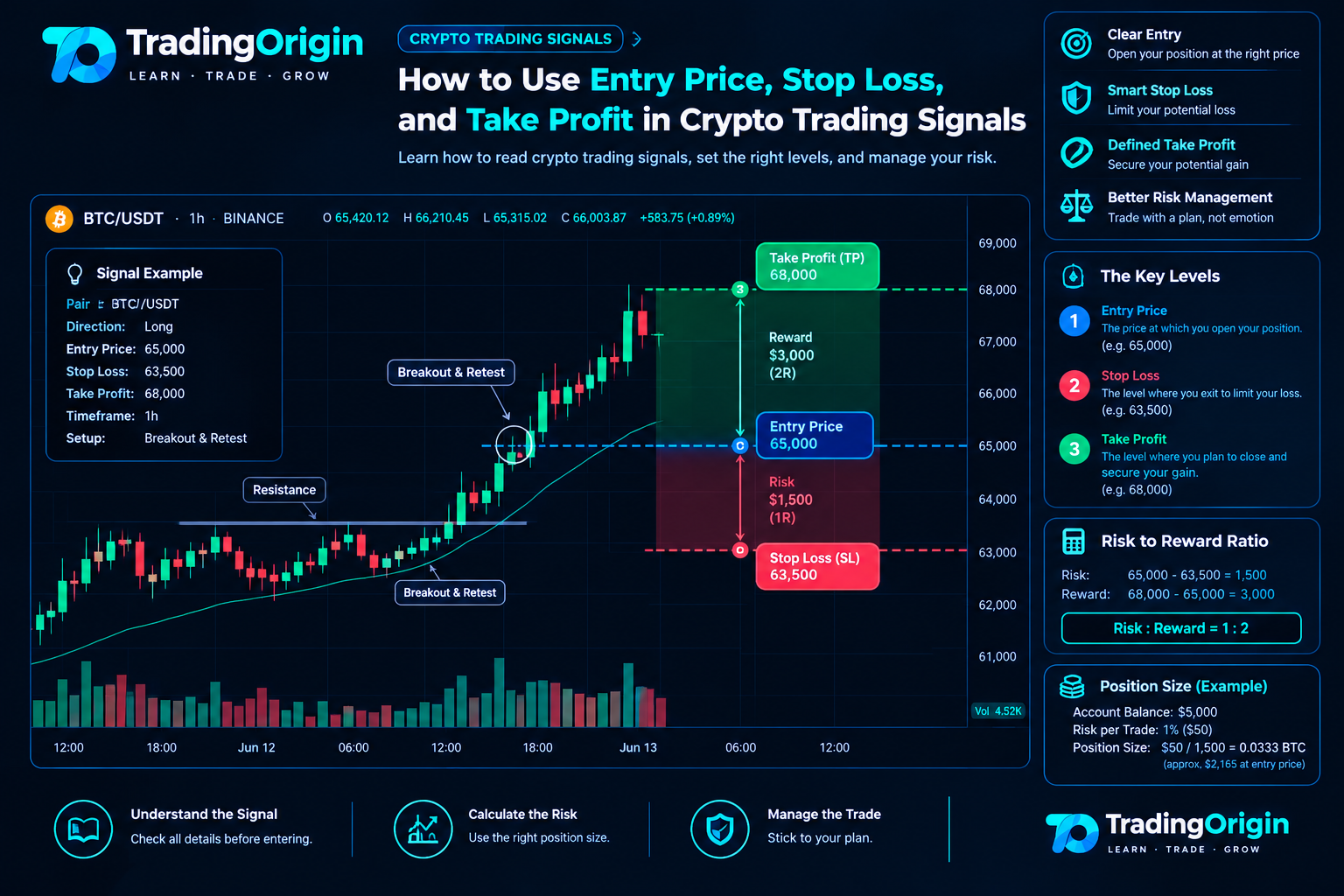
Understanding entry price, stop loss, and take profit is essential when learning how to use crypto trading signals. A signal may identify a potential trading opportunity, but knowing where to enter, where to exit, and how much you could lose is just as important as the direction of the trade.
Many traders focus only on whether a signal says BUY or SELL. However, a complete trading decision requires a clear entry plan, a defined exit strategy, and an understanding of the potential risk.
In this guide, you will learn how to read crypto trading signals, calculate risk-to-reward ratios, understand common mistakes, and evaluate whether a trade setup fits your trading plan.
What Are Entry Price, Stop Loss, and Take Profit?
These three elements serve different purposes in a crypto trading signal.
1. Entry Price: Where a Trade Begins
The entry price is the price at which a trader plans to open a position.
For example, a Bitcoin trading signal might identify an entry price of $65,000. This does not automatically mean that buying Bitcoin at any price near that level is appropriate. The signal may depend on a specific market condition, such as a breakout, a pullback, or a confirmed support level.
Some signals provide a single entry price, while others specify an entry zone.
Before entering a trade, check:
Whether the current market price is still within the planned entry area.
Whether the original setup remains valid.
Whether the price has already moved too far from the intended entry.
Whether fees and slippage could affect the trade.
If the price has moved significantly, chasing the market may create a different risk-to-reward profile from the one originally proposed.
2. Stop Loss: Where the Trade Is Exited to Limit Losses
A stop loss is an order or predefined exit level intended to limit a trade's loss if the market moves against the position.
For example, a Bitcoin trade might have an entry price of $65,000 and a stop-loss level of $63,500. The planned price difference is $1,500 per BTC.
A stop loss should be connected to the trade's risk and the conditions that invalidate its setup. It should not be selected randomly simply because a particular loss amount feels uncomfortable.
Keep in mind that a stop-loss order does not guarantee execution at its exact trigger price. Fast-moving markets, gaps in liquidity, and slippage can result in a worse execution price. On some platforms, the stop trigger and execution price also depend on the selected order type and price reference.
3. Take Profit: Where Gains May Be Realized
A take-profit level is a predefined price at which a trader plans to close all or part of a position to realize a gain.
Suppose a Bitcoin signal identifies an entry at $65,000 and a take-profit target at $68,000. If the position is a long trade and the target is reached, the planned price gain is $3,000 per BTC before fees and other costs.
Some signals include multiple targets, such as TP1, TP2, and TP3. These may represent different exit levels rather than a guarantee that every target will be reached.
Before following a multi-target signal, understand whether the provider expects a partial exit at each level and how the stop loss may change after an exit.
A target should have a logical basis in the trading plan, not simply be chosen to make the potential profit look attractive.
How to Read a Crypto Trading Signal Correctly
A well-structured signal should give you enough information to evaluate its assumptions and potential risks.
A typical example might look like this:
Example: BTC/USDT Long Signal
Asset: BTC/USDT
Direction: Long
Entry price: $65,000
Stop loss: $63,500
Take profit: $68,000
Timeframe: 1-hour chart
Setup: Hypothetical bullish breakout and retest
This is an educational example, not a live recommendation.
The entry establishes the planned opening price. The stop loss defines the intended exit if the setup fails, while the take-profit level identifies the planned profit target.
The timeframe helps explain the context of the setup, but it does not guarantee how long the trade will remain open.
Before entering, verify that the market conditions still match the signal. If the price has already moved beyond the intended entry zone, the original trade parameters may no longer be appropriate.
How to Calculate Risk-to-Reward Ratio in Crypto Trading
The risk-to-reward ratio compares the potential loss on a trade with its potential gain.
For a simple long position:
Potential risk per unit = Entry price − Stop-loss price
Potential reward per unit = Take-profit price − Entry price
Risk-to-reward ratio = Potential risk ÷ Potential reward
Consider the BTC/USDT example above:
Entry price: $65,000
Stop loss: $63,500
Take profit: $68,000
Potential price risk: $1,500 per BTC
Potential price reward: $3,000 per BTC
The risk-to-reward ratio is 1:2. In other words, the planned potential reward is twice the planned price risk, before costs.
This ratio does not mean the trade has a two-thirds probability of winning. It also does not establish whether the strategy is profitable. The probability of reaching each exit level, the order of price movements, execution costs, and the strategy's historical performance all matter.
Why Risk-to-Reward Ratio Matters
Comparing risk and reward helps traders avoid evaluating a signal solely by its profit target.
A signal offering a large potential gain may still be unattractive if the stop loss is very wide, the target is unrealistic, or the setup has little supporting evidence.
Likewise, a smaller target may be reasonable for a strategy with a different win rate and trading frequency.
The objective is to evaluate the complete trading plan rather than automatically favoring a particular ratio.
How to Calculate Position Size Before Entering a Trade
Position sizing determines how much of an asset you trade relative to your account and the amount you are prepared to risk.
Suppose a trader has a $5,000 account and decides to risk 1% of the account on a single trade.
Planned risk budget = $5,000 × 1% = $50
Using the BTC/USDT example, the distance between the entry and stop-loss prices is $1,500 per BTC.
For a simple spot-style calculation:
Position size = Risk budget ÷ Price distance to stop loss
Therefore:
$50 ÷ $1,500 = 0.0333 BTC, approximately.
At an entry price of $65,000, this represents a position worth about $2,165, before fees.
If the position is closed at the planned stop-loss price, the price-based loss would be approximately $50, excluding fees and slippage.
This calculation assumes a straightforward linear position and execution at the specified prices. Derivatives, contract multipliers, leverage, funding costs, and exchange rules can change the calculation.
The 1% figure is an illustrative risk-management assumption, not a universally appropriate amount for every trader.
Should You Move Your Stop Loss After Entering?
Changing a stop loss can alter the risk profile of a trade, so any adjustment should follow a predefined plan.
Moving a stop farther away simply to avoid realizing a loss increases the amount at risk and may undermine the original setup.
Some strategies allow a stop to move toward the entry price or trail the market as a position becomes profitable. However, such changes should follow explicit rules rather than emotional reactions to short-term price movements.
Before adjusting a stop loss, consider:
Has the original trade setup changed?
Does the strategy specify when the stop should be adjusted?
Will the change increase the maximum planned loss?
Could volatility or normal market fluctuations trigger the new level?
A stop-loss adjustment cannot guarantee that a trade will become profitable.
Common Mistakes When Using Crypto Trading Signals
Entering After the Price Has Already Moved
A signal may become outdated quickly. Entering well above a long signal's intended entry price can increase the distance to the stop loss and reduce the potential reward.
Recalculate the trade using the current price instead of assuming the original ratio still applies.
Ignoring Trading Fees and Slippage
A trade's actual result may differ from its price-based calculation because of commissions, spreads, slippage, and, where applicable, funding costs.
These expenses are particularly relevant for frequent trading and leveraged positions.
Choosing a Stop Loss Without Considering Market Structure
A stop placed too close to the entry may be triggered by ordinary price fluctuations. A very distant stop may create excessive risk for the available account balance.
Stop placement should reflect the strategy, volatility, and invalidation conditions, while position size should reflect the resulting risk.
Treating Take-Profit Targets as Guaranteed
A published target is a planned exit level, not a prediction that the market must reach it.
Price may reverse before reaching the target, and limit orders may not fill as expected under every market condition.
Using Leverage Without Understanding Liquidation Risk
Leverage increases exposure relative to the margin committed. It can magnify both gains and losses, and liquidation may occur before a planned stop-loss order protects the position.
Before using leveraged products, understand the exchange's margin rules, liquidation process, and how position size affects the potential loss.
A Practical Checklist Before Following a Crypto Signal
Use this checklist to evaluate a signal before opening a trade.
Is the trading pair and direction clearly identified?
Is the entry price or entry zone still relevant?
Is the stop loss defined and consistent with the setup?
Is the take-profit target supported by a reasonable trading plan?
Have I calculated the potential loss and risk-to-reward ratio?
Is the position size appropriate for my risk budget?
Have I considered fees, slippage, and funding costs where relevant?
Do I understand the conditions that invalidate the signal?
Am I making the decision without pressure or fear of missing out?
If important information is missing, do not assume the signal is complete. Ask for clarification or skip the trade if you cannot evaluate the risk.
Frequently Asked Questions
What is the difference between stop loss and take profit in crypto?
A stop loss is intended to limit losses when the market moves against a position. A take-profit level identifies where a trader plans to realize some or all of a potential gain.
How do you calculate risk-to-reward ratio in crypto trading?
For a basic long trade, divide the distance between the entry and stop-loss prices by the distance between the entry and take-profit prices. For a short trade, reverse the price differences accordingly. Include trading costs when evaluating the expected outcome.
What is a good risk-to-reward ratio for crypto trading signals?
There is no single ratio that is best for every strategy. A ratio must be considered alongside the strategy's win rate, execution costs, market conditions, and historical performance. A high ratio does not guarantee profitability.
Can a stop loss guarantee that I will lose only the planned amount?
No. Stop orders can experience slippage, and fast-moving or illiquid markets can produce worse execution prices than expected. The actual loss can exceed the initial estimate.
Should beginners follow crypto trading signals?
Beginners should first understand the signal's entry, exit, and risk parameters. Paper trading can help them practice evaluating setups without committing real funds. No signal should replace independent judgment or appropriate risk controls.
Final Thoughts
Entry price, stop loss, and take profit work together to define a crypto trade's plan. The entry identifies where the position is intended to begin, the stop loss defines an intended exit if the trade moves against the setup, and the take-profit level identifies a planned opportunity to realize gains.
Before following any crypto trading signal, evaluate its assumptions, calculate position size, account for trading costs, and confirm that the setup remains valid.
A clearly defined plan cannot eliminate market risk, but it can help traders make more consistent, informed decisions instead of relying on a signal's direction alone.
Educational disclaimer: This article is for informational and educational purposes only. It is not financial or investment advice. Cryptocurrency trading involves substantial risk, including the possible loss of your entire investment.
Further Reading
Continue learning about crypto trading signals by exploring:
Bitcoin Trading Signals: How to Confirm BTC Trade Setups
These articles cover signal confirmation and warning signs that complement the entry, stop-loss, and take-profit concepts discussed in this guide.
Keep Learning: More Crypto Articles
- How to Manage Risk in Crypto Trading
- What Is a Crypto Trading Strategy? A Beginner’s Guide
- How to Identify Fake Crypto Trading Signals
Want structured, step-by-step lessons? Explore the TradingOrigin Academy.
📢 Get our signals on Telegram
Follow our Telegram channel for crypto and forex signals, shared as they happen: 📲 Join TradingOrigin on Telegram
Want full access? View our crypto and forex signal plans.