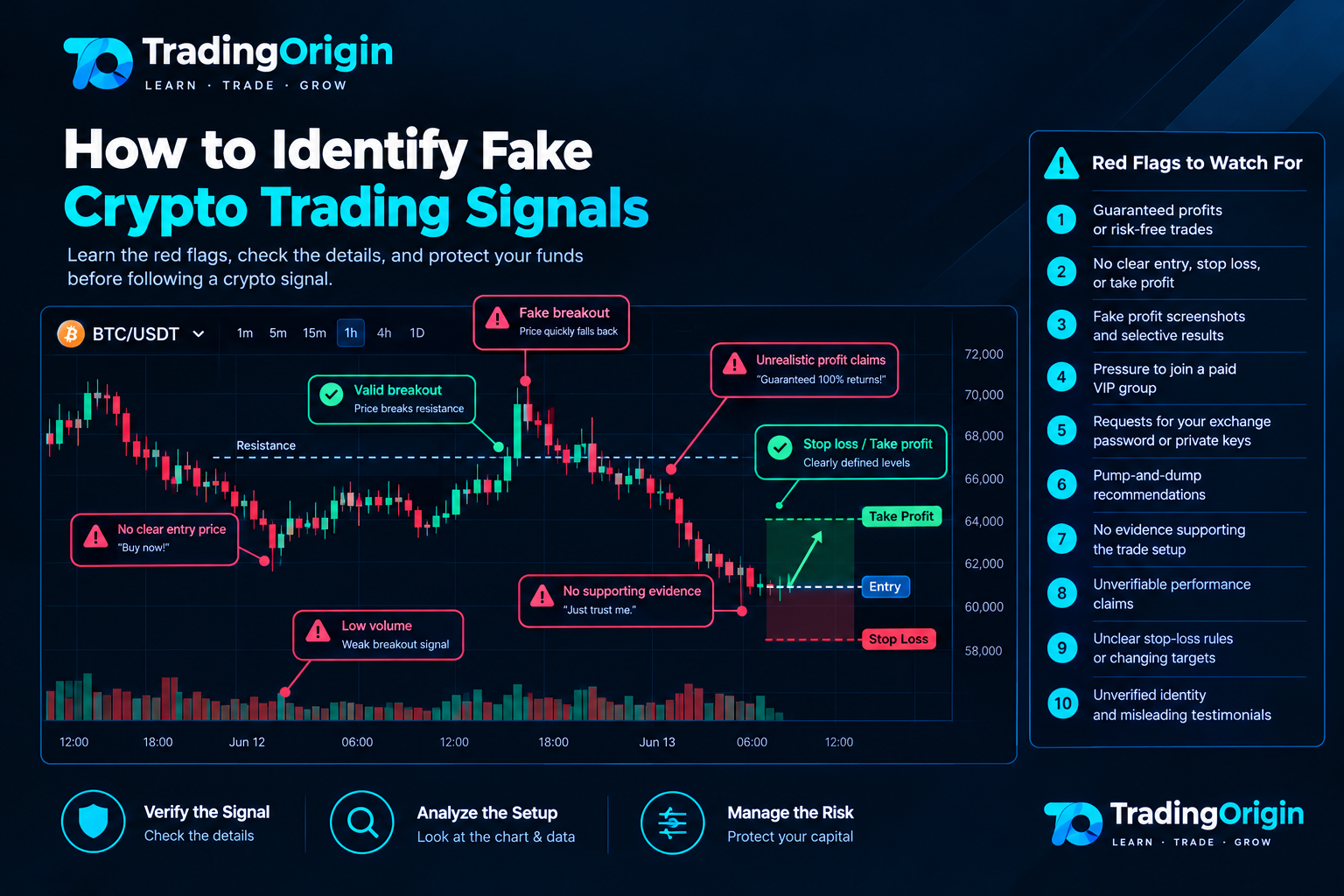
Crypto trading signals can help traders identify potential market opportunities, but not every signal is reliable. Some are poorly analyzed, while others are promoted through misleading profit claims, fabricated results, or outright scams.
Knowing how to identify fake crypto trading signals is an important skill for anyone who follows Bitcoin, Ethereum, or altcoin trade recommendations. Before acting on a signal, traders should understand where it comes from, how the setup is structured, and whether the potential reward justifies the risk.
This guide explains the most common crypto signal red flags, how to verify trading recommendations, and how to evaluate a signal provider without relying on promises of guaranteed profits.
What Are Fake Crypto Trading Signals?
Fake crypto trading signals are misleading or fraudulent trade recommendations that may encourage people to enter positions without reliable analysis or an honest explanation of the risks.
A suspicious signal might include an unrealistic entry price, an arbitrary stop-loss level, an exaggerated profit target, or claims that a trade cannot lose. Some providers publish only successful trades while hiding losses, making their performance appear much better than it actually is.
Not every losing signal is fake. Even a well-researched trade can fail because cryptocurrency markets are volatile and unpredictable. The important distinction is between a legitimate trading idea that carries risk and a misleading recommendation presented as a certainty.
10 Red Flags of Fake Crypto Trading Signals
1. Guaranteed Profits or Risk-Free Trades
One of the clearest warning signs is a promise of guaranteed profits.
Claims such as “100% accurate signals,” “zero-risk crypto trading,” or “guaranteed daily returns” should be treated with skepticism. No trading strategy can eliminate market risk, and past performance cannot guarantee future results.
A credible signal provider explains the assumptions behind a trade and acknowledges that the setup can fail.
2. No Clear Entry Price, Stop Loss, or Take Profit
A useful trading signal should provide enough information for a trader to understand the proposed setup.
Depending on the strategy, this may include:
The cryptocurrency or trading pair.
The proposed entry price or entry zone.
The stop-loss level or conditions that invalidate the setup.
One or more take-profit targets, when applicable.
The timeframe and reasoning behind the trade.
A message that simply says “Buy Bitcoin now” without a clear rationale or risk plan is difficult to evaluate objectively.
Missing information does not automatically prove fraud, but it makes the recommendation harder to verify.
3. Fake Profit Screenshots and Selective Results
Screenshots showing large profits are not sufficient evidence of a signal provider's performance. Images can be edited, taken out of context, or selected to show only successful trades.
To evaluate a provider, look for a consistent record that includes losing trades, timestamps, entry and exit prices, and the results of completed positions.
Check whether reported returns account for trading fees, funding costs where relevant, and slippage. These costs can materially affect the outcome of a strategy.
A transparent record is more useful than a collection of impressive screenshots.
4. Pressure to Join a Paid VIP Group
Some signal services use countdowns, limited-time offers, or aggressive private messages to pressure people into paying immediately.
Be cautious if a provider claims that a profitable opportunity will disappear unless you purchase a subscription at once.
Before paying for a crypto signal service, examine its pricing, refund terms, track record, and the identity of the business or person operating it. Avoid making a financial decision solely because of urgency or fear of missing out.
5. Requests for Your Exchange Password or Private Keys
A signal provider generally does not need your exchange password, wallet recovery phrase, or private keys to explain a trade.
Never share your seed phrase or private keys with a signal group. Anyone who obtains them may be able to control your cryptocurrency.
Also be cautious of websites that ask you to connect a wallet and approve unfamiliar transactions, or that request API permissions allowing withdrawals. If you use exchange API access for any legitimate trading integration, restrict permissions to the minimum necessary and disable withdrawals.
Receiving a trading signal should not require handing over control of your funds.
6. Pump-and-Dump Recommendations
A pump-and-dump scheme involves promoting an asset to drive demand or its price upward, then selling into that demand while later buyers may suffer losses.
Warning signs include intense promotion of an obscure token, claims that a price is about to explode, pressure to buy immediately, and unexplained recommendations to trade an illiquid market.
A sudden price increase is not proof of a coordinated scheme on its own. However, promotional pressure combined with poor transparency and concentrated selling risk deserves careful scrutiny.
7. No Evidence Supporting the Trade Setup
A reliable trading recommendation should offer a reason for the proposed trade.
Depending on the strategy, that reason could involve a trend, a support or resistance level, a confirmed breakout, volume behavior, or a defined technical setup.
For example, a Bitcoin buy signal after a breakout should explain which level matters and what price action would invalidate the idea. A recommendation based only on “Bitcoin will rise soon” offers little that can be independently evaluated.
Technical analysis does not guarantee success, but a clear rationale allows traders to assess whether the trade makes sense.
8. Results That Cannot Be Independently Verified
Some providers advertise extremely high win rates without explaining how they calculate them.
Ask whether the record includes all published signals, whether losing and cancelled trades are counted consistently, and whether the results are based on actual executions or hypothetical prices.
A high win rate alone does not establish profitability. A strategy can win frequently but lose money if its average loss is much larger than its average gain.
For a more complete evaluation, consider win rate, average win, average loss, fees, drawdown, and the number of trades in the sample.
9. Unclear Stop-Loss Rules or Constantly Changing Targets
A provider may publish a trade with one stop-loss level and later change the recommendation without clearly explaining why.
Markets can change, and legitimate traders sometimes adjust their analysis. The concern is a pattern of unexplained changes, deleted losing calls, or revised targets that make past results look better than they were.
Keep a dated copy of each signal and its original entry, stop-loss, and target levels. This helps you evaluate the recommendation using the information available when it was issued.
10. Unverified Identity and Misleading Testimonials
A professional-looking website or a large social media following does not prove that a provider is trustworthy.
Check the provider's identity, contact details, terms, and public history where available. Look for independent evidence rather than relying entirely on testimonials published by the provider.
Be particularly careful if someone impersonates a well-known trader, exchange, or company, or asks you to transfer cryptocurrency directly to an individual wallet.
How to Verify a Crypto Trading Signal Before Entering
Use the following process to evaluate a signal before risking money.
Step 1: Check the Market Context
Identify the trading pair and timeframe. Examine the current price, overall trend, and nearby support and resistance levels.
For example, a bullish Bitcoin signal may deserve closer examination if price is approaching a major resistance area. The relevant question is whether the setup still meets its stated conditions, not whether the provider sounds confident.
Step 2: Confirm the Setup Independently
Review the chart and the reasoning behind the recommendation. Depending on the strategy, useful checks may include price structure, trading volume, momentum, or a confirmed breakout.
Indicators are tools for analysis, not proof that a trade must succeed. Avoid adding confirmation rules after the fact simply to justify a trade you already want to take.
Step 3: Review the Risk-to-Reward Ratio
Compare the potential loss between the entry and stop-loss with the potential gain to the target.
For example, if a trade risks $100 to pursue a potential $200 gain, its planned risk-to-reward ratio is 1:2 before fees and slippage. That does not mean the trade has a 2-to-1 probability of winning.
A favorable ratio is not enough on its own. The strategy must also have a reasonable, tested probability of achieving its targets.
Step 4: Check Whether the Signal Is Still Valid
A signal may become outdated if the market has moved significantly since it was published.
Do not automatically enter at the current price when the original entry zone has already been missed. Recalculate the potential risk and determine whether the original setup remains valid.
If the conditions have changed, skipping the trade may be more sensible than chasing the price.
Step 5: Test the Provider's Track Record
If historical signals are available, evaluate a meaningful sample rather than selecting a few winning examples.
Record the publication time, entry price, stop-loss, target, final outcome, and relevant trading costs. Apply consistent rules to every trade, including losses and signals that never reach their entry conditions.
Where possible, test the strategy on historical data and then evaluate it on new data. Be aware that backtests can be misleading if they rely on hindsight or unrealistic execution assumptions.
Step 6: Protect Your Funds
Never risk money you cannot afford to lose simply because a signal appears convincing.
Avoid borrowing to follow signals, using excessive leverage, or increasing position size to recover previous losses. Start with education and paper trading if you are unfamiliar with the strategy.
A legitimate signal should support your decision-making, not replace your own risk controls.
Are Free Crypto Trading Signals More Dangerous Than Paid Signals?
Not necessarily. Price alone does not determine whether a signal is trustworthy.
Free signals can be useful for learning, but they may also be promotional tools designed to sell a paid subscription. Paid signals can provide detailed analysis and a structured record, but a subscription fee does not guarantee quality or profitability.
Compare both free and paid services using the same criteria:
Transparency about losing trades.
Clear entry and exit rules.
A consistent, verifiable performance record.
Realistic statements about risk.
Clear pricing and cancellation terms.
No requests for sensitive wallet credentials.
The goal is to evaluate the quality of the information, not simply whether it is free or expensive.
Can You Trust a Crypto Signal Provider With a High Win Rate?
A high win rate should never be the only measure of performance.
Imagine a strategy that wins nine trades out of ten, making $10 on each winner, but loses $150 on the remaining trade. Before fees, it earns $90 from winners and loses $150 on the losing trade, producing a net loss of $60.
This simplified example shows why average profit, average loss, trading costs, and drawdown matter alongside win rate.
Even a complete historical record cannot guarantee future results. Market conditions change, and a strategy that worked in one environment may perform differently in another.
Crypto Trading Signal Scam Checklist
Before following a recommendation, ask yourself:
Does the provider avoid guarantees of profits or claims of zero risk?
Are the entry, exit, and invalidation conditions clearly explained?
Can I review both winning and losing signals?
Can the reported performance be checked independently?
Do I understand the risk-to-reward ratio and potential loss?
Is the provider avoiding pressure tactics and unrealistic promises?
Have I avoided sharing passwords, private keys, or wallet recovery phrases?
Does the trade still make sense at the current market price?
If several answers are no, pause and investigate further. You do not need to take every trade that someone recommends.
Frequently Asked Questions
How can I tell if crypto trading signals are fake?
Look for guaranteed-profit claims, missing trade parameters, unverifiable performance records, aggressive payment pressure, and requests for sensitive account or wallet credentials. Evaluate the evidence rather than relying on promotional claims.
Are crypto trading signals a scam?
Not all crypto trading signals are scams. Some are research-based trade ideas, while others are unreliable or fraudulent. The provider's transparency, evidence, risk disclosures, and conduct help distinguish between them.
Can a legitimate crypto signal lose money?
Yes. A legitimate signal can lose because markets are uncertain. A losing trade alone does not prove fraud; the quality and honesty of the analysis and reporting matter.
Is a 90% crypto signal win rate reliable?
Not by itself. You need to understand the sample size, calculation method, average gains and losses, fees, and maximum drawdown. A high reported win rate may be misleading if the record is incomplete or the losses are unusually large.
Should I pay for a VIP crypto signals group?
Only consider paying after independently evaluating the provider, understanding the terms, and deciding that the service offers value for your needs. Never treat a subscription as a guarantee of profits.
What should I do if I suspect a crypto signal scam?
Stop sending money, do not share additional credentials, and preserve relevant messages, transaction records, and screenshots. If funds or accounts may be compromised, contact the relevant exchange or financial service through its official channels and report suspected fraud to the appropriate authorities.
Final Thoughts
Learning how to identify fake crypto trading signals is about more than spotting exaggerated profit claims. It means checking the trade setup, questioning performance statistics, understanding risk, and protecting your funds.
No signal provider can remove the uncertainty of cryptocurrency trading. By evaluating evidence, keeping consistent records, and refusing to trade under pressure, you can make more informed decisions and avoid many common warning signs.
Educational disclaimer: This article is for informational and educational purposes only. It is not financial or investment advice. Cryptocurrency trading involves substantial risk, including the possible loss of your entire investment.
Further Reading
For additional guidance, consult the U.S. Commodity Futures Trading Commission's educational resource, 10 Signs of a Scam Crypto or Forex Trading Website. Always verify relevant warnings and reporting options with the appropriate authorities in your jurisdiction.
Before following a recommendation, learn how to confirm Bitcoin trading signals by checking price trends, key levels, and confirmation signals.
Keep Learning: More Crypto Articles
- How to Manage Risk in Crypto Trading
- What Is a Crypto Trading Strategy? A Beginner’s Guide
- How to Use Entry Price, Stop Loss, and Take Profit in Crypto Trading Signals
Want structured, step-by-step lessons? Explore the TradingOrigin Academy.
📢 Get our signals on Telegram
Follow our Telegram channel for crypto and forex signals, shared as they happen: 📲 Join TradingOrigin on Telegram
Want full access? View our crypto and forex signal plans.