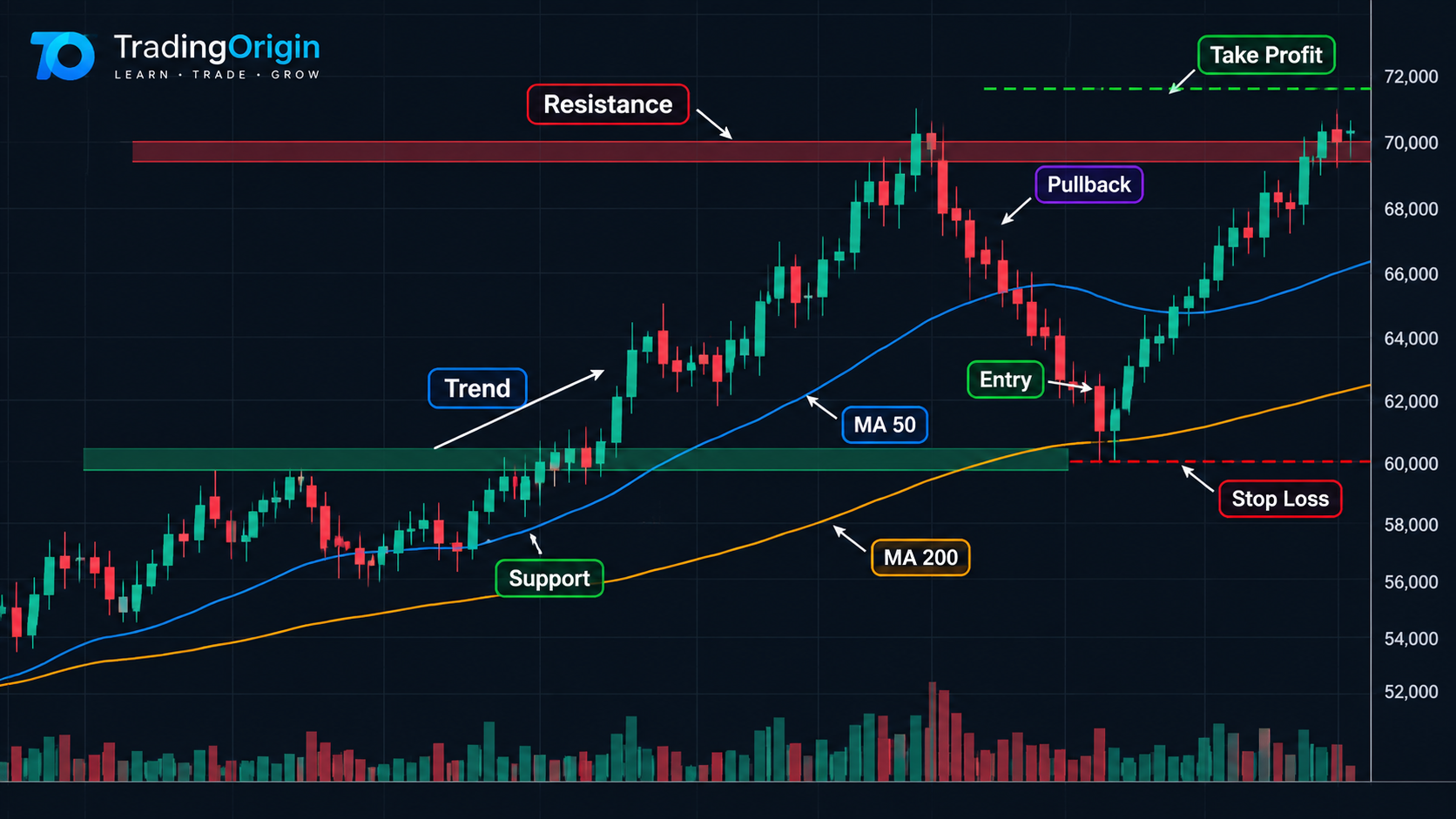
What Is a Crypto Trading Strategy?
A crypto trading strategy is a structured plan that helps a trader decide when to enter a cryptocurrency trade, where to exit, and how much risk to take. Instead of making decisions based only on emotions or short-term price movements, traders use a strategy to create a consistent process for analyzing the market.
Cryptocurrency markets can move quickly and experience significant volatility. A clear trading strategy can help traders organize their decisions and avoid entering trades without a defined plan.
A strategy does not guarantee profits. Its purpose is to provide a repeatable framework for making trading decisions while managing risk.
Why Do Traders Need a Crypto Trading Strategy?
Without a defined plan, it is easy to make impulsive decisions when the market moves quickly. Fear, greed, and the desire to chase a sudden price movement can influence trading decisions.
A crypto trading strategy gives traders a set of rules to follow before, during, and after a trade. These rules can help answer important questions such as:
- Why am I entering this trade?
- Where is my entry point?
- Where will I take profit?
- Where will I exit if the trade moves against me?
- How much of my trading capital am I willing to risk?
- What market conditions must be present before I enter?
Having these answers before entering a trade can make the trading process more structured and easier to evaluate.
Key Components of a Crypto Trading Strategy
A complete trading strategy usually combines several important elements. The exact rules can differ from one trader to another, but most strategies include market analysis, entry conditions, exit rules, and risk management.
1. Market Analysis
Before entering a trade, traders often analyze the cryptocurrency market to understand price direction and important levels.
Technical analysis can include price trends, support and resistance, chart patterns, indicators, volume, and other market information. Traders may also consider broader factors such as market sentiment and major cryptocurrency news.
For a general introduction to technical analysis, read What Is Technical Analysis?.
2. Entry Rules
Entry rules define the conditions that must be present before opening a position.
For example, a trader might look for a price breakout, a bounce from support, a trend continuation, or confirmation from trading volume before entering a position.
The important point is that the entry should be based on predefined conditions rather than a sudden emotional decision.
3. Exit Rules
A trading strategy should define how and when a trader plans to close a position.
Some traders use predetermined profit targets, while others use technical levels or trailing exits. A strategy should also define what happens when the original trade idea becomes invalid.
Planning the exit before entering the trade can help reduce emotional decision-making.
4. Risk Management
Risk management is one of the most important parts of a crypto trading strategy. Even a well-researched trade can move in the opposite direction.
Traders can manage risk by controlling position size, using stop-loss levels, avoiding excessive leverage, and limiting the amount of capital exposed to a single trade.
A strategy that focuses only on finding profitable entries without considering risk is incomplete.
Popular Types of Crypto Trading Strategies
There is no single strategy that works for every cryptocurrency trader. Different approaches are designed for different time horizons, market conditions, and trading styles.
Day Trading
Day trading involves opening and closing positions within a relatively short period, often during the same trading day. Day traders typically focus on short-term price movements and may use technical indicators, support and resistance, volume, and price action.
This approach requires active monitoring and disciplined risk management.
Swing Trading
Swing trading focuses on capturing larger price movements that may develop over several days or weeks.
Swing traders may combine trend analysis, support and resistance, chart patterns, and technical indicators to identify potential opportunities.
Trend Following
Trend-following strategies attempt to participate in an established market direction. Traders may look for higher highs and higher lows in an uptrend or lower highs and lower lows in a downtrend.
The goal is generally to follow the market rather than predict every short-term movement.
Breakout Trading
Breakout trading focuses on situations where price moves beyond an important support or resistance area.
Because some breakouts can fail, traders may look for additional confirmation before entering a position. Volume, candle closes, and retests of important levels can be part of a breakout strategy.
How to Build a Crypto Trading Strategy
Building a crypto trading strategy does not require dozens of indicators. A simple set of clearly defined rules can be easier to follow and evaluate.
Step 1: Choose Your Trading Timeframe
First, decide whether your strategy is designed for short-term, medium-term, or longer-term trading.
Your timeframe affects how frequently you trade, how long positions remain open, and how much market noise you may encounter.
Step 2: Define the Market Conditions
Decide which market conditions your strategy is designed to trade.
For example, you may focus on trending markets, breakouts, range-bound markets, or pullbacks. Clearly defining these conditions can prevent you from forcing trades when the market does not match your strategy.
Step 3: Define Your Entry Conditions
Write down the specific conditions that must be met before entering a trade.
A strong trading plan should make it clear what qualifies as a valid setup and what conditions invalidate the setup.
Step 4: Define Your Exit and Stop-Loss Rules
Decide where you will take profit and where you will exit if the trade moves against you.
A stop-loss can help limit losses when a trade does not develop as expected. The level should be based on the trading setup and risk plan rather than an arbitrary price.
Step 5: Determine Position Size
Position sizing determines how much capital is allocated to a trade.
Rather than increasing position size because of confidence in a particular setup, traders can use consistent risk rules to keep individual losses manageable.
Step 6: Test and Review the Strategy
Before relying heavily on a new strategy, traders can study historical market data, backtest their rules where appropriate, and use a trading journal to record results.
The goal is to understand how the strategy behaves across different market conditions and identify weaknesses that need improvement.
Crypto Trading Strategy vs. Trading Signals
A trading strategy and a trading signal are related, but they are not the same thing.
A strategy is the overall framework that defines how trading decisions are made. A signal is a specific trading opportunity or setup that may provide information about a potential entry, exit, or market direction.
Traders who use signals should still understand the reasoning behind the setup and apply appropriate risk management instead of blindly following every signal.
To learn more about evaluating crypto setups, see Bitcoin Trading Signals: How to Confirm BTC Trade Setups.
Common Mistakes When Using a Crypto Trading Strategy
Even a well-designed strategy can be used poorly. Some common mistakes include:
- Changing the rules after a losing trade.
- Entering trades because of fear of missing out.
- Using excessive leverage.
- Risking too much capital on one position.
- Ignoring the overall market trend.
- Taking trades that do not meet the strategy's conditions.
- Using too many indicators without a clear purpose.
- Failing to review previous trades.
Consistency is important. A strategy can only be properly evaluated if its rules are applied consistently over a meaningful number of trades.
How Technical Analysis Can Support a Crypto Trading Strategy
Technical analysis can provide the tools needed to build and evaluate a trading strategy.
Traders may study support and resistance, trends, price action, volume, chart patterns, and indicators to identify potential setups.
Support and resistance are particularly useful because they can help traders identify areas where price has previously reacted.
For a deeper explanation, read What Are Support and Resistance? A Beginner’s Guide.
Should Beginners Use a Crypto Trading Strategy?
Beginners can benefit from having a simple trading plan before risking real money. A strategy can help new traders focus on process rather than trying to predict every market movement.
It is usually better to understand a small number of concepts well than to combine many indicators without understanding how they work.
Beginners can start by learning basic market structure, support and resistance, risk management, and position sizing. They can then develop and test a simple set of rules.
Final Thoughts
A crypto trading strategy is a structured approach for making cryptocurrency trading decisions. It can define market conditions, entry rules, exit rules, position size, and risk management.
The best strategy is not necessarily the most complicated one. A clear and repeatable process can make it easier to evaluate trades, manage risk, and improve over time.
Trading cryptocurrencies involves substantial risk, and no strategy can guarantee profits. Traders should understand the risks involved and avoid risking more capital than they can afford to lose.
For more educational content about cryptocurrency, trading strategies, technical analysis, and trading signals, explore the TradingOrigin Articles section.
Keep Learning: More Crypto Articles
- How to Manage Risk in Crypto Trading
- How to Use Entry Price, Stop Loss, and Take Profit in Crypto Trading Signals
- How to Identify Fake Crypto Trading Signals
Want structured, step-by-step lessons? Explore the TradingOrigin Academy.
📢 Get our signals on Telegram
Follow our Telegram channel for crypto and forex signals, shared as they happen: 📲 Join TradingOrigin on Telegram
Want full access? View our crypto and forex signal plans.