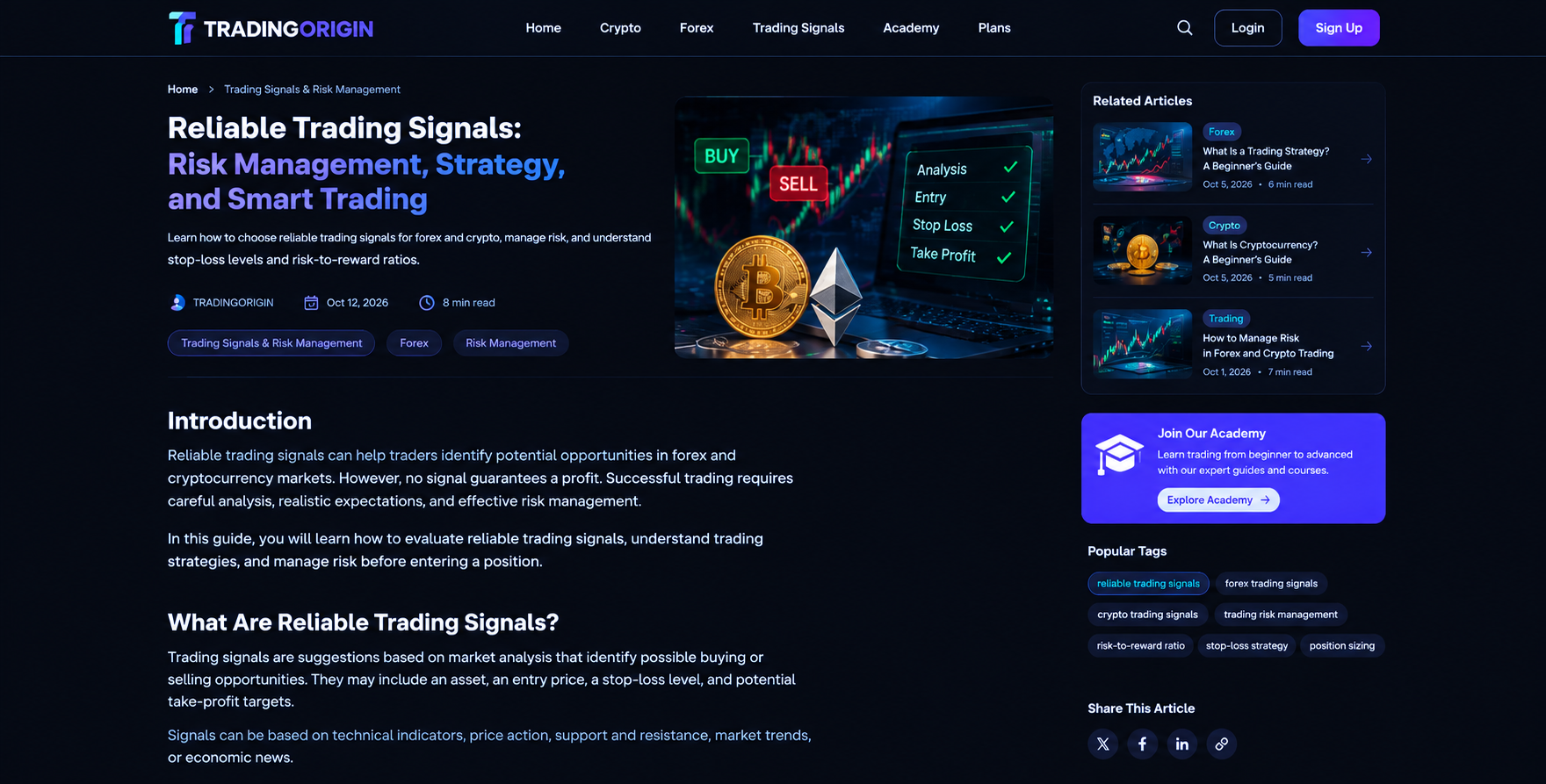
Trading in the cryptocurrency and forex markets offers opportunities, but it also involves significant risks. Prices can change quickly, market conditions can shift without warning, and even well-planned trades can result in losses.
For traders who want to make more informed decisions, trading signals can be a useful source of market analysis. However, not every signal provider is trustworthy, and no signal can guarantee a profitable outcome.
In this guide, we explain how to evaluate trading signals, understand the importance of risk management, and develop a more disciplined trading approach.
What Are Trading Signals?
Trading signals are market suggestions that help traders identify potential trading opportunities. A signal may include an asset, a possible entry price, a stop-loss level, and one or more take-profit targets.
Signals can be based on technical analysis, price action, market trends, economic news, or a combination of different methods.
For example, a forex signal might identify a potential EUR/USD trade based on a technical setup. A cryptocurrency signal might highlight a possible Bitcoin trading opportunity after a price breakout.
Signals should be treated as analytical information rather than instructions that must always be followed.
How to Identify Reliable Trading Signals
Choosing a signal provider requires more than looking at profit screenshots or advertised success rates. Consider the following factors before relying on any trading service.
1. Transparent Trading Analysis
A credible signal should explain the reasoning behind a potential trade. Relevant information may include market structure, technical indicators, support and resistance, and current market conditions.
Clear analysis helps traders understand why a setup is being considered instead of blindly copying a trade.
2. Clearly Defined Entry and Exit Levels
A well-structured signal should explain its proposed entry conditions and, where appropriate, its stop-loss and take-profit levels.
These details allow traders to assess the potential risk before entering a position. If essential information is missing, it may be difficult to evaluate whether the trade fits their strategy.
3. Honest Performance Reporting
Be cautious of providers that advertise guaranteed profits, claim to win every trade, or display results without explaining their methodology.
A useful performance record should account for losing trades, trading costs, drawdowns, and the period over which results were measured. Historical performance does not guarantee future results.
4. Realistic Expectations
Financial markets are uncertain. Even a carefully researched signal can fail because of unexpected news, changing liquidity, or sudden volatility.
Reliable trading education should acknowledge uncertainty rather than promise that every trade will be profitable.
Why Risk Management Matters in Trading
Risk management is a fundamental part of a trading plan. It helps traders control potential losses and avoid making decisions based solely on emotions.
Use Stop-Loss Orders Carefully
A stop-loss order is designed to limit losses by closing a position when a specified price condition is reached. However, execution can differ from the requested price during periods of high volatility or market gaps.
Traders should understand how their broker or exchange handles stop orders before relying on them.
Calculate Position Size Before Entering a Trade
Position sizing determines how much exposure a trader takes on in a particular trade.
For example, consider an account with a balance of $1,000 and a hypothetical risk limit of 1% per trade. The planned risk would be $10.
This does not mean the trader will necessarily lose exactly $10. Position size must account for the entry price, stop-loss distance, contract specifications, fees, and possible slippage.
The purpose is to make risk a deliberate decision rather than an afterthought.
Understand Risk-to-Reward Ratio
The risk-to-reward ratio compares the potential loss of a trade with its potential profit.
Suppose a trading setup has a planned risk of $20 and a potential profit target of $40. Its planned risk-to-reward ratio is 1:2.
This ratio alone does not make a strategy profitable. The probability of winning, transaction costs, execution quality, and consistency also matter.
Avoid Excessive Leverage
Leverage allows traders to control a larger position with less initial capital, but it can also magnify losses.
Before using leverage, traders should understand margin requirements, liquidation rules, and the possibility of losing capital rapidly. Beginners may benefit from learning with a demo account before risking real money.
Forex Signals vs. Cryptocurrency Signals
Forex and cryptocurrency markets have different characteristics, so traders should consider the market involved when evaluating a signal.
Forex markets can be influenced by interest-rate decisions, economic releases, central-bank policy, and geopolitical developments.
Cryptocurrency markets can experience sharp price movements related to liquidity, market sentiment, regulatory developments, and industry-specific events. Some crypto markets also operate around the clock.
A trading approach that works in one market may not perform the same way in another. Traders should evaluate signals in the context of the relevant asset and market conditions.
Common Mistakes to Avoid When Following Trading Signals
Several mistakes can undermine an otherwise reasonable trading plan:
Entering a trade without understanding its risk.
Increasing position size to recover previous losses.
Following social media claims without checking the evidence.
Ignoring stop-loss levels or changing them impulsively.
Using excessive leverage.
Assuming past results guarantee future performance.
Taking every signal without considering personal risk tolerance.
A disciplined approach involves evaluating each setup, following predefined rules, and reviewing decisions over time.
How TRADINGORIGIN Approaches Trading Analysis
TRADINGORIGIN aims to help traders explore cryptocurrency and forex markets through trading-related resources and plan-based services.
When evaluating any trading signal or market analysis, users should review the information provided, understand the proposed risk, and determine whether the approach fits their own trading objectives.
Before using a signal service, check the available methodology, risk guidance, performance information, and applicable plan terms. Do not assume that a signal is profitable simply because it is presented professionally.
The objective should be to make more informed trading decisions, not to eliminate market risk.
Build a More Disciplined Trading Routine
A structured trading routine can help traders avoid impulsive decisions.
Before entering a trade, consider these questions:
What is the reason for the trade?
What conditions would invalidate the trading idea?
Where is the planned stop-loss level?
How much capital is at risk?
Is the potential reward reasonable compared with the risk?
Does the trade fit the overall strategy?
Keeping a trading journal can also help identify recurring mistakes and evaluate performance over time.
Final Thoughts
Reliable trading signals are not defined by promises of guaranteed profits. They should be evaluated through transparent analysis, clearly explained trade parameters, realistic performance information, and appropriate risk management.
Whether trading forex or cryptocurrency, a disciplined strategy and an understanding of potential losses are essential.
Explore the educational resources and trading services available through TRADINGORIGIN, review the information carefully, and make decisions based on your own research and risk tolerance.
Risk Disclaimer: Trading forex and cryptocurrencies involves substantial risk and may not be suitable for every investor. You can lose some or all of your invested capital. Trading signals are not guarantees of future performance and should not be considered personalized financial advice.
What to Read Next
Understanding trading signals is only the first step toward becoming a disciplined trader. Learn how to calculate your potential risk before entering a position in our next guide: How to Calculate Position Size in Forex and Crypto Trading.
This practical guide will explain position sizing, stop-loss distance, and how to calculate the amount you could risk on a trade.
Keep Learning: More Forex Articles
- How Economic News Affects Forex Signals: Interest Rates, CPI and NFP
- How to Use ATR for Forex Signals, Stop Loss and Volatility Analysis
- Best Candlestick Patterns for Forex Signals: Engulfing, Pin Bar and Reversal Setups
Want structured, step-by-step lessons? Explore the TradingOrigin Academy.
📢 Get our signals on Telegram
Follow our Telegram channel for crypto and forex signals, shared as they happen: 📲 Join TradingOrigin on Telegram
Want full access? View our crypto and forex signal plans.