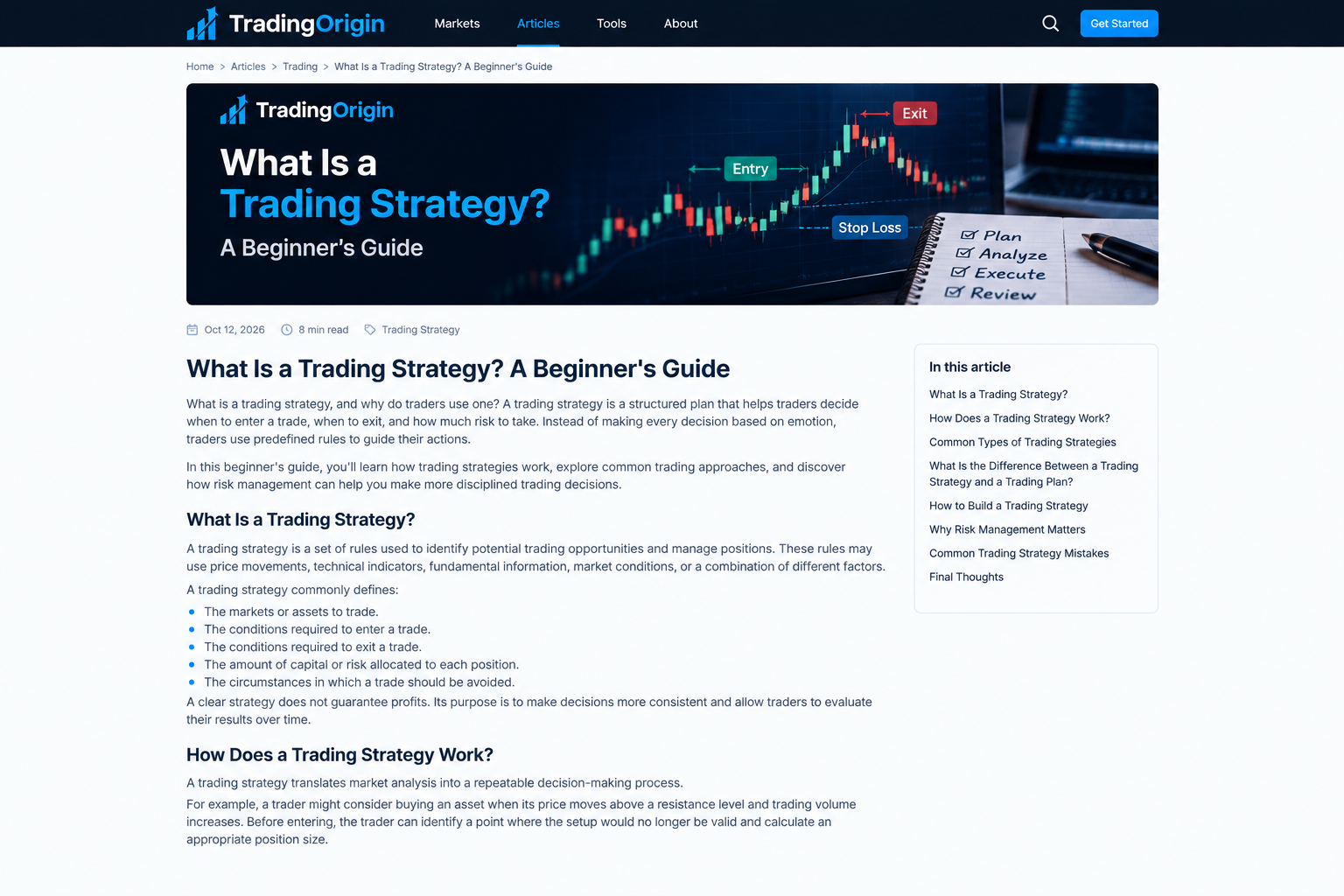
What is a trading strategy, and why do traders use one? A trading strategy is a structured plan that helps traders decide when to enter a trade, when to exit, and how much risk to take. Instead of making every decision based on emotion, traders use predefined rules to guide their actions.
In this beginner's guide, you'll learn how trading strategies work, explore common trading approaches, and discover how risk management can help you make more disciplined trading decisions.
What Is a Trading Strategy?
A trading strategy is a set of rules used to identify potential trading opportunities and manage positions. These rules may use price movements, technical indicators, fundamental information, market conditions, or a combination of different factors.
A trading strategy commonly defines:
The markets or assets to trade.
The conditions required to enter a trade.
The conditions required to exit a trade.
The amount of capital or risk allocated to each position.
The circumstances in which a trade should be avoided.
A clear strategy does not guarantee profits. Its purpose is to make decisions more consistent and allow traders to evaluate their results over time.
How Does a Trading Strategy Work?
A trading strategy translates market analysis into a repeatable decision-making process.
For example, a trader might consider buying an asset when its price moves above a resistance level and trading volume increases. Before entering, the trader can identify a point where the setup would no longer be valid and calculate an appropriate position size.
A basic trading process includes five steps:
Analyze the market and identify a potential setup.
Check whether the setup meets the strategy's rules.
Define the entry price, exit conditions, and potential risk.
Place and manage the trade according to the plan.
Record the outcome and review the decision.
Following a process helps traders distinguish between a strategy's performance and decisions made impulsively during a trade.
Common Types of Trading Strategies
1. Trend Trading
Trend traders attempt to identify markets moving consistently upward or downward. They may use price structure, moving averages, or other tools to assess the direction of a trend.
Trends can reverse unexpectedly, so traders need rules for managing risk when market conditions change.
2. Swing Trading
Swing traders aim to capture price movements that develop over several days or weeks. They may use support and resistance, chart patterns, and technical indicators to identify potential entries and exits.
Swing trading requires patience and an understanding of the risks associated with holding positions overnight or over weekends.
3. Day Trading
Day traders generally open and close positions within the same trading day. They may focus on short-term price movements and use technical analysis, market structure, or volume information.
Frequent trading can increase transaction costs and emotional pressure. Day trading is not suitable for everyone and can result in substantial losses.
4. Breakout Trading
Breakout traders look for price movements beyond an established support or resistance area. A breakout may indicate a change in market conditions, but some breakouts fail and the price returns to its previous range.
Traders may use confirmation rules and predefined exit conditions to manage this uncertainty.
5. Range Trading
Range traders look for assets moving between recognizable support and resistance levels. They may seek opportunities near the boundaries of a range, provided the market continues to respect those levels.
A strong breakout can invalidate a range-based setup, so risk controls remain important.
What Is the Difference Between a Trading Strategy and a Trading Plan?
A trading strategy describes the rules used to identify and manage trading opportunities. A trading plan is broader and may include the strategy, financial goals, risk limits, trading schedule, preferred markets, and review process.
For example, a strategy might define when to enter a breakout trade. The broader plan might specify which assets can be traded, how much risk is permitted, and when trading must stop after a series of losses.
Both can help traders approach decisions systematically.
How to Build a Trading Strategy
Building a trading strategy takes research, planning, and practice. Beginners should focus on clear rules and realistic expectations rather than searching for a system that promises guaranteed profits.
Step 1: Choose a Market
Decide which market you want to study, such as cryptocurrencies, stocks, or forex. Different markets have different trading hours, liquidity, fees, and risk characteristics.
Start by understanding how your chosen market operates.
Step 2: Define Your Trading Timeframe
Choose whether your approach focuses on short-term price movements or longer-term trends. Your timeframe affects how often you need to monitor the market and how much price fluctuation you may experience while holding a position.
Step 3: Establish Entry Rules
Define the conditions that must be present before entering a trade. These might include a price pattern, a trend condition, a support or resistance level, or a combination of signals.
Clear rules make it easier to test whether the strategy behaves as expected.
Step 4: Plan Your Exits
Decide in advance what would invalidate the trade and where you might take profits. Some traders use stop-loss orders to define an exit trigger when the market moves against their position.
A stop-loss order cannot guarantee execution at the exact trigger price, especially during volatile conditions or gaps in market prices.
Step 5: Set Risk Limits
Determine how much you can afford to risk and how position size relates to the distance between entry and stop-loss levels.
Avoid assuming that a strategy will always work. Even a well-tested approach can experience losing trades and periods of poor performance.
Step 6: Test Before Using Real Money
Backtesting applies a strategy's rules to historical market data. It can help identify weaknesses, but historical performance does not guarantee future results.
Where possible, include realistic fees, slippage, and execution assumptions. Consider testing the strategy in a demo environment before risking actual capital.
Step 7: Record and Review Results
Maintain a trading journal that records the setup, entry, exit, planned risk, outcome, and any deviation from your rules.
Review a meaningful sample of trades rather than judging a strategy from a single win or loss.
Why Risk Management Matters
Risk management is an essential part of any trading strategy. Without it, a series of losing trades can cause substantial damage to a trading account.
Common risk management practices include:
Calculating position size before entering a trade.
Defining exit conditions in advance.
Avoiding excessive leverage.
Diversifying exposure where appropriate.
Keeping records of trading costs.
Setting limits that help prevent impulsive decisions.
Risk controls cannot remove market risk, but they can help traders understand and manage the amount they expose to each position.
Common Trading Strategy Mistakes
Changing rules after every loss: A small number of losses does not necessarily mean a strategy is ineffective. Review sufficient evidence before making changes.
Ignoring transaction costs: Fees, spreads, and slippage can reduce results, particularly for frequent traders.
Overcomplicating the strategy: Adding many indicators can make decisions harder without improving performance.
Using excessive leverage: Leverage magnifies exposure and can increase losses quickly.
Failing to keep records: Without a trading journal, it is difficult to identify recurring mistakes or evaluate performance objectively.
Expecting guaranteed profits: No trading strategy works in every market condition, and no strategy guarantees a positive return.
Final Thoughts
A trading strategy provides a structured way to analyze markets, identify potential opportunities, and manage trades. For beginners, a simple and clearly defined approach can be easier to test and review than a complicated system with many rules.
Focus on learning the market, defining entry and exit conditions, managing risk, and evaluating results over time. Consistency and careful review are more useful than expecting every trade to succeed.
Disclaimer: This article is for educational purposes only and does not constitute financial or investment advice. Trading involves risk, including the possible loss of capital. Research carefully and consider your financial circumstances before making trading decisions.
Keep Learning: More Crypto Articles
- How to Manage Risk in Crypto Trading
- What Is a Crypto Trading Strategy? A Beginner’s Guide
- How to Use Entry Price, Stop Loss, and Take Profit in Crypto Trading Signals
Want structured, step-by-step lessons? Explore the TradingOrigin Academy.
📢 Get our signals on Telegram
Follow our Telegram channel for crypto and forex signals, shared as they happen: 📲 Join TradingOrigin on Telegram
Want full access? View our crypto and forex signal plans.