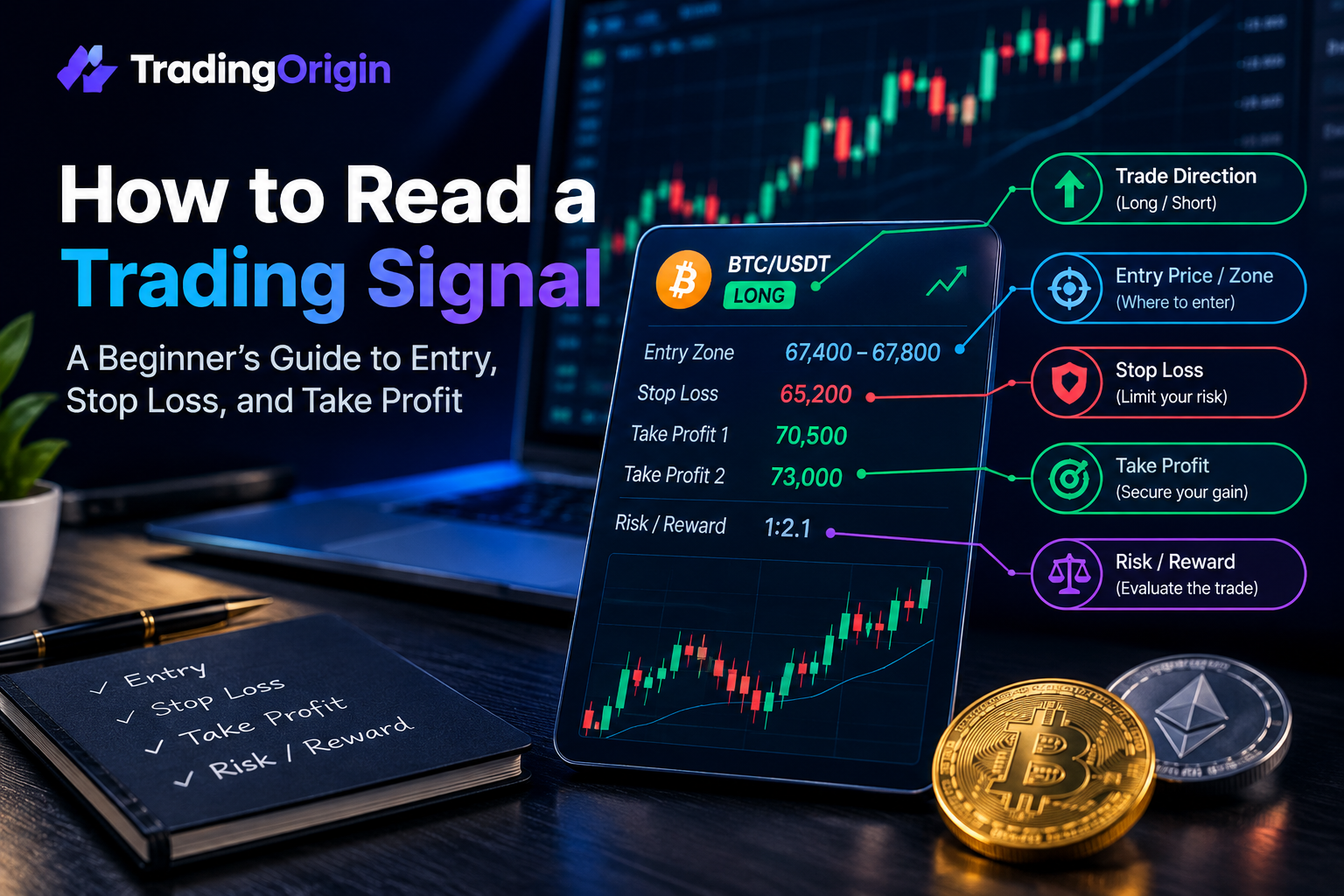
How to Read a Trading Signal
A trading signal is more than a simple buy or sell message. A well-structured signal contains information that helps a trader understand the market setup, planned entry, potential exit levels, and the risk involved in the trade.
Learning how to read a trading signal can help beginners understand what a signal actually means before deciding whether it fits their own trading plan.
Trading signals are commonly used in both cryptocurrency and forex markets. Although the assets are different, many signals use the same basic structure.
What Information Is Usually Included in a Trading Signal?
A typical trading signal may contain several important elements:
Understanding each part makes it easier to evaluate the trade instead of treating the signal as a simple instruction to buy or sell.
1. Trading Pair or Asset
The first part of a signal usually identifies the market being traded.
For example, a crypto signal might mention BTC/USDT, while a forex signal could use EUR/USD.
The trading pair tells you which two assets or currencies are involved and allows you to locate the corresponding market on your trading platform.
2. Trade Direction: Long or Short
The direction tells you whether the signal expects the market to move higher or lower.
Long generally means the trade is based on an expectation that price will rise.
Short generally means the trade is based on an expectation that price will fall.
Understanding this distinction is essential because the entry, stop loss, and take profit levels are interpreted differently depending on the trade direction.
3. Entry Price or Entry Zone
The entry is the price level or price area where the trading idea becomes active.
Some signals provide one specific entry price, while others provide an entry zone. An entry zone gives the trader a range instead of requiring an exact price.
For example:
or:
An entry zone can be useful when markets are moving quickly and an exact entry price is difficult to obtain.
4. Stop Loss
The stop loss identifies the price level where the trade idea is considered invalid or where the trader intends to limit the potential loss.
For example, a long signal could look like this:
If price moves against the position and reaches the stop loss level, the trade may be closed according to the order and execution conditions of the trading platform.
A stop loss is an important part of risk management. To learn more about this concept, see https://tradingorigin.com/articles/what-is-a-stop-loss">What Is a Stop Loss?.
5. Take Profit
Take profit identifies one or more potential price levels where the trader plans to close the position and secure a potential gain.
A signal may contain several targets:
Multiple targets can allow a trader to manage a position progressively rather than relying on one single exit level.
6. Risk-to-Reward Ratio
The risk-to-reward ratio compares the potential amount being risked with the potential reward of a trade.
For example, if a trader risks $100 and the planned target represents a potential $200 gain, the trade has a 1:2 risk-to-reward ratio.
This does not mean the trade will succeed. It simply describes the relationship between the planned risk and potential reward.
Risk-to-reward information can help traders evaluate whether a potential setup fits their overall trading strategy.
How to Read a Crypto Trading Signal
Crypto trading signals can contain the same basic elements as other signals, but cryptocurrency markets can experience significant volatility.
Consider a simplified example:
Reading this signal means understanding that the trading idea expects upward movement from the entry area, while the stop loss defines the planned downside and the take profit defines the potential exit.
The numbers themselves do not guarantee that the market will follow the expected path.
How to Read a Forex Trading Signal
Forex signals follow a similar structure.
For example:
The trader can identify the currency pair, direction, planned entry area, maximum planned loss level, and potential profit target from the signal.
Forex traders should also consider factors such as market sessions and major economic events before entering a position.
How to Read a Buy Signal
A buy signal generally indicates that the trading setup is based on an expectation of upward price movement.
The trader should identify the entry, understand where the stop loss is located, and review the potential take profit before considering the trade.
A buy signal should not be interpreted as a guarantee that price will rise.
How to Read a Sell Signal
A sell signal generally indicates that the setup is based on an expectation of downward price movement.
The same basic information should be reviewed: entry, stop loss, take profit, and potential risk-to-reward.
The important point is to understand the complete setup rather than focusing only on the word “Sell.”
What Should You Check Before Following a Signal?
Before entering a trade based on a signal, take a moment to review the complete setup.
A signal can provide a trading idea, but the final decision should still be based on your own risk tolerance and trading rules.
Common Mistakes When Reading Trading Signals
Beginners often focus only on the entry price and ignore the rest of the signal.
Another common mistake is entering after price has already moved far beyond the original entry zone. A delayed entry can change the potential risk and reward of the setup.
Some traders also ignore the stop loss because they are focused on the potential profit. This can create unnecessary risk.
Finally, traders should be careful with signals that promise guaranteed returns or claim that losses are impossible. No legitimate trading signal can eliminate market risk.
How to Use a Trading Signal Correctly
Understanding a signal is the first step. The next step is knowing how to manage it within a trading plan.
For a more detailed explanation of entries, exits, and risk management, read How to Use Trading Signals: Entry, Exit, and Risk Management.
The goal should not be to follow every signal automatically. Instead, traders should understand the setup, evaluate the risk, and decide whether the opportunity fits their own strategy.
Final Thoughts
Learning how to read a trading signal means understanding every part of the setup, not just whether the signal says buy or sell.
Entry, trade direction, stop loss, take profit, and risk-to-reward each provide important information about the proposed trade.
This approach can help traders make more informed decisions when reviewing crypto trading signals and forex trading signals.
Trading signals can be useful tools, but they cannot guarantee profits. Every trade involves risk, and responsible risk management should always come before the expectation of a return.
Trading involves risk. Always consider your own risk tolerance and trading plan before entering a position.
Keep Learning: More Crypto Articles
- How to Use Funding Rates and Open Interest to Confirm Crypto Signals
- Crypto Trading Signal Timeframes: 15-Minute, 1-Hour, and 4-Hour Charts
- How to Confirm Crypto Trading Signals with Volume
Want structured, step-by-step lessons? Explore the TradingOrigin Academy.
📢 Get our signals on Telegram
Follow our Telegram channel for crypto and forex signals, shared as they happen: 📲 Join TradingOrigin on Telegram
Want full access? View our crypto and forex signal plans.