Introduction
Finding a trading opportunity is easy. Identifying a setup that offers a clear entry, a logical stop-loss level, and a reasonable potential reward is much harder.
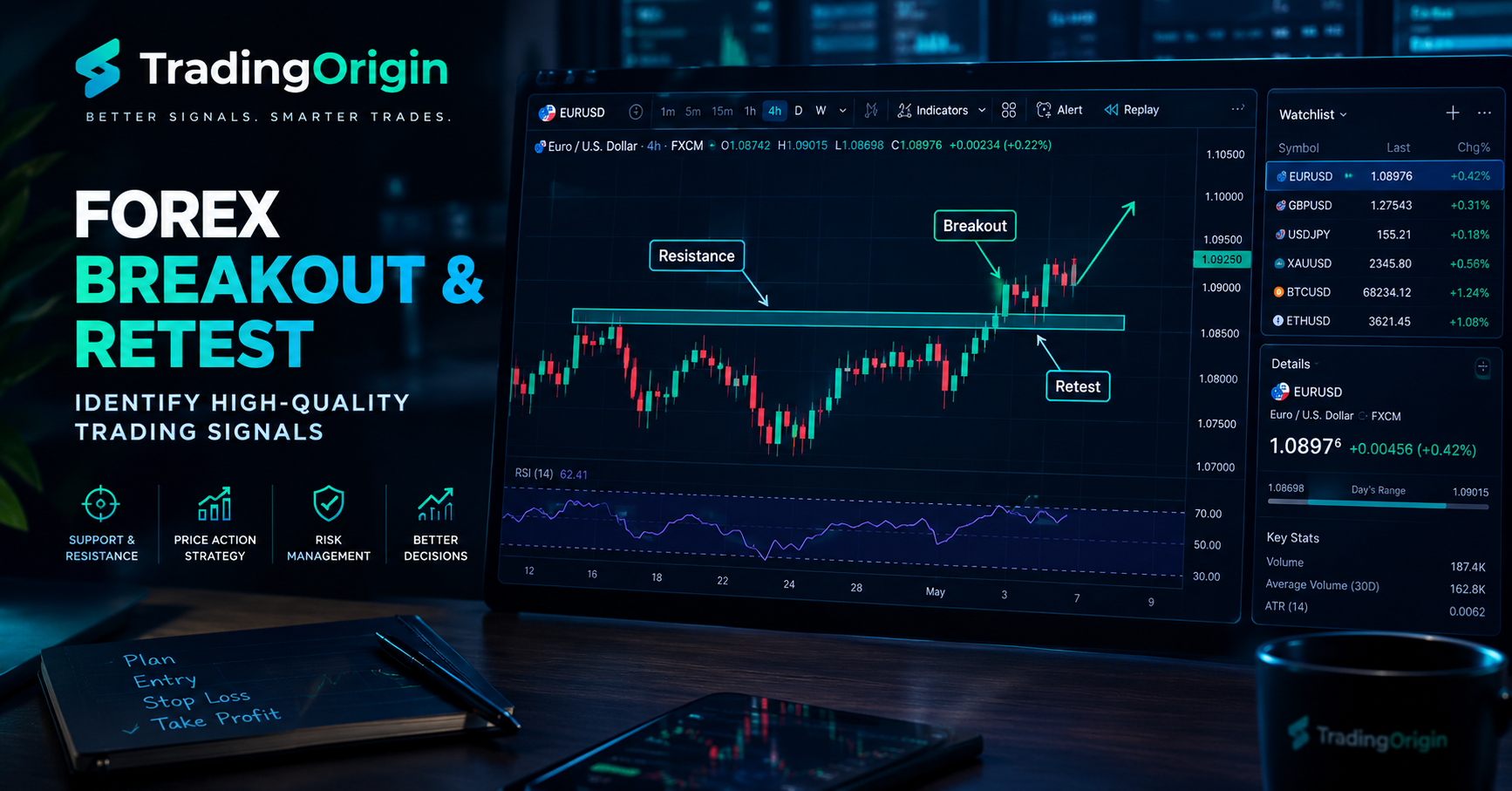
The forex breakout and retest strategy is a popular price-action approach that helps traders analyze when a currency pair moves beyond an important support or resistance level and whether the market confirms that move.
Instead of entering immediately when price breaks a level, traders wait for a possible retest and look for evidence that the broken level may hold. This approach can help structure trading decisions, reduce impulsive entries, and make risk management more systematic.
In this guide, you will learn how the breakout and retest strategy works, how to identify potential forex trading signals, which confirmation tools to consider, and how to plan a trade before risking capital.
What Is a Forex Breakout and Retest?
A breakout occurs when price moves beyond a significant support or resistance zone.
Resistance breakout: Price moves above an area where selling pressure previously appeared.
Support breakdown: Price moves below an area where buying interest previously appeared.
Retest: After the breakout, price returns toward the broken level and tests whether it may now act as support or resistance.
For example, if EUR/USD repeatedly struggles to move above 1.0850 and later closes above that zone, traders may watch for a retest of the former resistance area. If buyers defend the area and price shows renewed upward momentum, a potential bullish setup may develop.
However, not every breakout continues. Price can reverse immediately, move sideways, or return inside the previous range. That is why confirmation and risk management matter.
Why Traders Use the Breakout and Retest Strategy
The strategy offers a structured way to evaluate potential trading opportunities.
1. Clear market structure
Support and resistance zones give traders reference points for analyzing price movements instead of relying entirely on predictions.
2. More deliberate entry decisions
Waiting for a retest can prevent some traders from chasing a rapidly moving candle. It does not eliminate false signals, but it creates an opportunity to evaluate the setup before entering.
3. Defined invalidation levels
A trader can identify the price area that would weaken the trade idea and use it to plan a stop loss.
4. A framework for evaluating risk and reward
Before entering, traders can compare the distance to the planned stop loss with the distance to a potential profit target.
The strategy is not guaranteed to outperform other approaches. Its usefulness depends on market conditions, execution, costs, and consistent risk management.
Step 1: Identify Important Support and Resistance
The first step in finding a potential breakout trading signal is identifying meaningful price zones.
Look for areas where price has repeatedly reversed, consolidated, or encountered strong buying or selling pressure.
Useful chart observations include:
Multiple reactions around a similar price zone.
A clearly defined trading range.
A previous swing high or swing low.
A consolidation area before a strong price movement.
Treat support and resistance as zones rather than perfectly precise lines. Markets can move slightly beyond a level before reversing, and different traders may identify somewhat different zones.
Higher-timeframe charts, such as the four-hour or daily chart, can help establish broader market structure. A lower-timeframe chart can then help examine potential entries.
Step 2: Wait for a Confirmed Breakout
A price movement beyond resistance or below support does not automatically create a reliable trading signal.
Look for evidence that price has genuinely moved beyond the relevant zone.
Possible confirmation factors include:
A candle close beyond the zone rather than a brief wick.
Strong directional movement compared with recent price action.
Increasing participation or volume data, where reliable volume information is available.
Market structure that supports the direction of the breakout.
No single confirmation factor guarantees continuation. In spot forex, centralized exchange volume is generally unavailable, so tick volume from a broker should not be treated as a complete measure of market-wide trading volume.
Avoid entering solely because price briefly crosses a line. A false breakout can occur when price moves beyond a level and then returns to the previous range.
Step 3: Wait for the Retest
After a breakout, allow price an opportunity to return toward the broken zone.
For a bullish setup, former resistance may become support. For a bearish setup, former support may become resistance.
During the retest, observe whether price:
Holds near the broken zone.
Shows rejection in the direction opposite to the intended trade.
Forms a relevant candle pattern.
Resumes movement in the breakout direction.
A retest is not mandatory in every successful breakout, and a retest can fail. If price never returns to the zone, avoid forcing an entry simply because you do not want to miss the move.
Patience is part of the strategy.
Step 4: Look for Entry Confirmation
A high-quality trading setup should have a clear explanation for why an entry may be reasonable.
For a potential bullish breakout and retest, confirmation might include a bullish rejection candle, a higher low, or a strong close back in the direction of the breakout.
For a potential bearish setup, a bearish rejection candle, a lower high, or renewed downward momentum may support the trade idea.
Some traders also use moving averages, RSI, or MACD as secondary confirmation tools. These indicators should complement price action rather than replace it.
Using too many indicators can create conflicting signals and make decisions unnecessarily complicated.
Step 5: Plan Your Entry, Stop Loss, and Take Profit
Before entering a trade, define the conditions under which the setup is valid and the conditions under which it fails.
Entry
Consider entering only after the chosen confirmation rules are satisfied. The exact entry depends on the instrument, timeframe, spread, volatility, and trading plan.
Stop loss
A stop loss may be placed beyond the retest structure or another logical invalidation point. It should account for market volatility and the possibility of price fluctuations around the level.
A stop loss does not guarantee the exact exit price during gaps or fast-moving markets.
Take profit
Potential targets may include the next significant support or resistance zone, a measured price objective, or a predefined risk-to-reward plan.
Do not select a target only because it creates an attractive ratio. The target should also make sense in the context of market structure.
Practical Example: A EUR/USD Breakout
Imagine EUR/USD repeatedly encounters resistance near 1.0850.
Price later closes above the resistance zone, pulls back toward it, and forms a bullish rejection candle. A trader may interpret this sequence as a potential bullish breakout and retest.
Suppose the planned trade has the following illustrative parameters:
Potential entry: 1.0860
Planned stop loss: 1.0830
Potential take profit: 1.0920
The distance from entry to stop loss is 30 pips, while the distance to the target is 60 pips. This gives a planned risk-to-reward ratio of 1:2 before trading costs.
This is an educational example, not a live trading signal or a prediction about EUR/USD. Pip values, position sizes, spreads, commissions, and execution prices vary. A trader should calculate the potential monetary loss using the actual instrument specifications and account currency.
Even a technically valid setup can lose. A favorable planned risk-to-reward ratio does not guarantee profitability.
How to Avoid False Breakout Signals
False breakouts are one of the main challenges of this strategy.
Consider these practices when evaluating a potential setup:
Wait for a candle close. A brief move beyond support or resistance may not represent a sustained breakout.
Check the broader market structure. A breakout into a major opposing zone may have limited room to continue.
Avoid chasing extended candles. Entering after a large move can create an unfavorable stop-loss distance.
Be careful around major economic announcements. Forex volatility and spreads can change sharply during important releases.
Define your invalidation level. If the market returns decisively inside the previous range, reassess whether the original setup remains valid.
Test your rules. Backtesting and demo trading can help reveal how the approach behaves across different pairs and market conditions.
These practices may improve consistency, but no checklist can eliminate false signals.
Best Timeframes and Currency Pairs
There is no single best timeframe or currency pair for every trader.
The daily and four-hour charts can help identify broader support and resistance zones. The one-hour and fifteen-minute charts can provide more detailed views of price action, but shorter timeframes can also contain more market noise and transaction costs relative to the expected move.
Major currency pairs such as EUR/USD, GBP/USD, and USD/JPY are commonly analyzed because they often have substantial trading activity. However, liquidity and spreads vary by broker, session, and market conditions.
Choose instruments and timeframes that you can test consistently rather than assuming that one combination always produces better signals.
Risk Management for Forex Breakout Trading
Risk management is essential because even a well-planned breakout can fail.
Before entering a trade:
Decide the maximum amount you are prepared to lose.
Calculate position size using the stop-loss distance and the instrument's pip value.
Account for spreads, commissions, swaps, and potential slippage.
Avoid increasing position size to recover previous losses.
Record the outcome and whether you followed your rules.
Some traders use a small, predefined percentage of account equity as a risk limit per trade. The appropriate limit depends on individual circumstances, and no percentage is universally suitable.
A strategy should be evaluated across a meaningful sample of trades, including losing trades, rather than judged by one successful example.
Can Forex Trading Signals Help You Find Better Setups?
Forex trading signals can help traders organize market observations and identify potential opportunities. However, a signal should be treated as information to evaluate, not an instruction to trade blindly.
Before acting on any signal, check:
Whether the market structure supports the proposed direction.
Whether the entry, stop loss, and target are clearly explained.
Whether the potential reward justifies the risk.
Whether the signal is timely and relevant to current market conditions.
Whether the trade fits your own risk limits.
If you use a trading signal service, understand how its signals are generated, how performance is measured, and whether results include realistic trading costs. Historical results do not guarantee future performance.
Explore TradingOrigin
Building a consistent trading process takes more than finding an entry signal. It requires a repeatable strategy, risk management, and the discipline to avoid unsuitable setups.
At TradingOrigin, you can explore our trading resources and available plans to learn more about the tools and educational features offered on the platform.
Review the features included in each plan and choose only what fits your needs and budget. No trading tool or signal service can guarantee profits or eliminate the risk of loss.
Ready to explore more trading resources? Visit TradingOrigin and review the available plans to see which features are relevant to your trading workflow.
Frequently Asked Questions
What is the forex breakout and retest strategy?
It is a price-action approach in which a trader looks for price to move beyond support or resistance, return to the broken zone, and potentially continue in the breakout direction after confirmation.
Is the breakout and retest strategy profitable?
It can produce both winning and losing trades. Profitability depends on the rules used, market conditions, execution costs, risk management, and the strategy's tested performance. No outcome is guaranteed.
What is the best timeframe for breakout trading?
There is no universally best timeframe. Higher timeframes can provide broader market context, while lower timeframes can offer more detailed entry opportunities. Both should be tested against your trading objectives.
How can I confirm a forex breakout?
Traders may examine candle closes, retest behavior, price structure, momentum, and relevant market conditions. These factors can support a trade decision but cannot guarantee that the breakout will continue.
Should I enter immediately after a breakout?
Not necessarily. Waiting for a retest or other confirmation may help avoid some false breakouts, but some genuine breakouts never retest. Your entry rules should be defined and tested in advance.
What is a good risk-to-reward ratio?
There is no universally ideal ratio. A higher potential reward relative to risk does not automatically make a trade better, especially if the probability of reaching the target is lower. Evaluate the ratio alongside realistic testing and transaction costs.
Can beginners use the breakout and retest strategy?
Beginners can study and practice the method using historical charts and a demo account. They should understand position sizing, stop losses, and trading costs before risking real money.
Final Thoughts
The forex breakout and retest strategy provides a structured framework for analyzing potential trading signals. By identifying meaningful price zones, waiting for confirmation, planning invalidation levels, and managing risk, traders can make more deliberate decisions.
The goal is not to catch every market move. It is to develop a repeatable process, recognize when a setup is unsuitable, and evaluate performance over time.
Disclaimer: This article is for educational and informational purposes only and does not constitute financial or investment advice. Forex and leveraged trading involve substantial risk, including the possible loss of your capital.
Keep Learning: More Forex Articles
- Forex Support and Resistance Strategy: How to Find Better Trading Signals
- Best Time to Trade Forex: London and New York Session Overlap
- Forex Signal Risk-to-Reward Ratio: How to Evaluate a Trade Before Entry
Want structured, step-by-step lessons? Explore the TradingOrigin Academy.
📢 Get our signals on Telegram
Follow our Telegram channel for crypto and forex signals, shared as they happen: 📲 Join TradingOrigin on Telegram
Want full access? View our crypto and forex signal plans.