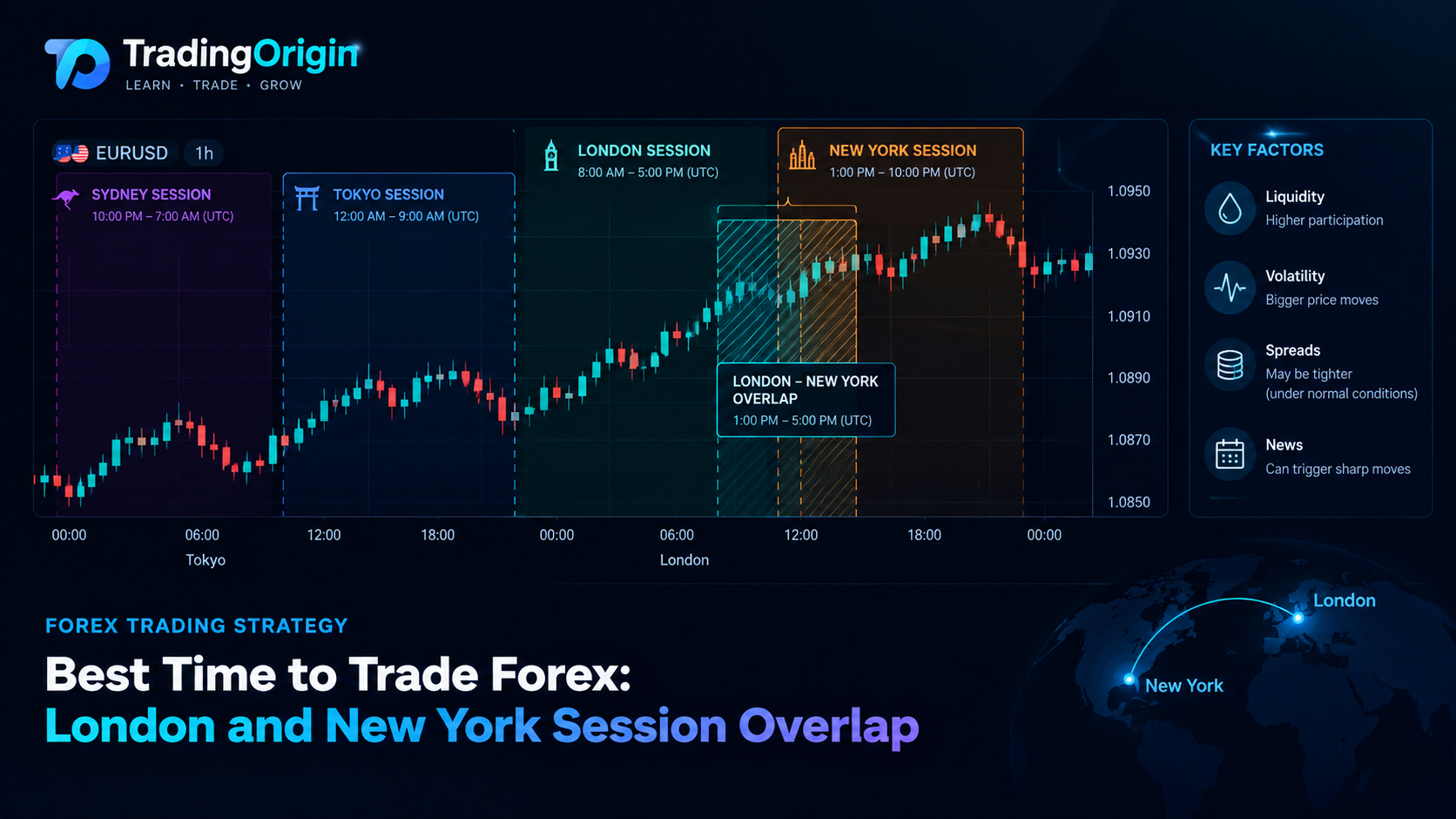
Choosing the best time to trade forex can make a meaningful difference to your trading decisions. Although the forex market operates 24 hours a day, five days a week, liquidity, volatility, spreads, and trading opportunities vary throughout the day.
For many intraday traders, the London and New York session overlap is an important period to watch. During this window, two major financial centres are active simultaneously, which can increase market participation and create opportunities for well-planned trading strategies.
However, higher activity does not automatically mean higher profits. The key is understanding when your preferred currency pairs are active, how economic news affects price movements, and how to evaluate a trading signal before entering a position.
In this guide, you will learn about the best time to trade forex, the major forex trading sessions, the London–New York overlap, and practical ways to combine session timing with technical analysis and risk management.
Quick Answer: What Is the Best Time to Trade Forex?
The London–New York overlap is often one of the most active periods for major currency pairs, particularly EUR/USD and GBP/USD.
The typical overlap occurs around 8:00 AM to 12:00 PM New York time. In UTC, this is commonly 12:00–16:00 or 13:00–17:00, depending on daylight saving time in the United States and the United Kingdom.
During this period, traders may observe:
Increased participation in major currency pairs.
Greater price movement around important economic announcements.
Potentially competitive spreads under normal market conditions.
Breakouts, pullbacks, and trend continuation setups.
These are possibilities, not guarantees. Actual spreads, volatility, and execution quality depend on the currency pair, broker, market conditions, and scheduled news.
Understanding the Four Major Forex Trading Sessions
The global forex market is commonly divided into four major trading sessions: Sydney, Tokyo, London, and New York.
Each session has different characteristics, influenced by regional economic activity, market participants, and the currencies being traded.
1. Sydney Session
The Sydney session marks the beginning of the conventional forex trading week after the weekend.
Currency pairs involving the Australian and New Zealand dollars may attract attention during this period. AUD/USD and NZD/USD are examples worth monitoring when Australian or New Zealand economic developments are relevant.
Trading activity can be comparatively quiet in some pairs, although important economic releases can create significant movement.
2. Tokyo Session
The Tokyo session is particularly relevant for traders following Japanese yen pairs, such as USD/JPY and EUR/JPY.
Japanese economic data, Bank of Japan announcements, and developments across Asian markets can influence price action.
For traders who prefer Asian-session strategies, it can be useful to observe overnight ranges, support and resistance levels, and reactions to economic news.
3. London Session
The London session is one of the major centres of global foreign exchange activity.
EUR/USD, GBP/USD, EUR/GBP, and other European currency pairs may see increased participation during London trading hours.
The opening of the London session can bring fresh liquidity and new price movements after quieter overnight conditions. Traders often monitor the Asian session high and low to identify potential breakouts or false breaks.
4. New York Session
The New York session is especially important for currency pairs involving the US dollar.
Economic releases such as US inflation data, employment reports, retail sales, and Federal Reserve announcements can influence USD-related pairs.
When New York opens while London is still active, market participation may increase. This creates the London–New York overlap, one of the most closely watched periods for intraday forex trading.
London and New York Session Overlap: Why It Matters
The London–New York overlap occurs when both financial centres are active at the same time.
This period attracts attention because European and North American market participants are trading simultaneously. It can be particularly relevant for EUR/USD, GBP/USD, and other liquid major currency pairs.
There are three important factors to understand.
Liquidity: Greater market participation can make it easier to enter and exit some positions, although liquidity is never guaranteed.
Volatility: Prices may move more quickly, especially when economic announcements surprise the market. This can create opportunities but also increase the risk of slippage and unexpected losses.
Spreads: Spreads on major pairs may be competitive during active market conditions. However, spreads can widen around important announcements or periods of market stress.
The London–New York overlap is therefore a useful window to study, not a universal signal to trade.
Forex Trading Sessions and Typical Characteristics
| Trading session | Common market focus | What traders may monitor |
|---|---|---|
| Sydney | AUD and NZD pairs | Regional news and overnight ranges |
| Tokyo | JPY and Asian-market pairs | Asian highs and lows, yen-related news |
| London | EUR and GBP pairs | Session breakouts and trend development |
| New York | USD-related pairs | US data, dollar strength, continuation setups |
| London–New York overlap | Major pairs, especially EUR/USD and GBP/USD | Liquidity, volatility, breakouts, and pullbacks |
Session times are approximate and depend on local market conventions. Daylight saving changes can shift the corresponding UTC times, so always verify the schedule for your trading date.
How to Find the Best Time for Your Forex Trading Strategy
The best trading time depends on your strategy, preferred currency pair, available trading hours, and tolerance for risk.
For Breakout Traders
Breakout traders look for price to move beyond an established support or resistance level.
The London open and London–New York overlap can be useful periods to monitor because increased participation may coincide with breaks of previous session ranges.
However, a candle moving above resistance does not automatically confirm a valid breakout. Price may reverse and return to the previous range.
A more disciplined process is to identify a clear level, wait for a meaningful break, assess the candle close, and determine whether a retest provides additional confirmation.
Read our guide to the Forex Breakout and Retest Strategy: How to Identify High-Quality Trading Signals to learn how to evaluate these setups.
For Trend-Following Traders
Trend-following traders seek opportunities in the direction of an established market trend.
During active sessions, a currency pair may extend an existing move, reverse, or enter consolidation. Traders can use market structure, moving averages, and price action to assess whether a potential setup aligns with the broader trend.
Avoid assuming that every strong candle marks the beginning of a new trend. Consider the higher-timeframe direction, nearby resistance or support, and the distance to a logical stop-loss level.
For Scalpers
Scalpers seek relatively small price movements and may take multiple trades within a short period.
Active sessions can provide more price movement, but scalping is particularly sensitive to transaction costs, spreads, commissions, slippage, and execution speed.
Before trading live, test your setup under realistic costs. A strategy that appears profitable on a chart may perform differently after execution costs are included.
For Swing Traders
Swing traders generally hold positions for longer periods and do not necessarily need to trade during the busiest hours.
For these traders, session timing may be more useful for refining an entry than determining the entire trade.
Higher-timeframe support and resistance, economic fundamentals, and the planned holding period may matter more than the session in which a position is opened.
How to Use Trading Sessions to Evaluate Forex Signals
A forex signal should be evaluated using more than the time of day.
A practical process can help you decide whether a potential trade fits your strategy.
Step 1: Identify the Currency Pair
Start by identifying which currencies are involved and which economic regions are active.
For example, EUR/USD may respond to both European and US developments. USD/JPY may react to US data, Japanese monetary policy, and changes in broader market sentiment.
Step 2: Check the Market Trend
Review the current price structure and, where appropriate, a higher timeframe.
Look for a sequence of higher highs and higher lows in an uptrend, or lower highs and lower lows in a downtrend. In a ranging market, identify the boundaries and avoid assuming that a breakout will occur.
Step 3: Mark Support and Resistance
Identify meaningful price levels before looking for an entry.
These levels may include previous session highs and lows, established swing points, or clear areas where price has repeatedly reacted.
A potential signal becomes more useful when its entry location, invalidation point, and market context can be explained clearly.
Step 4: Wait for Confirmation
Confirmation may involve a candle close beyond a level, a successful retest, or alignment with a predefined trend-following rule.
Indicators such as RSI, MACD, and moving averages can support the analysis, but they should not be treated as independent guarantees of a successful trade.
For more guidance, read How to Avoid False Forex Signals: 7 Confirmation Rules.
Step 5: Calculate Risk Before Entry
Determine the stop-loss location based on the trade setup rather than choosing a level simply because it produces a larger position.
Calculate the potential loss if the stop is reached, then determine whether the trade offers an acceptable risk-to-reward ratio.
If the setup does not meet your risk criteria, skipping it is a valid trading decision.
Why Economic News Can Change the Best Time to Trade Forex
Economic news can have a substantial effect on currency prices, particularly when the actual figures differ from market expectations.
Important events include:
US Nonfarm Payrolls (NFP).
Consumer Price Index (CPI) inflation reports.
Central bank interest-rate decisions.
Gross domestic product (GDP) releases.
Purchasing Managers' Index (PMI) reports.
Speeches from central bank officials.
Some major US economic releases occur during the London–New York overlap, making the calendar especially relevant for intraday traders.
However, a scheduled announcement can produce rapid price changes in both directions. Spreads may widen, orders may experience slippage, and technical levels may be crossed before a trade can be executed at the expected price.
Before entering a trade, check an economic calendar and understand your broker's execution conditions. If your strategy has not been tested for high-impact news, waiting until conditions stabilise may be more appropriate than attempting to trade the initial reaction.
Common Mistakes When Choosing Forex Trading Hours
1. Assuming More Volatility Means More Profit
Volatility increases the potential size of price movements in either direction. It does not guarantee that a trade will reach its target.
2. Trading Every Session Without a Plan
Constantly switching between currency pairs and sessions can lead to inconsistent decisions. Choose a manageable set of pairs and test specific trading windows.
3. Ignoring Spreads and Slippage
A signal may appear attractive before costs but become unprofitable after spreads, commissions, and slippage are considered.
4. Entering Immediately After a News Release
Initial reactions can be unpredictable. A sudden breakout may reverse within minutes, particularly when the market is reassessing new information.
5. Using Indicators Without Market Context
An RSI reading, MACD crossover, or moving-average signal should be assessed alongside price structure, volatility, and the broader market environment.
6. Ignoring Daylight Saving Time
The London and New York sessions do not change their clocks on the same dates. As a result, the UTC overlap can temporarily shift by an hour.
Always check session times for the specific date rather than relying on a fixed UTC schedule throughout the year.
Practical Example: Evaluating a London–New York Overlap Setup
Imagine that EUR/USD is approaching a resistance level established during the London morning.
Rather than buying immediately when the price moves above resistance, a disciplined trader could follow this process:
Identify the resistance level and the broader market trend.
Check the economic calendar for important US announcements.
Wait to see whether the breakout candle closes above resistance.
Observe whether price retests the level and holds above it.
Identify a technically justified stop-loss level.
Calculate the potential reward relative to the risk.
Check the live spread and confirm that the position size fits the risk limit.
Enter only if the setup meets the trading plan's predefined rules.
The breakout may still fail. If price returns below the level and invalidates the setup, the trader should follow the predefined exit rules rather than assume the market must recover.
This example illustrates a process for evaluating a trade, not a recommendation to buy EUR/USD or a prediction of future price direction.
How to Combine Session Timing With Risk-to-Reward Analysis
Choosing an active session is only one part of evaluating a trading opportunity.
Suppose a hypothetical trade has a stop-loss distance of 20 pips and a take-profit distance of 40 pips.
The potential reward-to-risk ratio is 2:1, before transaction costs.
This does not mean the trade has a high probability of success. A favourable ratio must be considered alongside the setup's historical performance, market conditions, and execution costs.
For a more detailed explanation, read our guide: Forex Signal Risk-to-Reward Ratio: How to Evaluate a Trade Before Entry.
A complete trade evaluation should consider:
The quality of the entry setup.
The technical invalidation level.
The potential reward relative to the risk.
The spread, commission, and possible slippage.
The economic calendar and current volatility.
The maximum risk permitted by the trading plan.
If the trade does not meet these conditions, the fact that it occurs during a busy session is not a sufficient reason to enter.
Frequently Asked Questions About the Best Time to Trade Forex
What is the best time to trade forex?
The London–New York overlap is often one of the most active periods for major currency pairs. However, the best time for an individual trader depends on the strategy, currency pair, execution costs, and market conditions.
What time does the London–New York overlap start?
The overlap typically begins around 8:00 AM New York time. In UTC, the start is commonly 12:00 or 13:00, depending on daylight saving arrangements. Verify the relevant dates before trading.
Is the London session better than the New York session?
Neither session is universally better. London may be particularly relevant for EUR and GBP pairs, while New York is important for USD-related pairs and US economic releases. The most suitable session depends on your strategy.
Which forex pairs are worth watching during the overlap?
EUR/USD and GBP/USD are common pairs to monitor during the London–New York overlap. Other pairs may also be relevant, depending on market conditions and the currencies involved. Always check live spreads and your broker's available instruments.
Is the London–New York overlap good for scalping?
It can offer frequent price movement, but faster markets also create execution risks. Scalpers should test their strategy using realistic spreads, commissions, slippage, and position sizing.
Should I trade forex during major economic news?
That depends on your strategy and experience. News can create rapid price changes, wider spreads, and slippage. If you have not tested your strategy around major releases, avoiding the initial reaction may reduce exposure to unpredictable execution conditions.
Can I make money by trading only during the London–New York overlap?
No trading session guarantees profits. Results depend on the strategy, execution, risk management, and market conditions. A trader should evaluate performance over a meaningful sample of trades rather than assume a particular session is always profitable.
How can I identify a high-quality forex signal?
Evaluate the market trend, support and resistance, entry confirmation, stop-loss placement, potential reward relative to risk, and relevant economic news. A signal should fit a tested trading plan rather than rely on a single indicator or time window.
Final Thoughts
The best time to trade forex is not simply the time when prices move the fastest. It is the period in which your chosen currency pair, strategy, risk limits, and execution conditions work together most effectively.
The London–New York overlap can be a useful starting point for intraday traders, particularly those monitoring EUR/USD and GBP/USD. Nevertheless, higher activity can also bring sharp reversals, news-driven volatility, and execution risks.
Build a repeatable process: understand the trading sessions, monitor economic releases, confirm price action, calculate risk before entry, and record your results. Over time, a trading journal can help you determine whether a particular session genuinely improves your strategy's performance.
Risk Disclaimer: Forex trading involves substantial risk and may not be suitable for every investor. No trading session, technical indicator, or signal guarantees profits. Always assess your financial circumstances, use appropriate risk management, and never risk money you cannot afford to lose.
Educational content by TradingOrigin.
Keep Learning: More Forex Articles
- Forex Support and Resistance Strategy: How to Find Better Trading Signals
- Forex Signal Risk-to-Reward Ratio: How to Evaluate a Trade Before Entry
- Forex Trend Following Strategy: How to Generate Better Trading Signals
Want structured, step-by-step lessons? Explore the TradingOrigin Academy.
📢 Get our signals on Telegram
Follow our Telegram channel for crypto and forex signals, shared as they happen: 📲 Join TradingOrigin on Telegram
Want full access? View our crypto and forex signal plans.