Introduction
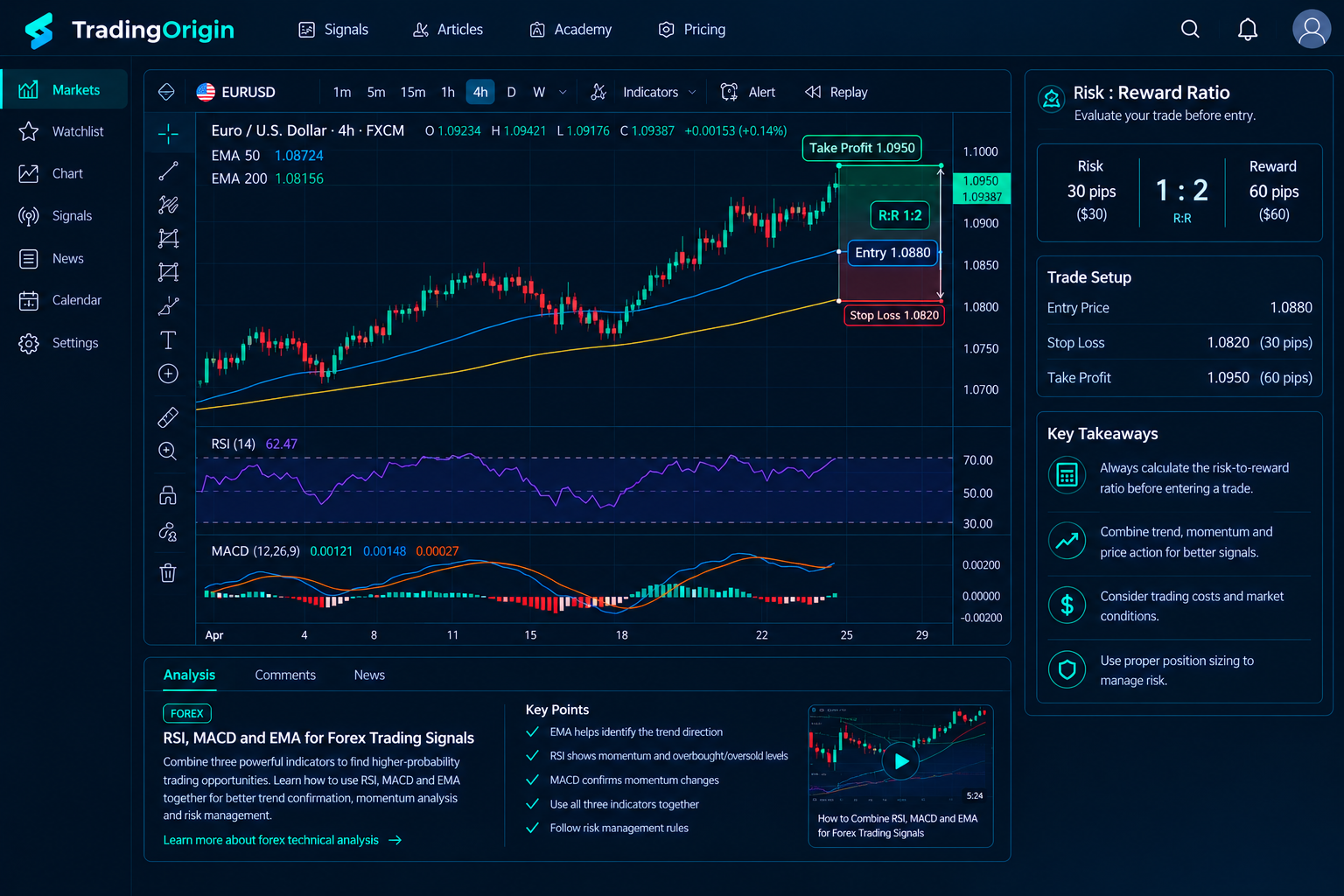
A forex trading signal can look attractive, but a potential entry is only one part of a trading decision. Before placing a trade, you also need to understand how much you could lose if the setup fails, where the trade idea becomes invalid, and how much profit is realistically available before the next important price level.
This is where the forex risk-to-reward ratio becomes useful.
The risk-to-reward ratio compares the amount you plan to risk on a trade with the potential profit you are targeting. It helps traders evaluate forex signals more systematically instead of focusing only on the predicted market direction or a provider's advertised success rate.
In this guide, you will learn how to calculate the risk-to-reward ratio in forex trading, evaluate entry prices and stop-loss levels, estimate potential profit, understand the popular 1:2 risk-to-reward ratio, and identify warning signs before entering a trade.
You will also learn why a favorable ratio does not guarantee profitability and how trading costs, win rate, position sizing, and execution can affect real results.
What Is the Risk-to-Reward Ratio in Forex Trading?
The risk-to-reward ratio compares the potential loss on a trade with its potential profit.
For example, if a forex trade has a planned risk of $50 and a potential profit target of $100, the risk-to-reward ratio is 1:2.
This means the trader is planning to risk one unit of money for every two units of potential profit.
The ratio does not predict whether the trade will win. It simply describes the relationship between the planned loss and the potential gain at the selected entry, stop loss, and take-profit levels.
A trade with a 1:3 ratio is not automatically better than one with a 1:2 ratio. The probability of reaching the target, the quality of the setup, the trading costs, and the strategy's historical performance also matter.
How to Calculate the Forex Risk-to-Reward Ratio
The calculation starts with three prices:
Entry price: The price at which you plan to open the trade.
Stop-loss price: The level where you plan to exit if the trade moves against the setup.
Take-profit price: The level where you plan to take profit if the target is reached.
For a long trade, calculate the distances from entry to stop loss and from entry to take profit. For a short trade, calculate the corresponding distances in the opposite direction.
The general formula is:
Risk-to-reward ratio = Potential loss ÷ Potential profit
For clarity, many traders express the result as 1, where R is the potential reward for each unit of risk.
Example: A hypothetical EUR/USD trade
Suppose EUR/USD has the following planned levels:
Entry price: 1.0850
Stop loss: 1.0820
Take profit: 1.0910
For this illustrative trade:
Planned risk distance: 30 pips
Potential reward distance: 60 pips
Risk-to-reward ratio: 30 ÷ 60 = 0.5, or 1:2
The target is twice as far from the entry as the stop loss.
This calculation assumes that the trade can be executed and exited at the specified prices. Actual outcomes may differ because of spreads, commissions, slippage, and market gaps.
Understanding the 1:1, 1:2, and 1:3 Risk-to-Reward Ratios
Different trading strategies use different risk-to-reward profiles. The right ratio depends on the strategy's win rate, execution costs, and ability to reach its targets.
What does a 1:1 risk-to-reward ratio mean?
A 1:1 ratio means the potential profit equals the planned loss.
If a trader risks $50 to target $50, the ratio is 1:1 before costs.
The trade needs a sufficiently high win rate to cover losses and trading expenses. A 1:1 ratio does not mean the trader must win exactly half of all trades to break even under real-world conditions.
What does a 1:2 risk-to-reward ratio mean?
A 1:2 ratio means the potential profit is twice the planned loss.
For example, risking $50 to target $100 produces a 1:2 ratio before costs.
This ratio is popular in educational trading examples because it makes the relationship between risk and reward easy to understand. However, it does not guarantee better results than a strategy with a lower ratio.
If the target is too ambitious for the market conditions, the trade may reach the stop loss more often before reaching the target.
What does a 1:3 risk-to-reward ratio mean?
A 1:3 ratio means the potential profit is three times the planned loss.
For example, a trader might plan to risk $40 while targeting $120.
Although the potential reward is larger relative to the risk, the target may be harder to reach. The strategy must be evaluated using actual trade data rather than the ratio alone.
Risk-to-Reward Ratio Examples
The following table shows hypothetical trades before transaction costs.
Planned riskPotential rewardRatio$50$501:1$50$1001:2$50$1501:3$25$1001:4These examples describe planned outcomes, not guaranteed profits.
A trade targeting $150 while risking $50 can still lose $50. The potential reward becomes relevant only if the target is reached.
How to Evaluate a Forex Signal Before Entry
When you receive a forex signal from a provider or identify one through your own analysis, do not evaluate it using the entry price alone.
Use the following steps to determine whether the trade fits your predefined rules.
Step 1: Check the entry price
Identify the exact entry condition and determine whether the signal is still valid.
A signal received late may no longer offer the same risk-to-reward ratio as the original setup. If the market has already moved substantially, the stop loss and target distances may have changed.
Avoid entering a trade simply because the original signal looked attractive.
Step 2: Evaluate the stop-loss level
The stop loss should correspond to a meaningful invalidation point in the trading setup.
For example, a trader using a breakout strategy might place the stop beyond the price level that would invalidate the breakout idea, according to the strategy's rules.
An arbitrarily tight stop can cause a trade to exit during normal price fluctuations. An excessively wide stop can create an unnecessarily large potential loss.
The stop-loss distance should be considered together with position size and the structure of the market.
Step 3: Identify a realistic take-profit target
A take-profit target should have a clear rationale.
Possible reference points include a previous swing high or low, a significant support or resistance zone, or a target method that has been tested as part of the strategy.
Avoid choosing a distant target solely to make the risk-to-reward ratio look more attractive.
If a major resistance zone sits just above a potential buy entry, for example, the market may have limited room to reach a much higher target.
Step 4: Calculate the ratio before entering
Once the entry, stop loss, and target are defined, calculate the potential loss and potential profit.
If the setup fails to meet the requirements of your trading plan, consider skipping it.
A disciplined trader does not need to take every signal. Waiting for an opportunity that meets the strategy's criteria is a valid decision.
Step 5: Check transaction costs
Spreads, commissions, swaps, and slippage can reduce the amount a trader actually earns or increase the cost of a losing trade.
This is particularly important for strategies that target small price movements or trade frequently.
Calculate the ratio using realistic execution assumptions whenever possible. The nominal ratio based on chart prices may overstate the effective reward relative to risk.
How to Evaluate a Forex Signal With a Realistic Example
Consider a hypothetical GBP/USD buy signal.
The planned entry is 1.2700, the stop loss is 1.2670, and the take-profit target is 1.2760.
The planned risk is 30 pips, while the potential reward is 60 pips. This produces a nominal 1:2 risk-to-reward ratio before trading costs.
Before entering, ask:
Is the buy signal supported by the market structure?
Is the stop-loss level consistent with the setup's invalidation point?
Is there a significant resistance area before the target?
Is the potential target realistic under current volatility?
Has the market already moved away from the intended entry?
Is the position size appropriate for the account?
Have trading costs and upcoming economic announcements been considered?
If the answers reveal that the setup no longer meets the strategy's conditions, the original 1:2 ratio alone is not a reason to enter.
The ratio describes the trade's planned distances. It does not measure the probability that the target will be reached.
What Win Rate Do You Need for a Profitable Risk-to-Reward Ratio?
The relationship between win rate and risk-to-reward ratio is important because a strategy can have many losing trades and still produce a positive result, or a high win rate and still lose money.
Under simplified assumptions, the break-even win rate before costs can be calculated as:
Break-even win rate = Risk ÷ (Risk + Reward)
For a 1:1 ratio, the simplified break-even win rate is 50%.
For a 1:2 ratio, it is approximately 33.3%.
For a 1:3 ratio, it is 25%.
These figures assume that every winning trade achieves the full target, every losing trade loses exactly the planned amount, and there are no trading costs or other execution differences.
Real trading results may require a higher win rate because of spreads, commissions, slippage, partial exits, and other factors.
Example of a 1:2 strategy
Suppose a strategy produces 100 trades, with 40 winners and 60 losers.
Assume each winner earns $100 and each loser loses $50.
Total profit from winning trades: 40 × $100 = $4,000.
Total loss from losing trades: 60 × $50 = $3,000.
Simplified net result: $1,000 before costs.
This example illustrates how the average win and average loss can influence results. It is not a prediction of how a particular forex signal service will perform.
To evaluate a real strategy, examine a sufficiently large and representative sample of trades and include transaction costs.
How Position Sizing Affects Forex Risk Management
The risk-to-reward ratio does not tell you how much money you should risk on a trade. Position sizing determines the financial exposure associated with the stop-loss distance.
Consider a hypothetical account with $5,000 in equity and a planned risk limit of 1% per trade.
The planned monetary risk would be $50.
If a trade uses a 25-pip stop loss, position size must be calculated so that a 25-pip adverse move corresponds approximately to the intended $50 risk, after considering the instrument's pip value and trading costs.
If the stop loss changes to 50 pips, the position size would generally need to be reduced to keep the same planned monetary risk.
The calculation depends on the currency pair, account currency, contract specifications, and pip value.
The 1% figure is an illustrative example, not a recommendation for every trader. Even a carefully sized position can lose more than expected during gaps or severe slippage.
Common Risk-to-Reward Mistakes in Forex Trading
Choosing a target just to achieve a high ratio
A distant target may make the ratio appear attractive but may not reflect realistic market conditions.
Define targets using a consistent method and evaluate the strategy over a meaningful sample of trades.
Moving the stop loss farther away
Moving a stop loss to avoid taking a planned loss can increase the risk beyond the original amount.
If a setup is invalidated, follow the strategy's rules rather than changing the risk after entry without a predefined reason.
Ignoring the signal's entry price
A signal may have had a favorable ratio when first issued. If price moves before you enter, the opportunity can become less attractive.
Always recalculate the ratio using the actual proposed entry and the still-valid stop and target levels.
Focusing only on the win rate
A high win rate does not automatically indicate a profitable strategy. The average size of wins and losses, transaction costs, and drawdown also matter.
Ignoring market structure
A target placed immediately beyond a strong opposing price zone may be less realistic than the same target in an area with more room for price movement.
Increasing position size after losses
Increasing exposure to recover previous losses can undermine risk controls. Position sizing should follow a predefined method rather than emotional reactions.
How to Compare Forex Signal Providers
If you use a paid forex signal service, do not evaluate it solely by its advertised risk-to-reward ratio.
Ask whether the provider explains its entry conditions, stop-loss levels, take-profit targets, and methodology.
Consider whether performance information includes losing trades and meaningful historical results. Look for transparent assumptions about transaction costs, execution, and the difference between theoretical and actual returns.
Check whether signals are delivered promptly and whether the entry price remains realistic when you receive them.
A provider's advertised 1:3 ratio does not mean every trade will achieve three times its planned risk. Some trades may hit the stop loss, some may close early, and others may never reach the stated target.
Before purchasing a plan, review its features, limitations, pricing, and terms. No signal provider can guarantee profits or remove the risk of forex trading.
A Forex Trade Evaluation Checklist
Before acting on a potential signal, review the following:
Entry: Is the entry condition still valid at the current price?
Stop loss: Does the stop represent a logical invalidation point?
Take profit: Is the target supported by the strategy and market structure?
Risk-to-reward ratio: Has the ratio been calculated from the proposed entry, stop, and target?
Win-rate evidence: Has the strategy been tested over a representative sample?
Position size: Is the planned monetary risk within the trading plan's limit?
Trading costs: Have spreads, commissions, swaps, and possible slippage been considered?
Market conditions: Are volatility and upcoming economic events relevant to the setup?
Signal timing: Has the price already moved enough to invalidate the original opportunity?
Discipline: Does the trade meet the strategy's predefined rules?
If a key condition is missing, reassess the setup before committing capital.
Explore Trading Resources at TradingOrigin
Understanding risk-to-reward ratios can help traders assess potential opportunities more consistently, but it is only one component of a complete trading process.
TradingOrigin offers trading-related educational resources and information about its available plans. Review the actual features and terms to determine whether they fit your needs.
If you are considering a forex signal service, evaluate the methodology, entry prices, risk controls, and performance evidence rather than relying on advertised profit claims.
Explore TradingOrigin's available plans to find the features that fit your trading workflow.
Use educational resources to strengthen your decision-making process, and remember that all forex signals require independent evaluation and appropriate risk management.
Frequently Asked Questions
What is a good risk-to-reward ratio in forex trading?
There is no universally best ratio. A 1:2 ratio is a common example, but its suitability depends on the strategy's win rate, target realism, trading costs, and execution. A higher ratio does not automatically mean a better trade.
How do you calculate a forex signal risk-to-reward ratio?
Calculate the potential loss from entry to stop loss and the potential profit from entry to take profit. Divide the planned loss by the potential profit. A trade risking 30 pips to target 60 pips has a nominal 1:2 ratio.
Is a 1:2 risk-to-reward ratio profitable?
Not necessarily. Under simplified assumptions, a 1:2 strategy has a break-even win rate of approximately 33.3% before costs. Actual profitability depends on the real win rate, average outcomes, trading costs, and execution.
Should I take every forex signal with a 1:3 ratio?
No. A 1:3 ratio does not guarantee that the target is realistic or that the setup has a favorable probability of success. Evaluate the entry, stop loss, target, market structure, and tested strategy rules before deciding.
Can risk-to-reward ratios help evaluate paid forex signals?
Yes. They can help you compare the stated potential loss and reward of a signal. However, you should also evaluate signal timing, historical performance, execution assumptions, costs, and the provider's risk disclosures.
Does a higher risk-to-reward ratio mean lower risk?
No. The ratio compares planned potential loss with potential profit. It does not measure the probability of loss, the size of your position, or the overall volatility of the trade.
How much should I risk on each forex trade?
There is no single percentage suitable for everyone. Your planned risk should reflect your financial circumstances, trading experience, strategy, and ability to tolerate losses. Position size should be calculated before entering a trade.
Can a forex signal guarantee a profit?
No. Forex markets are uncertain, and all trading strategies can experience losses. A risk-to-reward calculation helps structure a decision but cannot guarantee the outcome.
Final Thoughts
The forex signal risk-to-reward ratio is a useful tool for evaluating a potential trade before entry. By comparing the planned loss with the potential reward, traders can assess whether an opportunity fits their strategy.
However, a favorable ratio is only one part of the decision. Entry timing, stop-loss placement, realistic targets, win-rate evidence, position sizing, and trading costs all influence the outcome.
Calculate the ratio before entering, follow consistent risk rules, and test your approach using realistic assumptions.
For more educational resources and information about available features, explore TradingOrigin and choose tools that support your own trading workflow.
Risk Disclaimer: This article is for educational and informational purposes only and does not constitute financial, investment, or trading advice. Forex and leveraged trading involve substantial risk, including the possible loss of your capital. Past performance does not guarantee future results.
Learn how to avoid false forex signals by applying practical confirmation rules before entering a trade.
Keep Learning: More Forex Articles
- Forex Support and Resistance Strategy: How to Find Better Trading Signals
- Best Time to Trade Forex: London and New York Session Overlap
- Forex Trend Following Strategy: How to Generate Better Trading Signals
Want structured, step-by-step lessons? Explore the TradingOrigin Academy.
📢 Get our signals on Telegram
Follow our Telegram channel for crypto and forex signals, shared as they happen: 📲 Join TradingOrigin on Telegram
Want full access? View our crypto and forex signal plans.