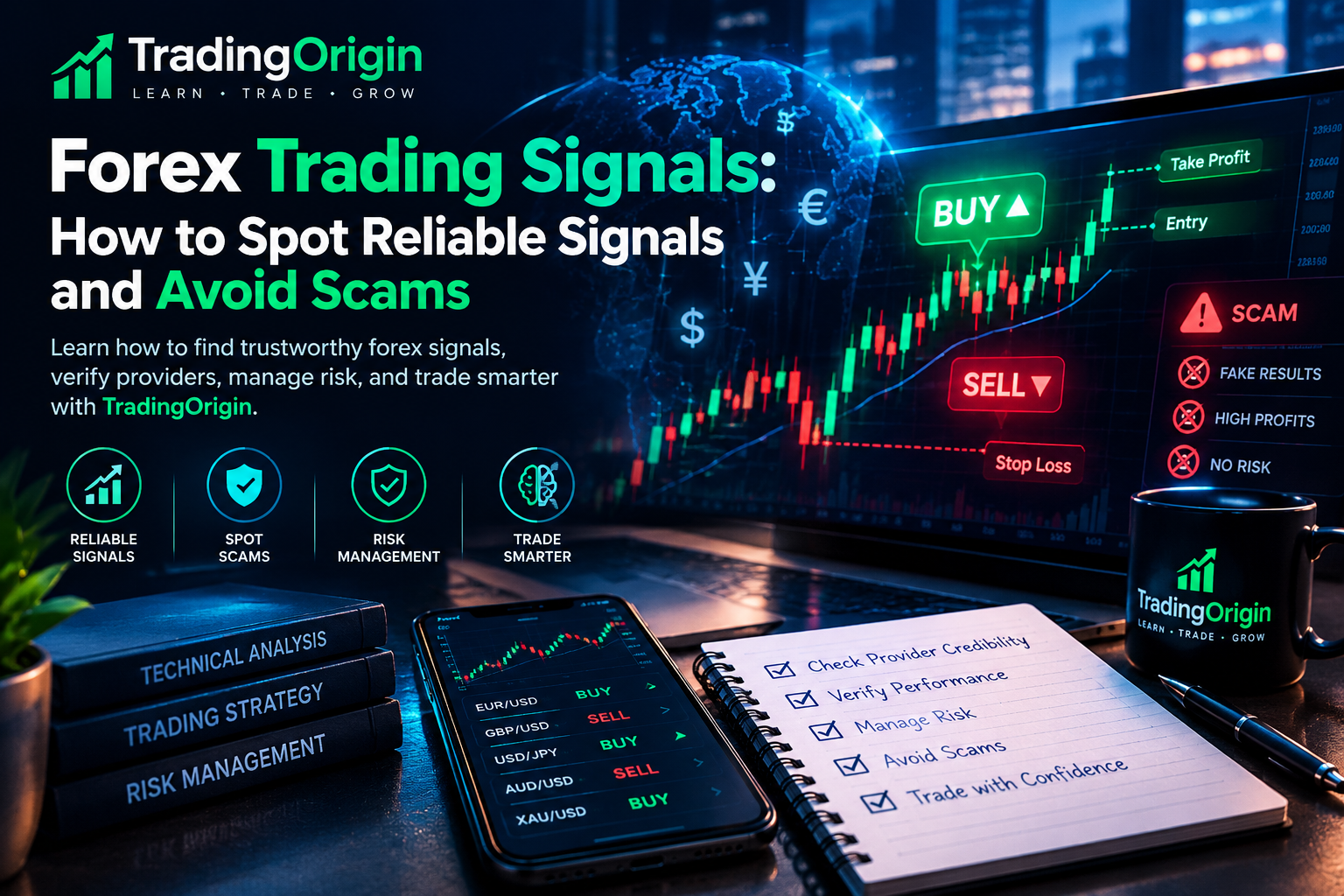
Forex trading signals can help traders identify potential entry and exit opportunities in the foreign exchange market. However, a signal is not a guarantee of profit, and a professional-looking website or a high advertised win rate does not automatically make a provider trustworthy.
Before paying for a forex signal service, traders need to understand how signals work, how performance should be evaluated, and which warning signs deserve attention.
This guide from TradingOrigin explains how to assess forex trading signals, verify a provider's claims, recognize misleading marketing, and build a safer process for making trading decisions.
Important: Forex trading involves substantial risk. You can lose some or all of your trading capital. This article is for educational purposes and does not provide personalized investment advice.
What Are Forex Trading Signals?
Forex trading signals are trade ideas that suggest a possible opportunity to buy or sell a currency pair. They may be generated by technical analysis, fundamental analysis, quantitative models, automated trading systems, or human analysts.
A typical forex signal may contain:
Currency pair: The instrument being analyzed, such as EUR/USD or GBP/USD.
Trade direction: A potential buy or sell position.
Entry price: The proposed price or price range for entering a trade.
Stop-loss (SL): A predefined level intended to limit losses if the trade moves against the trader.
Take-profit (TP): A target price at which the trader may choose to close a profitable position.
Timeframe: The period relevant to the analysis, such as a 15-minute chart, a 4-hour chart, or a daily chart.
Reason for the signal: The technical, fundamental, or quantitative evidence supporting the trade idea.
A message that simply says “BUY EUR/USD NOW” without a clear rationale, invalidation level, or risk explanation gives a trader very little information for evaluating the opportunity.
The key distinction is simple: a forex signal is a hypothesis about a potential market move, not a promise about what the market will do next.
How Do Forex Trading Signals Work?
Forex signals can be produced in several ways.
1. Technical Analysis Signals
Technical signals use price charts and market indicators to identify potential trading opportunities. Common tools include support and resistance, moving averages, the Relative Strength Index (RSI), and the Moving Average Convergence Divergence (MACD).
For example, a trader may consider a bullish setup when price breaks above a resistance level and subsequently holds above it. This is a potential trading scenario, not proof that the market will continue rising.
Indicators can produce false signals, especially in choppy markets or around major economic announcements.
2. Fundamental Analysis Signals
Fundamental signals consider economic and financial information that may affect currency prices. Relevant factors include central bank interest-rate decisions, inflation reports, employment data, and changes in market expectations.
For example, a change in expectations about future interest rates may affect the EUR/USD exchange rate. However, prices can move in unexpected directions when the market has already anticipated the news.
3. Automated and Algorithmic Signals
Automated systems use predefined rules, statistical models, or algorithms to identify possible trades. Some systems analyze technical indicators, while others use more complex datasets.
Automation does not automatically mean a strategy is accurate. Results can deteriorate when market conditions change, and historical backtests may not reflect real trading conditions, transaction costs, or execution problems.
4. Copy Trading and Social Trading Signals
Some services allow users to copy trades from another trader or connect a signal provider to a trading account.
These arrangements introduce additional considerations, including execution differences, account permissions, fees, potential conflicts of interest, and the possibility of losing money without fully understanding the strategy.
Before connecting an account, understand what access you are granting and whether the service or person is appropriately authorized in your jurisdiction.
How to Identify Reliable Forex Trading Signals
There is no single test that proves a signal provider is reliable. A more sensible approach is to examine several independent aspects of its process and evidence.
1. Look for a Verifiable Trading Track Record
One of the most important questions is whether the provider can demonstrate its claimed performance using evidence that can be independently checked.
Screenshots of profitable trades are not enough. They can show selected results without revealing losing trades, deposits, withdrawals, or the full history of an account.
Look for evidence that clearly explains:
The period covered by the results.
Whether the results come from a live account or a backtest.
The complete trade history, including losing positions.
Maximum drawdown and the method used to calculate it.
Whether results include spreads, commissions, swaps, and other relevant costs.
Whether deposits, withdrawals, and changes in account size are disclosed.
Independent verification can improve confidence in the accuracy of reported results, but it does not guarantee future performance or eliminate every possibility of misleading presentation.
If a provider refuses to explain how its results were produced, treat that as a reason to pause rather than a reason to trust its marketing.
2. Be Careful With Extremely High Win-Rate Claims
A provider may advertise a 90% win rate or claim that almost every signal is profitable. Such a number is meaningless without context.
Win rate tells you how frequently trades close profitably. It does not tell you how much money is won or lost on each trade.
Consider this simplified example:
Strategy A wins 8 trades out of 10, earning $10 on each winning trade but losing $50 on each losing trade.
Total winning trades: $80.
Total losing trades: $100.
Net result before costs: -$20.
Despite an 80% win rate, the strategy loses money in this example.
A useful evaluation should consider average win, average loss, risk-to-reward ratio, transaction costs, and drawdown alongside win rate.
Do not confuse a high percentage of winning trades with a profitable or suitable strategy.
3. Every Signal Should Have a Clear Risk Plan
A signal should explain how the trader can define the trade's risk before deciding whether to enter.
Check whether the provider communicates:
A clear entry condition or price range.
A stop-loss or an explicit explanation of the exit and invalidation rules.
A realistic profit target or exit methodology.
A suggested maximum risk per trade, if applicable.
The circumstances under which the original trade idea is no longer valid.
A provider that continually moves stop-loss levels farther away, removes losing trades from its published history, or encourages unlimited averaging down deserves additional scrutiny.
No stop-loss method guarantees a maximum loss under all circumstances. Gaps, slippage, liquidity conditions, and broker execution can cause actual results to differ from the planned risk.
4. Understand the Strategy Behind the Signal
A trustworthy educational process should make it possible to understand why a trade is being considered.
Ask the provider:
What market conditions does the strategy target?
Which timeframe does it use?
What evidence supports the entry?
What would invalidate the setup?
How are trades managed when the market moves against the original idea?
How does the strategy perform after trading costs?
A provider does not necessarily need to reveal every proprietary detail of an algorithm. However, you should be able to understand the basic risk, limitations, and intended use of the service before paying for it.
5. Check the Provider's Identity and Business Model
Before subscribing, identify who operates the service and how it earns money.
Check for a verifiable business identity, clear contact information, written terms, transparent fees, and an understandable cancellation process.
If the provider claims to be regulated or licensed, verify the claim directly through the relevant regulator's official register. Do not rely solely on a logo, certificate image, or registration number supplied by the provider.
Also investigate whether the provider receives compensation from a broker when users open accounts or trade. Referral arrangements and other financial incentives can create conflicts of interest that deserve disclosure.
The absence of a particular license is not automatically proof of fraud because requirements vary by country and service. The important step is to establish which rules apply to the service being offered.
Forex Signal Scams: Warning Signs You Should Never Ignore
Not every poor-performing service is a scam. A genuine strategy can lose money. However, deception, fabricated results, and misleading promises are different from ordinary trading losses.
The following warning signs deserve careful attention.
Guaranteed Profits or Claims of No Risk
The forex market is uncertain. Claims of guaranteed returns, risk-free trading, or an almost certain profit from every signal should be treated with extreme caution.
A disclaimer elsewhere on the website does not make an unrealistic promise trustworthy.
Pressure to Buy a VIP Subscription Immediately
Some sellers use countdown timers, limited-time discounts, private groups, or repeated messages to pressure people into paying quickly.
A legitimate service should allow prospective customers enough time to review its methods, costs, risks, and cancellation terms.
Never let fear of missing an opportunity replace due diligence.
Fake Profit Screenshots and Selective Results
Images of large profits can be easy to misunderstand and may be difficult to authenticate.
A screenshot alone does not establish that the account belongs to the provider, that all trades are shown, or that the results were achieved consistently.
Look for a complete, independently verifiable record rather than a collection of selected winning trades.
Martingale Strategies Presented as Safe
Some strategies increase position sizes after losses in an attempt to recover previous losses through a future winning trade.
This is sometimes called a martingale-style approach. It can create a high proportion of small wins while exposing the account to a potentially severe loss when a losing sequence continues.
Ask whether position sizes increase after losses and how the strategy behaves during extended adverse market conditions.
Requests for Account Passwords or Unnecessary Access
A signal service generally should not need your broker password to send you trade ideas.
Be especially cautious if a provider requests withdrawal permissions, remote access to your device, cryptocurrency transfers to a personal wallet, or unrestricted control of your trading account.
Before authorizing any integration or copy-trading arrangement, independently verify the service and understand its permissions.
Hidden Fees and Misleading Refund Promises
Read the terms before making a payment. Look for recurring subscription charges, cancellation requirements, refund exclusions, and additional fees.
Keep copies of receipts and the terms that applied when you subscribed. Avoid paying when the seller's identity, billing arrangements, or refund conditions are unclear.
A Practical Checklist for Evaluating a Forex Signal Provider
Use this checklist before buying a subscription or following a signal service.
| Check | What to look for | Warning sign |
|---|---|---|
| Performance history | A complete, explainable record | Only winning screenshots |
| Verification | Evidence that can be independently checked | Unsupported profit claims |
| Risk management | Clear stop-loss and exit rules | No defined risk |
| Drawdown | Honest disclosure of losing periods | Losses are hidden or minimized |
| Trading costs | Spreads, commissions, swaps and slippage considered | Costs are ignored |
| Business identity | Verifiable operator and clear terms | Anonymous seller with unverifiable claims |
| Incentives | Fees and broker relationships disclosed | Undisclosed referral incentives |
| Security | Limited, appropriate account permissions | Requests for passwords or withdrawal access |
| Pressure tactics | Time to evaluate the service | Guaranteed returns and urgent payment demands |
How to use this checklist: Treat it as a screening tool, not a certification. A provider that fails a critical check should not be assumed trustworthy simply because it performs well on other checks. Passing the checklist also does not guarantee that the service is profitable or legitimate.
How to Test Forex Trading Signals Before Using Real Money
Even after checking a provider's claims, consider evaluating the process before risking capital.
Step 1: Record Signals Before the Outcome Is Known
Save each signal when it is first published, including the timestamp, entry, stop-loss, target, and reasoning.
This helps prevent hindsight bias, in which only successful signals are remembered or highlighted after the market moves.
Step 2: Use a Demo Account
A demo account can help you understand how the signals work and whether you can execute them as intended.
However, demo results do not fully reproduce live execution, emotional pressure, or every trading cost. A demo test is a learning exercise, not proof of future profitability.
Step 3: Include All Results
Record winning trades, losing trades, cancelled signals, missed entries, and changes to trade instructions.
Define your evaluation rules before testing. Otherwise, it is easy to change the criteria after seeing the results.
Step 4: Measure More Than the Win Rate
Track net performance after relevant costs, average win and loss, maximum drawdown, trade frequency, and consistency across different market conditions.
A short test period may not contain enough trades to support a meaningful conclusion. Avoid drawing strong conclusions from a small sample.
Step 5: Decide Whether the Service Fits Your Situation
A service may have a documented process and still be unsuitable for your experience, available capital, time zone, risk tolerance, or trading objectives.
You do not need to buy a signal service simply because other traders recommend it.
Risk Management: How to Use Forex Signals More Carefully
A signal is only one input into a trading decision. Position sizing and risk management determine how much an unfavorable outcome can affect your account.
For example, suppose a trader has a $2,000 account and chooses to risk 0.5% of the account on a single trade.
Planned monetary risk:
$2,000 × 0.005 = $10
This means the trader intends to risk $10 if the stop-loss is reached under the assumed execution conditions. It does not mean the loss is guaranteed to be capped at exactly $10.
Actual position size depends on the currency pair, entry price, stop-loss distance, pip value, account currency, and trading costs.
Avoid opening multiple highly correlated positions without considering their combined exposure. Several signals on different currency pairs may effectively represent the same underlying market risk.
Never borrow money to follow signals, and do not increase position sizes merely to recover a previous loss.
For a deeper explanation, read our guide: What Is a Stop Loss? A Beginner's Guide to Managing Risk.
Free vs. Paid Forex Trading Signals: What Is the Difference?
Free and paid signals can both be useful, misleading, or poorly suited to a particular trader. Price alone is not a reliable measure of quality.
Free Forex Signals
Free signals may be offered to build an audience, demonstrate a strategy, promote a trading platform, or encourage users to purchase another service.
Before using them, find out how the provider benefits from offering the service and whether important information is withheld from free subscribers.
Paid Forex Signals
Paid services may offer more detailed analysis, structured reporting, customer support, or automated delivery. Those features do not prove that the underlying trading strategy is profitable.
Before subscribing, compare the fee with the service's actual features, read the terms, examine the evidence, and consider whether the same educational information is available elsewhere.
The central principle: Never pay for a signal simply because it is advertised as premium, exclusive, or used by professional traders.
Frequently Asked Questions About Forex Trading Signals
What are the best forex trading signals?
There is no universally best forex signal. Suitability depends on the strategy, evidence, costs, market conditions, and the trader's own objectives and risk tolerance. Evaluate the process rather than relying on popularity or advertising claims.
Are forex trading signals profitable?
Some strategies may be profitable during certain periods, while others lose money. No signal service can reliably guarantee future profits. Results should be evaluated over a meaningful period and after relevant trading costs.
Are free forex signals safe?
Free signals can still expose traders to financial losses, misleading claims, or inappropriate broker promotions. Check the source, understand the trade setup, and avoid granting unnecessary account access.
How can I tell whether a forex signal provider is legitimate?
Check the provider's identity, terms, independently verifiable performance history, risk disclosures, and relevant regulatory status. Be cautious of guaranteed profits, hidden losses, pressure tactics, and unverifiable testimonials.
Should beginners use forex trading signals?
Beginners should first understand currency pairs, spreads, leverage, stop-loss orders, and position sizing. Studying signals in a demo account can be an educational exercise, but copying trades without understanding their risks can lead to losses.
Can a signal provider guarantee a 90% win rate?
A claim like this needs clear definitions, a transparent sample, complete results, and independent verification. Even a genuinely high historical win rate does not establish that the strategy will remain profitable.
Is copy trading the same as receiving forex signals?
No. A signal provides a trade idea, while copy trading can automatically reproduce another trader's positions in your account. Copy trading may introduce additional risks involving execution, account permissions, fees, and dependence on another trader's decisions.
Final Thoughts: Trust Evidence, Not Promises
Forex trading signals can provide ideas for analyzing currency markets, but they should never replace independent judgment or sound risk management.
Before trusting a provider, examine its complete performance history, verify its claims where possible, understand its trading method, and look carefully for conflicts of interest or misleading marketing.
Remember three principles:
Verify before you pay. Marketing screenshots and impressive win rates are not enough.
Understand before you trade. Know the entry logic, exit conditions, and potential loss.
Protect your capital. No signal is worth risking money you cannot afford to lose.
At TradingOrigin, the goal is to help traders make more informed decisions through education, transparent analysis, and a better understanding of market risk.
A credible approach to trading begins with questions, evidence, and risk awareness—not promises of easy money.
Risk disclaimer: This article is educational and does not constitute financial or investment advice. Forex and leveraged trading carry substantial risks. Past performance does not guarantee future results. Always conduct your own research and consider seeking advice from an appropriately qualified professional.
Keep Learning: More Forex Articles
- How Economic News Affects Forex Signals: Interest Rates, CPI and NFP
- How to Use ATR for Forex Signals, Stop Loss and Volatility Analysis
- Manual vs Automated Forex Trading Signals: Which Is Better?
Want structured, step-by-step lessons? Explore the TradingOrigin Academy.
📢 Get our signals on Telegram
Follow our Telegram channel for crypto and forex signals, shared as they happen: 📲 Join TradingOrigin on Telegram
Want full access? View our crypto and forex signal plans.