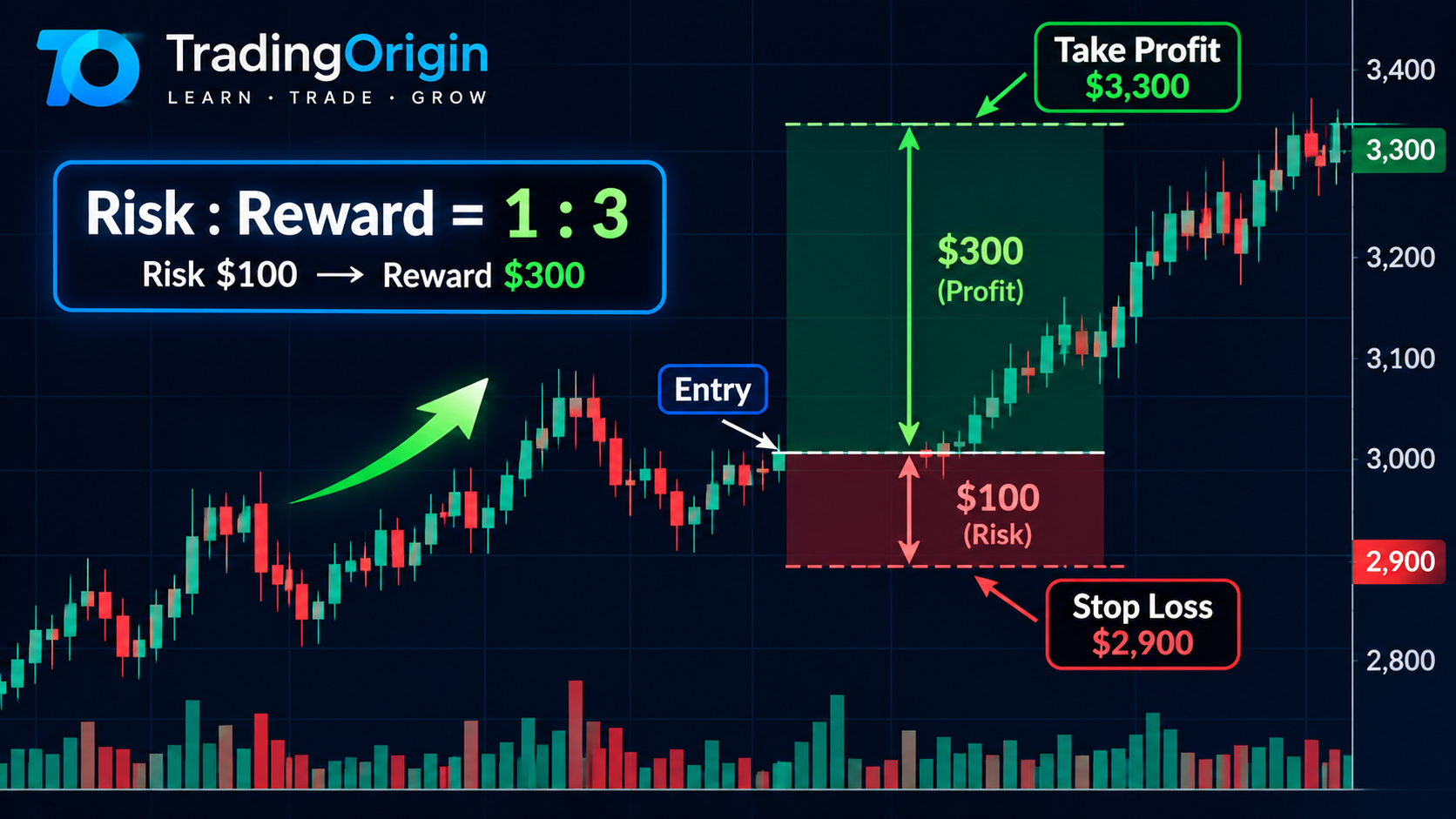
The risk to reward ratio in crypto trading is a simple way to compare how much money a trader could lose on a trade with how much they are targeting to make. It is one of the most useful concepts in crypto risk management because it helps traders plan trades before entering the market.
Instead of entering a trade based only on whether the price may go up or down, traders can use the risk-to-reward ratio to define an entry price, stop loss, and take profit level.
For example, if a trader is willing to risk $50 to potentially make $100, the trade has a 1:2 risk-to-reward ratio.
This does not guarantee that the trade will be profitable. However, using a consistent risk-to-reward framework can help traders make more structured decisions and control potential losses.
What Does Risk-to-Reward Ratio Mean?
The risk-to-reward ratio compares the potential loss of a trade with its potential profit.
The first number represents the amount being risked, while the second number represents the potential reward.
- 1:1 means risking $1 to potentially make $1.
- 1:2 means risking $1 to potentially make $2.
- 1:3 means risking $1 to potentially make $3.
A trader does not necessarily need to risk a large amount of money to achieve a favorable ratio. The ratio is based on the distance between the entry, stop loss, and take profit levels.
How to Calculate the Risk-to-Reward Ratio in Crypto Trading
The basic calculation is straightforward:
Risk-to-Reward Ratio = Potential Loss ÷ Potential Profit
For example, imagine a trader buys Bitcoin at $100,000 and places a stop loss at $98,000.
The potential risk is:
$100,000 − $98,000 = $2,000
If the trader sets a take profit at $106,000, the potential reward is:
$106,000 − $100,000 = $6,000
The trade therefore has a:
1:3 risk-to-reward ratio
The trader is risking $2,000 in price movement to target a potential $6,000 gain.
Common Risk-to-Reward Ratios
Different trading strategies can use different risk-to-reward ratios. There is no single ratio that is appropriate for every market condition or trading style.
1:1 Risk-to-Reward Ratio
A 1:1 ratio means the potential reward is equal to the potential risk.
For example, a trader could risk $100 to target $100.
This type of setup requires a relatively high win rate to remain profitable after trading costs and losses.
1:2 Risk-to-Reward Ratio
A 1:2 ratio means the trader risks $1 to potentially make $2.
For example, risking $50 for a potential $100 profit creates a 1:2 risk-to-reward ratio.
This is a commonly discussed framework because a trader can potentially remain profitable even if some trades lose, provided the strategy has an appropriate win rate and is executed consistently.
1:3 Risk-to-Reward Ratio
A 1:3 ratio means the trader risks $1 to potentially make $3.
For example, a trader could risk $50 while targeting a potential $150 gain.
Higher ratios can be attractive, but they may also require larger price movements and may result in fewer trades reaching the take profit level.
Risk-to-Reward Ratio Example in Crypto
Consider a hypothetical Ethereum trade.
- Entry: $3,000
- Stop Loss: $2,900
- Take Profit: $3,300
The potential risk is $100 per unit.
The potential reward is $300 per unit.
Therefore:
$100 risk ÷ $300 reward = 1:3
This means the trade has a 1:3 risk-to-reward ratio before considering fees, slippage, funding costs, or other trading expenses.
Risk-to-Reward Ratio and Stop Loss
The stop loss is an important part of calculating the risk-to-reward ratio.
A stop loss defines the price level where the trader accepts that the original trade idea may no longer be valid.
For example, a trader might identify support below an entry point and place the stop loss below that support area. The take profit can then be planned using the next resistance level or another predefined target.
This is why risk-to-reward analysis should not be performed independently from market structure.
A trader should avoid moving the stop loss simply to create a more attractive ratio.
Risk-to-Reward Ratio and Take Profit
The take profit determines the potential reward side of the calculation.
Instead of choosing an arbitrary profit target, traders can use technical levels such as resistance, previous highs, trend targets, or other areas where the price may encounter selling pressure.
A strong risk-to-reward setup should therefore make sense from both a risk-management perspective and a market-analysis perspective.
Why Risk-to-Reward Ratio Matters in Crypto Trading
Crypto markets can experience significant volatility. Prices can move quickly, and leverage can increase both potential gains and losses.
Using a crypto risk-to-reward ratio helps traders think about the downside before focusing on the upside.
It can help answer three important questions:
- How much could I lose if the trade fails?
- Where would my trade idea become invalid?
- Is the potential reward large enough compared with the risk?
These questions can make a trading plan more structured and reduce impulsive decisions.
Risk-to-Reward Ratio Does Not Guarantee Profits
A common mistake is assuming that a high risk-to-reward ratio automatically makes a trade good.
It does not.
A 1:5 setup may look attractive, but if the take profit is unrealistic and the market is unlikely to reach it, the ratio alone does not create an advantage.
Likewise, a 1:2 setup can still lose.
The risk-to-reward ratio should therefore be combined with market analysis, probability, trade selection, and disciplined risk management.
Risk-to-Reward Ratio and Win Rate
Risk-to-reward ratio and win rate should be considered together.
Suppose a trader uses a 1:2 risk-to-reward ratio. Ignoring fees and other trading costs, a trader could potentially lose one trade and make twice that amount on a winning trade.
This means the trader does not necessarily need to win every trade.
However, the actual results depend on the strategy's win rate, execution, fees, slippage, market conditions, and consistency.
The goal is not to find a magical ratio. The goal is to create a repeatable trading process with controlled downside.
How Position Size Affects Risk
The risk-to-reward ratio should not be confused with the amount of money being risked.
Position sizing determines how much capital is exposed to the trade.
For example, two traders can use the same 1:2 risk-to-reward ratio while risking very different amounts of money.
Trader A may risk $20.
Trader B may risk $200.
The ratio is the same, but the financial impact is very different.
This is why crypto position sizing is an important part of overall risk management.
Risk-to-Reward Ratio When Using Leverage
Leverage can make risk management even more important.
Using leverage does not automatically improve a trade's risk-to-reward ratio. It can increase the size of a position relative to the trader's available capital and therefore increase the potential impact of price movements.
Traders should calculate the amount they are actually willing to lose before opening a leveraged position.
A favorable risk-to-reward ratio does not protect a trader from excessive position size or liquidation risk.
How to Choose a Risk-to-Reward Ratio
There is no universal best risk-to-reward ratio for every crypto trade.
A suitable ratio depends on the trading strategy, timeframe, market structure, volatility, entry location, stop loss placement, and realistic price targets.
Instead of forcing every trade into a specific ratio, traders can first identify a valid setup and then evaluate whether the potential reward justifies the risk.
For example:
- Identify the market trend or structure.
- Find a potential entry zone.
- Determine where the trade idea becomes invalid.
- Set a logical stop loss.
- Identify a realistic take profit.
- Calculate the risk-to-reward ratio.
- Decide whether the trade fits the overall trading plan.
Common Risk-to-Reward Mistakes
Choosing the Ratio First
One mistake is deciding that every trade must have a 1:3 ratio before analyzing the chart.
Market structure should come first. The ratio should be evaluated after identifying a logical entry, stop loss, and target.
Moving the Stop Loss
Moving a stop loss farther away simply to avoid taking a loss can increase the amount at risk and destroy the original trading plan.
Setting Unrealistic Take Profit Levels
A very distant take profit can create an impressive-looking ratio while making the probability of reaching the target much lower.
Ignoring Trading Costs
Fees, spread, slippage, and funding costs can affect actual results, especially for frequent traders and leveraged positions.
Risking Too Much on One Trade
A good ratio does not justify risking an excessive percentage of trading capital on a single position.
How to Use Risk-to-Reward Ratio With Trading Signals
When using crypto trading signals, the risk-to-reward ratio can be another useful part of evaluating a setup.
A trading signal may provide an entry, stop loss, and take profit. Traders can use these levels to calculate the potential risk and reward before deciding whether the setup fits their own trading plan.
However, a signal should not be treated as a guarantee of profit. Traders should understand the setup, manage position size, and use appropriate risk controls.
For a broader understanding of how crypto trading signals can be evaluated, readers can also explore TradingOrigin's educational content on Bitcoin trading signals and signal confirmation.
Risk-to-Reward Ratio Checklist
Before entering a crypto trade, consider the following checklist:
- Do I have a clear entry point?
- Where is my logical stop loss?
- Where is my realistic take profit?
- How much capital am I risking?
- What is my risk-to-reward ratio?
- Does the setup make sense based on market structure?
- Am I using excessive leverage?
- Have I considered fees, slippage, and funding costs?
- Does this trade fit my overall strategy?
Final Thoughts on Risk-to-Reward Ratio in Crypto Trading
The risk-to-reward ratio in crypto trading is a useful framework for planning trades and controlling potential downside.
A trader can use the relationship between entry, stop loss, and take profit to understand whether a potential reward justifies the amount being risked.
However, the ratio should never be used alone. Successful crypto risk management also requires appropriate position sizing, realistic targets, disciplined stop-loss placement, and a consistent trading strategy.
The goal is not to find a perfect risk-to-reward ratio. The goal is to build a repeatable process that keeps losses controlled while allowing profitable trades enough room to develop.
Keep Learning: More Crypto Articles
- How to Manage Risk in Crypto Trading
- What Is a Crypto Trading Strategy? A Beginner’s Guide
- How to Use Entry Price, Stop Loss, and Take Profit in Crypto Trading Signals
Want structured, step-by-step lessons? Explore the TradingOrigin Academy.
📢 Get our signals on Telegram
Follow our Telegram channel for crypto and forex signals, shared as they happen: 📲 Join TradingOrigin on Telegram
Want full access? View our crypto and forex signal plans.