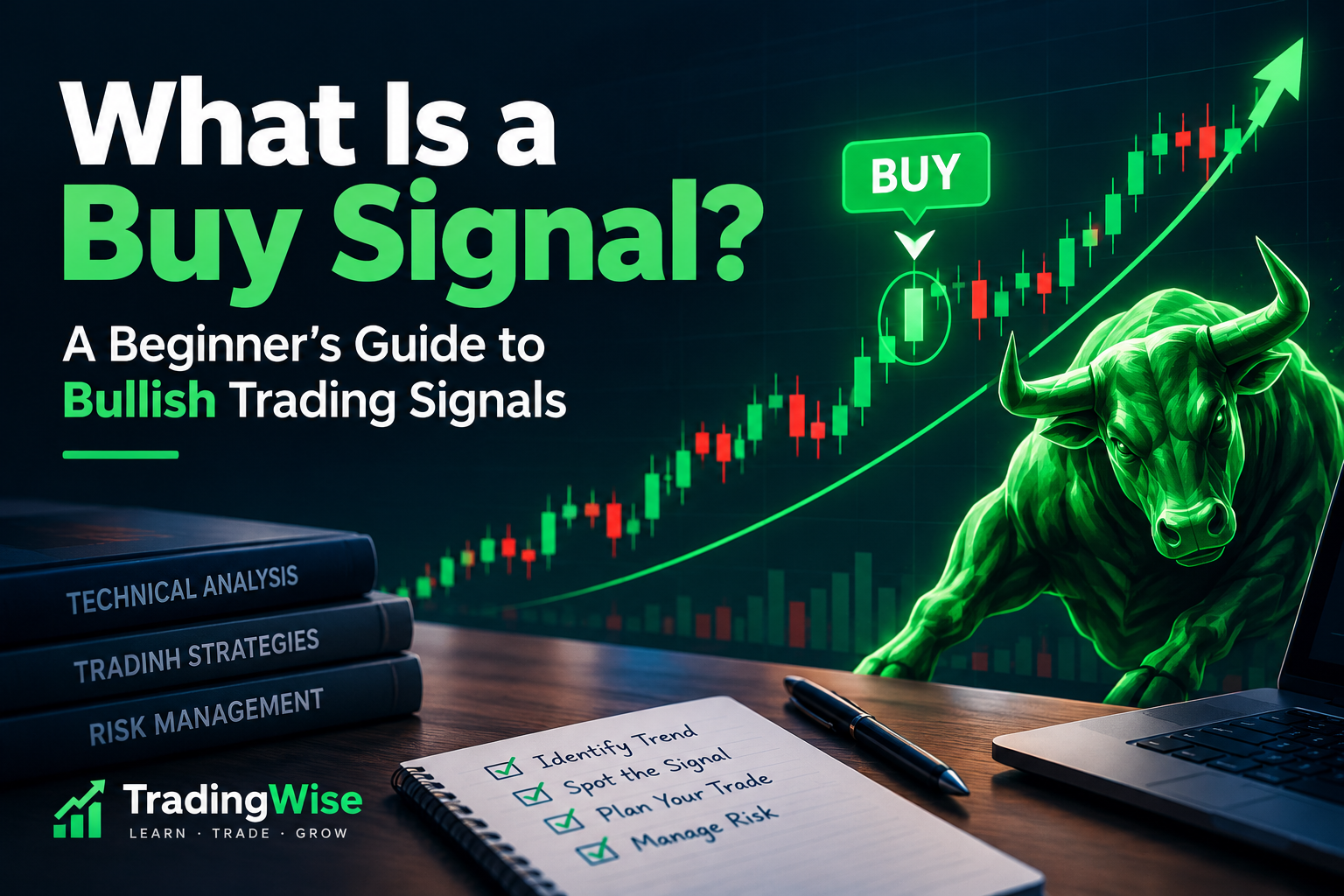
What Is a Buy Signal?
A buy signal is a market condition that suggests an asset may have an opportunity for an upward move. In practical trading, it can help identify a possible point to consider a long position, but it is never a guarantee that price will rise.
Buy signals are used across different markets, including cryptocurrency and forex. They can come from price action, technical indicators, market structure, volume, or a combination of several factors.
The important difference between simply seeing a green candle and identifying a useful buy signal is confirmation. A disciplined trader does not treat every upward move as an invitation to enter.
What Does a Buy Signal Mean in Trading?
In simple terms, a buy signal means that the available market information is showing conditions that may support a potential long trade.
A signal can be created by a technical indicator, a chart pattern, a breakout, a change in momentum, or a combination of these factors.
However, a buy signal should be treated as a potential trading opportunity, not as a prediction of guaranteed profit.
This distinction matters because markets can reverse immediately after a bullish setup appears. Even a well-structured signal can fail.
What Makes a Buy Signal Bullish?
A bullish trading signal usually appears when the balance of market evidence begins to favor buyers.
Depending on the trading method, bullish conditions can include:
No single condition is automatically reliable in every market. The same indicator can behave differently during a strong trend, a sideways market, or a period of extreme volatility.
How Does a Buy Signal Work?
A useful buy signal can be viewed as a process rather than a single notification.
First, a trader identifies a market condition. Next, the trader looks for confirmation that the setup is still valid. After that, the potential entry, stop loss, and profit target can be defined.
This creates a simple sequence:
This approach is more useful than treating a buy signal as a simple command to press the Buy button.
Crypto Buy Signals
Crypto buy signals are designed around cryptocurrency markets such as Bitcoin, Ethereum, and other digital assets.
Crypto markets operate continuously and can experience rapid changes in price, liquidity, and momentum. Because of this, a bullish setup can become invalid quickly.
A crypto buy signal may consider factors such as:
A strong-looking crypto buy signal should still be evaluated in the context of the broader market. A bullish setup on one cryptocurrency does not automatically mean the entire crypto market is moving higher.
Forex Buy Signals
Forex buy signals are potential bullish trade setups involving currency pairs such as EUR/USD, GBP/USD, or USD/JPY.
Forex traders may evaluate price structure, momentum, support and resistance, trend direction, and important economic events when looking for a buy signal.
Unlike cryptocurrency markets, forex trading is strongly influenced by scheduled economic events and market sessions. Interest-rate decisions, inflation data, employment reports, and central-bank communication can quickly change market conditions.
For this reason, a technical buy signal should not be considered in isolation when a major economic event is approaching.
Buy Signal Indicators
Different trading systems use different indicators to identify potential bullish conditions.
Moving Averages
Moving averages can help traders identify the general direction of a market. A bullish crossover may be interpreted as a potential buy signal, particularly when it agrees with the broader market structure.
However, moving averages are based on historical price data and can react slowly when market conditions change.
RSI
The Relative Strength Index can provide information about momentum and whether recent price movement has become unusually strong or weak.
An oversold RSI condition may attract attention from traders looking for a potential bullish reversal, but oversold does not automatically mean that price must rise.
MACD
MACD can help traders evaluate changes in momentum and trend direction. A bullish crossover may be used as one component of a buy signal.
Like other indicators, MACD can produce false signals, especially when the market lacks a clear trend.
Volume
Volume can provide additional context. A price breakout accompanied by stronger trading activity may be more meaningful than a breakout occurring with very little participation.
Volume should be interpreted together with price structure rather than used as a standalone reason to enter.
How to Confirm a Buy Signal
One of the biggest mistakes beginners make is acting on the first bullish indication they see.
A better approach is to ask whether several independent pieces of information support the same idea.
For example, a potential buy setup could have:
The goal is not to collect as many indicators as possible. Too many indicators can create confusion and produce conflicting information.
The goal is to understand why the signal exists and whether the setup still makes sense before entering.
What Is a False Buy Signal?
A false buy signal occurs when bullish conditions appear to support an upward move, but the market fails to continue higher.
For example, price may break above resistance and attract buyers, only to fall back below the level shortly afterward.
False signals can become more common in:
This is why confirmation and risk management are more important than simply trying to find a signal with a perfect win rate.
Buy Signal vs. Buy Recommendation
A buy signal and a personal investment recommendation are not necessarily the same thing.
A signal can identify a market condition that may be worth examining. The trader still needs to consider the entry, risk, position size, market conditions, and whether the setup fits their own trading plan.
This distinction is especially important for beginners. A signal should provide information, not remove the trader’s responsibility for managing risk.
How a Buy Signal Should Be Structured
A professional trading signal should be understandable without forcing the trader to guess what the analyst meant.
A structured signal can include:
Clear information helps the trader evaluate the setup before making a decision.
If you want to learn how these individual components fit together, read How to Read a Trading Signal.
Buy Signals and Risk Management
A buy signal should never be separated from risk management.
Even if the market setup looks attractive, the trade can move in the opposite direction. A predefined stop loss can help limit the amount a trader is prepared to lose if the original idea fails.
Position size also matters. Risking too much on one trade can turn a normal losing signal into a serious account drawdown.
For a deeper explanation of stop loss planning, see What Is a Stop Loss?.
Buy Signal and Take Profit
Finding an entry is only one part of planning a trade. A trader should also consider where the potential move could reasonably end.
Take profit levels can be based on market structure, previous resistance, planned risk-to-reward, or another clearly defined trading rule.
Read What Is a Take Profit? to understand how profit targets can be incorporated into a trading plan.
How to Evaluate a Buy Signal Before Entering
Before entering a trade, ask a few simple questions:
If the answers are unclear, there may not be enough information to justify entering the trade.
How to Avoid Buy Signal Scams
The popularity of crypto and forex signals has also created an environment where misleading signal services can attract inexperienced traders.
Be cautious of any service that promises guaranteed profits, claims that losses are impossible, or uses pressure to make you purchase a subscription immediately.
A trustworthy signal approach should be transparent about risk. Losing trades should not be hidden, and historical performance should not be presented as a guarantee of future results.
TradingOrigin's approach is built around education, structured market information, and responsible risk awareness rather than promises of guaranteed returns.
No legitimate signal can remove market risk. A buy signal is an analytical tool, not a guarantee.
How TradingOrigin Signals Should Be Used
A signal should be treated as a starting point for evaluation.
Before taking a trade, a trader can review the signal, check the current market price, understand the entry and invalidation levels, and decide whether the opportunity fits their own risk limits.
This is especially important when a market moves quickly. An old signal may no longer represent the same opportunity after price has moved significantly.
For a complete guide to using trading signals, read How to Use Trading Signals: Entry, Exit, and Risk Management.
Final Thoughts
A buy signal is not a promise that an asset will rise. It is a defined market condition that may indicate a potential bullish opportunity.
The strongest approach is not to chase every signal. Instead, traders should understand what created the signal, confirm the surrounding market conditions, define the risk, and know where the trade idea becomes invalid.
This applies whether you are reviewing crypto buy signals, forex buy signals, or another type of bullish trading setup.
Good trading is not about finding a signal that can never lose. It is about having a clear process for evaluating opportunities and managing the trades that follow.
Trading involves risk. No buy signal, indicator, strategy, or trading service can guarantee profits.
Keep Learning: More Crypto Articles
- How to Use Funding Rates and Open Interest to Confirm Crypto Signals
- Crypto Trading Signal Timeframes: 15-Minute, 1-Hour, and 4-Hour Charts
- How to Confirm Crypto Trading Signals with Volume
Want structured, step-by-step lessons? Explore the TradingOrigin Academy.
📢 Get our signals on Telegram
Follow our Telegram channel for crypto and forex signals, shared as they happen: 📲 Join TradingOrigin on Telegram
Want full access? View our crypto and forex signal plans.